Natural Gas, LNG, Crude Oil, Energy Transition, Renewables
May 14, 2026
Hormuz crisis exposes structural energy flaw, pushes electrification case: ETC

Editor:
HIGHLIGHTS
ETC urges renewables over fossil lock-in
Hormuz closure disrupts 18 million b/d oil flows
'Readily deployable' alternatives are key difference
The closure of the Strait of Hormuz triggered a historic disruption to fossil fuel supplies, and should accelerate clean energy deployment, with governments and markets responding to disrupted oil and liquefied natural gas flows by fast-tracking renewable electricity, electric vehicles and heat pumps rather than locking in new fossil fuel infrastructure, the Energy Transitions Commission said in a report published May 15.
The crisis has disrupted around 18 million b/d of oil supply and 20% of global LNG trade, or more than 110 Bcm/year, with 75% of the world's population living in fossil fuel-importing countries, the report said. If sustained, elevated prices could add $1 trillion-$2 trillion in annual energy costs globally, it said.
"This is a reminder to governments -- both in Asia and in Europe -- that as long as we have fossil fuel-based economies, we are vulnerable to another political event," ETC co-chair Adair Turner told Platts, part of S&P Global Energy, in an interview on May 15. "Four years ago, it was Russia-Ukraine. Now it's the Gulf. Who knows what the next one is."
The ETC, a global coalition of leaders from across the energy landscape committed to achieving net-zero emissions by mid-century, said fossil fuel systems were "structurally vulnerable" because of their dependency on continuous extraction, trade and transport.
"Supply is geographically concentrated and relies on a small number of critical transit routes, meaning that relatively localized disruptions can rapidly propagate into global economic shocks," it said.
Renewable energy is inherently more secure, Turner said.
"Clean energy systems are more distributed, more efficient and less exposed to the price shocks created by continuous dependence on traded fuels," he said.
The ETS said stocks provided only a temporary buffer, were unevenly distributed and did not remove exposure to higher prices.
As a result, governments should focus their efforts on boosting renewable deployment. "Accelerating the deployment of these technologies can reduce global oil demand by 20% and gas demand by more than 30% by 2035, insulating economies from the next shock," the report said.
"Clean energy systems are more resilient because they change the physical and economic structure of energy supply," the report said, adding that decentralized energy supply alternatives were already available.
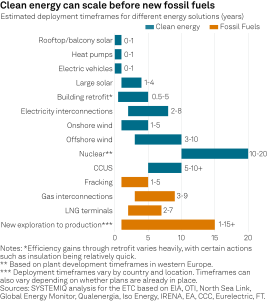
"The key difference between this crisis and previous crises is the availability of readily deployable alternatives," the ETC said, contrasting the current price shock with the oil crisis of the 1970s.
Chinese solar photovoltaic exports doubled in March 2026 compared with February, while 50 countries recorded all-time high solar import records, the report said.
Electric vehicle registrations in the EU rose nearly 50% year over year in March, while EV searches in Australia surged 75%-80% in a single week and heat pump sales hit records in the UK, the ETC said.
Around 70%-90% of clean energy costs are upfront capital, rather than fuel costs, it said. As such, while geopolitical disruptions can temporarily affect new projects, but not current energy consumption, it noted.
"Faced with the latest fossil fuel supply crisis, governments, policymakers and businesses should accelerate the shift towards the more resilient and secure energy systems that clean technologies can deliver, while managing short-term distributional impacts and supply risks," it said.
"The market is already signaling the answer," the ETC said. "Policy must not contradict it."
Policy priorities
Policy priorities should include accelerating renewable power deployment, electrifying road transport, heating and cooking, developing green fuels and fertilizers and improving energy efficiency across all sectors, it said.
The group said oil and gas fields typically take 5-10 years to reach production. By contrast, rooftop solar and heat pumps can scale within months, while electric vehicles were already structurally reducing oil demand, it said.
Alongside these measures, the ETC recommended the careful management of targeted fossil fuel subsidies, acknowledging that there could be a short-term increase in fuels such as coal to bridge the supply crunch, particularly in Asia.
Such use should be time-limited and not come from new capacity, it said.
New LNG commitments should be made only with robust methane standards and short-term contracts.
In the EU, it said the Emissions Trading System structure should be reformed but not weakened, to preserve carbon pricing credibility.
Platts, part of S&P Global Energy, assessed nearest December EU ETS carbon allowances at Eur75.04/mt ($87.23/mt) on May 14.
Meanwhile, the ETC warned against blanket fossil fuel subsidies, large-scale new upstream oil and gas or the weakening of 2030 and 2050 climate targets.
"New fossil infrastructure now would lock in the next shock," the ETC said in a statement accompanying the report.
Previous crises offered a stark warning that short-term fossil fuel subsidies were a "sticking plaster" rather than a long-term solution.
"The 2026 Iran crisis is not an isolated event, but a clear manifestation of a structural vulnerability in the global energy system," it said.
