Electric Power, Energy Transition, Renewables
October 01, 2026
PATH TO NET ZERO: States cut back on renewable goals amid affordability concerns

By Kassia Micek
Editor:
HIGHLIGHTS
Arizona’s REST repeal in limbo as AG pushes back
Offshore wind delays threaten state goals
This is the final in a multi-part series on net-zero efforts across industries. The previous article can be found here.
As concerns about energy affordability grow, states are pulling back on their clean energy goals or reclassifying what qualifies as a clean energy resource.
Connecticut scaled back its renewable portfolio standard targets in November 2025. Arizona officials are trying to repeal the state's renewable standard rules. North Dakota repealed its voluntary renewables goal after meeting it. New Jersey paused annual increases in the state's overall renewables target in 2025. Pennsylvania reintroduced legislation to replace its RPS requirement.
"The repeals and the backtracking of the targets kind of started last year," said Monica Hlinka, senior principal analyst at S&P Global Energy CERA. "Another trend that we were noticing is states that had the more ambitious RPS targets already on the books, are now expanding into stand-alone energy targets."
Arizona repeal in limbo
The Arizona Corp. Commission in March repealed the state's Renewable Energy Standard and Tariff (REST), which required utilities to generate 15% of their energy from renewable sources by 2025. Commissioners said the REST policy "served its purpose."
However, Arizona Attorney General Kris Mayes (Democrat), who was a member of the commission in 2006 when it approved the rules, has challenged the repeal decision and has not yet finalized the rule change. Technically, the repeal is not codified into law until the attorney general publishes the rule change through the secretary of state.
"Right now, it's still just in limbo," Hlinka said. "The attorney general is on the ballot this year. So, it might be another thing to wait and see since that could change."
Two seats on the five-member commission, all currently held by Republicans, are up for a statewide vote in November, even though Commissioner Nick Myers finished third in a Republican primary in July. Two Republican candidates, including Commissioner Kevin Thompson, and two Democratic candidates will be on the ballot for the two seats.
"We could possibly see some changes there, and that may impact the outcome," Hlinka said.
If the results of the district board election in April for the Salt River Project (SRP) are any indication, a political-party change could be coming in Arizona. SRP, a Phoenix-area public power and water utility, is controlled by a board elected by landowners and experienced a historic shift in which pro-clean-energy candidates were elected to the board for the first time in years. The on-the-ground momentum from having Democrats elected to the SRP board could provide a push to get Democrats elected to the corporation commission, Hlinka said.
"With the incumbent losing in the primary, we might see an upset," Hlinka said, adding that the commission had both Republican and Democratic members in the past.
Arizona is one of the leading US states for solar and battery storage projects. Shayne Willette, a CERA senior research analyst, said the state is a market to keep an eye on as "significant levels of solar-plus-storage configurations are becoming increasingly common."
Arizona ranks third in the US for total clean energy generating capacity, with nearly 16 gigawatts as of the end of the second quarter of 2026, according to S&P Global Market Intelligence data. The state accounted for 14.3% of US clean energy additions in the second quarter, behind only New Mexico and Texas. Arizona added 1.7 GW of energy storage, second only to Texas; 504 megawatts of wind, the third-largest amount; and 389 MW of solar, the sixth-largest amount, according to the data.
In total, Arizona ranks third in the country for energy storage, with 6.8 GW; fourth for solar, with 7.5 GW; and 21st for wind, with 1.7 GW.
Trend of pauses, repeals emerging
"Arizona kind of follows a trend we've been noticing in the past couple of years where states have now been repealing or putting a pause on their RPS standards or clean energy standards," Hlinka said.
In Pennsylvania, legislation has been introduced several times in recent years, including during the current legislative session that ends Nov. 20, to replace the state's energy standard. Politics also plays into the mix, as the Senate has a Republican majority (27-23), while the House of Representatives has a Democratic majority (103-100), and the governor is a Democrat.
"They just can't get anything done when it comes to passing any energy legislation or meaningful pieces of legislation altogether," Hlinka said.
However, half the Senate, all 203 House seats and Governor Josh Shapiro are up for election this year.
"Depending on the outcome of the election, it could either get reintroduced or just completely forgotten about," Hlinka said, referring to renewables repeal legislation.
Pennsylvania ranks 31st in the US for total clean energy capacity, with 2.8 GW, according to Market Intelligence data. The state added 3 MW of solar in the second quarter. The PJM Interconnection footprint, which includes Pennsylvania, had the biggest year-over-year increase in solar generation output, at 29%, up to an average of 107.2 gigawatt-hours per day of solar output, according to PJM data.
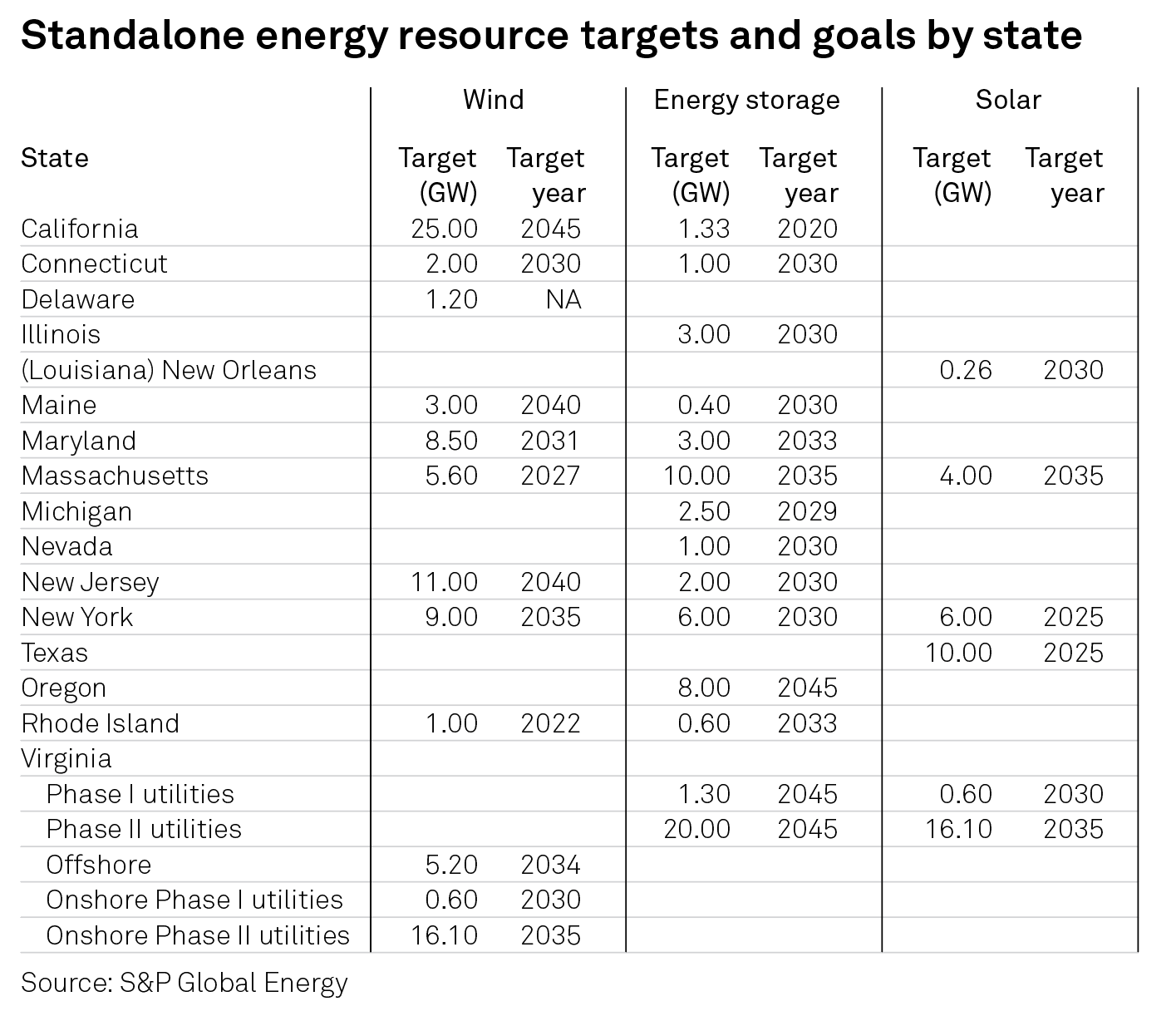
In neighboring New Jersey, the Board of Public Utilities reduced the state's RPS compliance level for 2026 and 2027, keeping it at 35% instead of raising it to 38% and 41%, respectively, according to CERA's report on renewable and clean energy targets and goals by state. While the 2028 target was set at 40%, that is still below the initial target of 44%.
"They can't actually change the final end target in New Jersey," Hlinka said, adding that the final target is 52.5% by 2030. "It has to be done through the legislature, but they can kind of like massage the numbers a bit. ... They're holding it for the next two years. They're increasing it for 2028, but it's going to be at a much lower level than what it was initially."
There is a separate proceeding looking at the remaining target years.
"They're looking at other avenues that they can, because it all kind of comes down to the affordability aspect of it," Hlinka said. "That was one of the main reasons they were looking to freeze and pause their RPS standards."
New Jersey ranks 37th in the US for total clean energy capacity with 1.5 GW, according to Market Intelligence data. The state added 37 MW of solar in the second quarter.
Affordability is one of the main reasons behind clean energy policy changes in many states.
"It's just way too high for ratepayers," Hlinka said. "And so, they're ... putting a pause on it."
States coming short of goals
States that enacted renewable or clean energy targets a decade or more ago are approaching their final target years, but, in some cases, are not near those goals.
"It was really ambitious at the time and they were hopeful they were going to at least come close to it, but I don't think they were anticipating some of the changes at the federal level," Hlinka said. "I wouldn't be too surprised if a majority of them did not make their targets."
Several Northeast and mid-Atlantic states had planned to rely on offshore wind resources as a major part of their renewables mix, but the Trump administration has delayed some projects and prompted others to be canceled. New York, for example, called for 9 GW of offshore wind by 2035 in its 2019 Climate Leadership and Community Protection Act.
New York ranks 16th in the US for total clean energy capacity with about 6.7 GW, according to Market Intelligence data. The state added 16 MW of solar and 8 MW of storage in the second quarter. Two offshore wind projects are under construction and are due to be completed in 2027.
Similarly, Maryland is nowhere close to reaching its goal of 100% clean energy by 2035. Its offshore wind target is 8.5 GW by 2031.
"They were banking a lot of their renewable energy targets to be met with offshore wind, and there's just no way that they're going to make it without that generation source," Hlinka said. "So that's why they were looking at possible alternatives, and that's why they were looking to nuclear."
Baltimore-based developer US Wind Inc. has the only remaining offshore wind project under development in Maryland. Constellation Energy Corp., the operator of the 1,800-MW, two-unit Calvert Cliffs Clean Energy Center nuclear plant, has expressed interest in expanding the facility.
Maryland ranks 40th in the US for total clean energy capacity at about 1.5 GW, according to Market Intelligence data. The state added 4 MW of solar in the second quarter.
