Chemicals, Polymers
September 30, 2026
PATH TO NET ZERO: Downcycle delays chemical producers' decarbonization ambitions
HIGHLIGHTS
Emissions rise 1.53% as downcycle stalls cuts
Chemical sector needs $232B yearly investment
This is the seventh in a multi-part series on net-zero efforts across industries. The previous article can be found here.
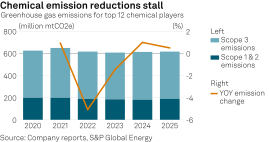
Greenhouse gas reductions among the largest North American and European chemical producers stalled in 2025, as a prolonged downcycle, high capital costs and uneven policy support constrained investment in low-carbon projects.
A survey of the 30 largest North American and European chemical producers by June 2026 market cap found that Scope 1 and Scope 2 emissions rose by 1.53% from 2024 to 2025, according to data from Platts, part of S&P Global Energy. Scope 3 emissions fell 1.17% over the same period.
The American Chemistry Council told Platts that member companies are facing difficult decisions about capital expenditure in the current downturn. In several interviews with Platts, companies confirmed that interim reduction targets that once looked achievable are being revised downward or shelved.
Polymers producer LyondellBasell Industries NV cut its 2030 Scope 1 and Scope 2 GHG reduction goal to 32% from 42% in February, citing "the need for disciplined capital allocation, evolving market conditions and regulatory developments."
Agrichemicals maker Nutrien Ltd. retired its 30% Scope 1 and Scope 2 GHG emission intensity 2030 goal because "a lack of clarity and timing on regulatory policies" affected the company's carbon capture, utilization and storage (CCUS) plans for low-carbon ammonia.
Investment challenges
The European Chemical Industry Council told Platts that the industry needs affordable and reliable energy, faster permitting, regulatory predictability and policy designed to support demand and industrial value chains.
"What can be misunderstood is the idea that net-zero depends only on corporate ambition or technology choice," said Yvonne van der Laan, executive vice president of sustainable solutions and technology business for LyondellBasell. "In reality, progress also depends on market conditions, infrastructure, standards, policy frameworks and a supportive regulatory environment. Sustainability progress is most durable when it is tied to clear value creation for the business and customers — in other words, by creating a growing market for low-carbon product solutions."
Those market conditions, however, have been absent for chemicals as weak demand from persistent overcapacity in base chemicals, high energy costs in Europe and trade uncertainty have limited the sector's ability to invest.
Van der Laan said LyondellBasell evaluates decarbonization investments with the same discipline it applies to any major project. "All projects must compete for capital and meet established return expectations before they move forward," she said.
The World Economic Forum estimates that the chemical industry needs to invest $232 billion per year in low-carbon technologies by 2050 to reach net-zero goals. The industry currently invests $86 billion.
Downcycle delays
As capital costs rise for key low-carbon technologies — CCUS, clean hydrogen, plastics circularity and renewable energy — the build-out of this infrastructure is delayed even further.
"The industry is delivering what can realistically be achieved under current economic conditions," said Ralf Düssel, head of sustainability at Evonik Industries AG. "Projects that combine emissions reduction with economic value will remain a priority for Evonik even in a constrained environment."
The most significant roadblocks are the slow pace of infrastructure development and the lack of market signals needed to support large-scale deployment of low-carbon technologies, Dow Inc. told Platts.
In January, Dow restarted construction of the world's first net-zero Scope 1 and Scope 2 carbon emissions ethylene cracker in Fort Saskatchewan, Alberta, but the first phase of the $6.5 billion project is now expected to come online in 2029 instead of 2027. Dow paused the project in 2025 due to the downcycle, rising construction costs and tariff uncertainty.
"Without swift delivery on these [technologies], Europe risks further investment delays and capacity losses at a critical moment for its industry," the European Chemical Industry Council said.
According to its latest European Chemical Closures & Investments Radar report, released in January, confirmed investments in European chemical capacity have decreased by 90% between 2021 and 2025.
"When we look at mature technologies in this industry, you do have to measure in decades," Mitchell Toomey, the American Chemistry Council's vice president of sustainability and responsible care, told Platts. "Our members are only now getting the chance to do their first experiments with these technologies."
Project momentum slows
CCUS, clean hydrogen and electrification all have long development cycles and face uneven deployment across the sector. Many large-scale CCUS and low-carbon hydrogen projects are caught in final investment decision limbo. And the projects that do make it past FID are slowed by high costs, permitting hurdles and uncertain long-term policy support.
For example, ExxonMobil Holdings Corp.'s carbon capture infrastructure partner Blue Sky Infrastructure LLC received tentative approval from Louisiana to bury 8 million metric tons of CO2 per year south of Baton Rouge. However, ExxonMobil's own sequestration site projects along its CO2 pipeline network in Louisiana and Texas have not been permitted yet.
Australian energy company Woodside Energy Group Ltd. announced in August that it was putting its Beaumont New Ammonia low-carbon ammonia project in Texas under strategic review and retired its 2030 Scope 3 investment and emissions abatement targets.
"The reality is that markets for emerging lower-carbon opportunities, including hydrogen, ammonia and carbon capture and storage, have developed more slowly than anticipated," Woodside Energy CEO Liz Westcott said. "Therefore, the targets no longer aligned in evolving technology, current policy settings and customer demand."
Additionally, global clean hydrogen development is falling behind 2030 targets. In the US and Europe, stalled incentives, repealed tax credits, canceled hydrogen hub funding and weak offtake agreements have sharply reduced expected capacity. S&P Global Energy CERA estimates that large-scale blue hydrogen project cancellations have lowered 2030 estimated capacity by 10%, to 6.8 million metric tons per year, compared with its first-half 2025 forecast.
In June, Air Products & Chemicals Inc. and Yara International ASA canceled their $9 billion low-carbon and ammonia complex in Darrow, Louisiana. Air Products also scrapped a number of small-scale projects to support clean fuel distribution, attributing the decision to "challenging commercial conditions, project-specific economic factors and slower-than-expected development in certain markets, largely hydrogen for mobility."
Still, project activity has not dried up entirely. CF Industries Holdings Inc. broke ground on Blue Point One, a 1.4 million mt/year low-carbon ammonia plant, in August. The facility is expected to be operational in 2029 and will have the lowest environmental footprint of any large-scale ammonia production facility in the world, the company said.
Regulatory holdups
Industry participants and trade groups say the industry has the technology concepts, but permitting and policy pose additional hurdles that hamper the industry's ability to bring the technology to commercial scale.
"We continue to rely on old chemistry formulations because new decarbonization technologies and chemistries that our customers are demanding are queued up in the [US Environmental Protection Agency's Toxic Substances Control Act program] holding pattern," Toomey said, calling for a modernized and streamlined system that can provide consumer protections while allowing innovation to advance.
In June, American Chemistry Council President and CEO Chris Jahn said that more than 300 new chemicals in the EPA's review backlog have been waiting over a year for approval. Industry hoped that the Trump administration would speed along the EPA program, but the pace has been uneven, with the average review time for all cases completed in 2025 sitting at 665 days.
A shift to pragmatism
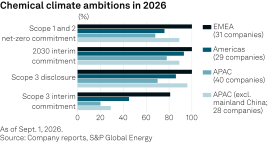
Despite these headwinds, 80% of the top 100 chemical companies by publicly disclosed revenue have released net-zero targets, the industry's highest mark ever. While the budding optimism of the early 2020s has been replaced with pragmatism, a handful of chemical companies have exceeded their interim targets and are formulating new ones.
DuPont de Nemours Inc. reported in May that it achieved a 76% reduction in Scope 1 and Scope 2 emissions from a 2019 baseline, exceeding its 50% 2030 reduction target. And Evonik reduced its Scope 1 and Scope 2 emissions by 31% from a 2021 baseline, edging out its 25% reduction target.
Industrial gas producer L'Air Liquide SA increased its 2035 Scope 1 and Scope 2 reduction goal from 30% to 33%, while Novozymes A/S and Symrise AG both reestablished higher 2030 targets.
"Net-zero is achievable for the chemical industry, but the timeline will depend heavily on external factors such as infrastructure development and regulatory frameworks," Düssel said. "The associated investments will be substantial and extend beyond individual companies. A full transition by 2050 may prove challenging for some segments. Additional time may be required."
Susan Dlin contributed to this article.
