LNG, Natural Gas, Energy Transition, Crude Oil, Electric Power, Emissions
September 07, 2026
INTERVIEW: US ambassador rebuffs prospect of EU energy trade as 'political tool'

By Matt Hoisch
Editor:
HIGHLIGHTS
‘No indication’ US would use energy ties as ‘political tool’: Puzder
Expects EU to hold to $750 billion energy purchase pledge
Remains critical of methane regulation, CSDDD, CSRD
The US ambassador to the EU does not expect Washington to exploit Europe's growing reliance on US energy as a political tool, even as the administration of US President Donald Trump critiques several policies out of Brussels at a time of both deepening bilateral energy relations and escalating international tensions.
"I've seen no indication that the United States would use energy as a political tool against our allies in Europe," Ambassador Andrew Puzder told Platts, part of S&P Global Energy, in an interview on Sept. 4. "We've been a reliable supplier in the past. I expect we will be in the future."
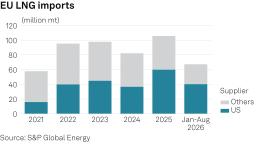
Europe has grown increasingly dependent on energy from its transatlantic partner — particularly on LNG amid the EU's pivot away from Russian pipeline gas since the 2022 invasion of Ukraine. The US supplied about 60% of the EU's imports of the super-chilled fuel over the first eight months of 2026 — about 40.2 million metric tons — according to data from S&P Global Energy CERA. That's up from some 42% across all of 2022.
At the same time, Europe has placed a greater focus on trimming energy dependencies and diversifying supply sources.
In January, European Commission President Ursula von der Leyen called for Europe to adopt an "urgency mindset" towards securing energy independence amid a "seismic change" in the world economic order. Shortly after, when the EU officially agreed to phase out Russian gas and LNG, EU Energy Commissioner Dan Jorgensen cautioned against once more becoming too reliant on any single supplier.
"We do not want to replace one dependency with another, so we need to diversify, but first and foremost we need to produce more of our own energy," Jorgensen said. "We need to become independent. We need to have our own homegrown energy instead of being [reliant] on imports."
Since then, the war in the Middle East has only sharpened that resolve. The conflict underscored that even though Europe's embrace of LNG boosted its gas sourcing flexibility, the continent remains vulnerable to supply-side shocks. European energy players have pushed for greater diversification amid a more geopolitically fraught landscape.
However, the EU has also agreed to increase US links.
Last year, the EU committed to expand US energy purchases as part of a sweeping trade agreement, pledging to buy $750 billion in US energy resources through 2028. Puzder highlighted LNG as a key element of that.
"The major fuel that we will supply — the US will supply – to Europe will be LNG," he said.
Analysts and even some EU politicians have assessed the mammoth headline figure as unrealistically high. Market watchers have characterized the commitment more as a signal of intention, rather than a binding pledge. They have also underscored that the deals needed to fuel the envisioned trade increase would come from private companies, not Brussels.
The ambassador, however, indicated a firmer, more literal understanding.
"We expect Europe to do what it said it's going to do, and I think there's every potential that they'll be able to do it," he said. "A deal is a deal."
Policy concerns
While the US ambassador downplayed the prospect of Washington weaponizing growing transatlantic energy ties, he also stressed the possibility for individual suppliers to shun Europe if US firms perceive undue regulatory requirements.
"Our companies are anxious to meet the Europeans' demands and requirements — they [Europeans] just need to make it possible to do so," he said. "They can't regulate us off the continent, and then ask us where the energy is."
Puzder reiterated concerns about the EU's methane emissions regulation, which the US has repeatedly criticized. In July, the European Commission recommended member states delay penalties under the law until after 2029, amid worries compliance uncertainty could hobble imports and threaten energy security.
Business groups, however, have bemoaned the move as insufficient. Importers can still face risks for falling foul of the law, even with Brussels backing a pause on penalties, they have argued.
Puzder echoed that view.
"Hopefully the Commission is going to adjust so that the industry can ship that energy into the EU, but we haven't seen enough of an adjustment yet," he said. "They [the EC] believe they've done enough to justify it, but everything we hear from the industry and from suppliers says that that's not the case."
An EC spokesperson said Sept. 2 the Commission does not plan to change the regulation, though it remains open to additional action if energy supply risks rise.
Ambassador Puzder also flagged lingering issues with two major EU laws related to environmental and human rights obligations for businesses: the Corporate Sustainability Due Diligence Directive, or CSDDD, and the Corporate Sustainability Reporting Directive, or CSRD.
The EU simplified both regulations earlier this year. The US, however, remains concerned about implications for companies outside the EU. It recently submitted comments on looming guidelines seeking clarifications, according to the ambassador.
"Hopefully we'll be able to resolve that, but as of right now, we're not really sure what the CSDDD and CSRD require anymore," he said.
European domestic production
Even as the ambassador extolled the reliability of US energy supplies, Puzder simultaneously advocated greater European hydrocarbon production at a time when capitals across the continent are more focused on energy supply security.
"It would be in the Europeans' best interest, if they're really concerned about long-term energy supplies and whether other countries could dominate or use these energy supplies politically — which I don't believe the United States intends to — but if that's a serious concern they ought to start looking for and drilling for natural gas and oil and develop some supplies here [in Europe]," he said.
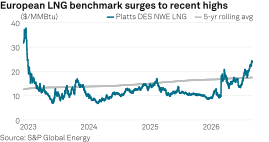
Global LNG prices are hovering at multi-year highs as the dramatic drop in maritime traffic through the Strait of Hormuz due to the war in the Middle East persists into its seventh month. Platts assessed the DES Northwest Europe LNG marker at $23.925/million British thermal unit on Sept. 4, up 1% day-over-day. The benchmark is around its highest point since December 2022.