LNG, Natural Gas
January 26, 2026
EU finalizes ban on Russian gas, LNG by 2027
By Matt Hoisch and Kelly Norways
HIGHLIGHTS
European Council gives approval to landmark legislation
To ban Russian LNG imports from Jan 1, 2027
EC to propose ban on Russian oil by end-2027
The EU will phase out all imports of Russian gas and LNG by late 2027 following a final European Council vote Jan. 26, cementing the landmark policy to cut ties with the bloc's once-dominant gas supplier in the wake of Russia's invasion of Ukraine.
"As of today, the EU energy market will be stronger, more resilient and more diversified," Michael Damianos, minister for energy, commerce and industry of Cyprus, said in a Jan. 26 Council statement following the vote. "We are breaking away from detrimental reliance on Russian gas and taking a major step, in a spirit of solidarity and cooperation, towards an autonomous Energy Union."
Cyprus holds the European Council's rotating six-month presidency.
The timeline approved by the Council aligns with that endorsed late 2025 by the European Parliament.
Under the legislation, a series of staggered restrictions will occur.
Spot imports of Russian gas and LNG will be prohibited six weeks after the law takes effect, following its publication in the Official Journal of the EU.
Pipeline imports of Russian gas brought in under short-term contracts concluded before June 17, 2025, will be banned from June 17, 2026.
Pipeline gas imports under long-term contracts concluded before June 17, 2025, will be banned from Sept. 30, 2027, if member states are on track to meet gas storage filling targets and as late as Nov. 1, 2027, if they are not on track.
Russian LNG imports under short-term contracts concluded before June 17, 2025, will be banned from April 25, 2026. Imports under long-term contracts concluded before June 17, 2025, will be outlawed from Jan. 1, 2027, in line with the restrictions in the EU's 19th sanctions package approved in October.
The EU legislation is more durable than sanctions, which require unanimous council renewal every six months.
Long-term contracts under the approved text are defined as those longer than one year, while short-term contracts are those shorter than one year.
The ban passed with 24 EU member states voting in favor. Two -- Hungary and Slovakia -- voted against the law. Bulgaria abstained.
Hungary and Slovakia have long opposed the full phaseout of Russian gas. Both countries, which source a significant share of their imports from Russia, cite energy security concerns.
Speaking after the Council vote, Hungary's representative, Barna Pal Zsigmond, reiterated past threats to take legal action against the ban.
Hungarian Foreign Minister Peter Szijjarto also said Jan. 26 that Hungary would pursue legal action against the legislation, which is part of the broader energy initiative known as REPowerEU, in the EU Court of Justice.
"The REPowerEU plan is based on a legal trick, presenting a sanctions measure as a trade policy decision in order to avoid unanimity," Szijjarto wrote on X. "This goes completely against the EU's own rules. The Treaties are clear: decisions on the energy mix are a national competence. Banning Hungary from buying oil and gas from Russia goes against our national interest and would significantly increase energy costs for Hungarian families."
Evolving gas, LNG trade
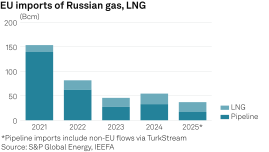
Since Russia's full-scale invasion of Ukraine in early 2022, the EU has substantially curtailed its reliance on Russian fuel -- notably through a massive expansion of LNG import infrastructure enabling the super-chilled fuel to contribute to the EU's baseline gas needs.
In 2025, the EU brought in a record of roughly 106 million mt (146.2 Bcm) of LNG, according to data from S&P Global Energy CERA.
Russia was the EU's second-largest supplier last year, shipping about 14.7 million mt, or some 13.9%, of its LNG imports.
Russia also supplied about 10% of the roughly 169.2 Bcm of pipeline gas imported into Europe in 2025, according to CERA data.
These figures are down significantly from just before Russia's 2022 invasion of Ukraine, when it contributed about 45% of the EU's total gas and LNG imports, according to the EC.
As Russia's contribution to European energy markets has waned, the US's has grown. About 56.6% of the EU's 2025 LNG imports, or some 60 million mt, came from the US.
Concerns about the risk of swapping one energy reliance for another have deepened in Europe in the wake of the recent EU-US tensions over US President Donald Trump's push to acquire Greenland.
EU Energy and Housing Commissioner Dan Jorgensen appeared to acknowledge such concerns Jan. 26.
"We do not want to replace one dependency with another, so we need to diversify, but first and foremost we need to produce more of our own energy," Jorgensen said ahead of a summit in Germany to promote the expansion of offshore wind energy. "We need to become independent. We need to have our own homegrown energy instead of being [reliant] on imports."
Oil imports in focus
EU countries still importing Russian oil will also be obliged to submit diversification plans by March 2026 under the new regulation, although a full import ban has yet to be enacted. The EC plans to propose separate legislation to phase out Russian oil imports by the end of 2027, the Council statement said, reiterating previous targets.
Hungary and Slovakia are some of Europe's last remaining buyers of Russian oil after the EU banned seaborne imports in 2022-23. Both countries remain firmly opposed to tougher restrictions.
In November 2025, Hungarian Prime Minister Viktor Orban secured an exemption from US sanctions on Lukoil and Rosneft, which analysts said could have cut off half the crude currently supplied to Hungary and Slovakia.
Russian oil flows make up less than 3% of all imports into the EU, according to council estimates. However, Hungary and Slovakia have challenged efforts to get the figure to zero. Additionally, Hungarian energy company MOL is working on a new pipeline project that would extend its Russian oil access into neighboring Serbia, with a target completion date by 2027.

Editor: