Natural Gas
August 25, 2026
INTERVIEW: Neptun Deep gas work uninterrupted after recent drone incident: CEO

By Matt Hoisch
Editor:
HIGHLIGHTS
OMV Petrom head says no ‘significant change in risk profile’
Some Neptun gas offtake contracts remain unannounced
Focus on equity product amid regional growth, rather than trading
The development of OMV Petrom's Neptun Deep natural gas project, as well as the company's wider Black Sea operations, are continuing uninterrupted following a military engagement with a naval drone near the platform offshore Romania last week, the energy company's CEO told Platts, part of S&P Global Energy, on Aug. 24.
"Nothing has interrupted the project, being able to deliver the project on time," Christina Verchere said in an interview on the sidelines of the ONS conference in Stavanger, Norway. "Nothing is interrupting our existing production offshore, nothing is interrupting our ability to get cargoes in, and nothing is interrupting the execution of Neptun. These are all moving forward as planned."
"We haven't seen a significant change in risk profile," Verchere said. "What we have seen is an ability to respond very strongly by authorities ... this is the aspect I think that gives us the comfort with regards to continuing the project overall."
Verchere signaled confidence in Romania's ability to continue securing the project against military threats.
"The project is highly strategic for the country, and therefore that gives all the right focus that we would hope as an investor, as well, to be able to manage that," she said.
Neptun Deep marketing
OMV Petrom operates Neptun Deep with a 50% stake. Romania's state-controlled Romgaz holds the other 50%.
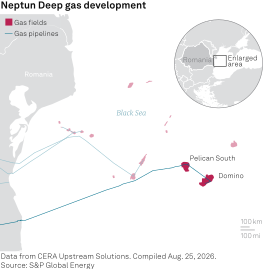
At peak production, the development, which is set to draw from 10 wells across the Pelican South and Domino offshore fields, is expected to yield some 8 billion cubic meters/year of gas.
"That is modest relative to total EU consumption, but strategically significant because it would be indigenous pipeline gas delivered directly into one of Europe's most exposed regional markets," Martin Vladimirov, director of the Energy and Climate Program at the Center for the Study of Democracy, a think tank, said.
OMV Petrom estimates total recoverable gas from Neptun Deep is around 100 Bcm.
The company has said the facility is on track to come online in 2027; Verchere declined to offer a more specific timeline while speaking in Stavanger.
Verchere said OMV Petrom plans to market its share of the gas via a mix of "mid-term contracts" and spot sales. "We've kind of announced a few of the contracts we've done, but not all of them," she said.
While the CEO explained that the added Neptun volumes will "likely" place Romania in a position to export gas, she declined to disclose how much of its volumes OMV Petrom aims to market beyond Romania. Nevertheless, she stressed that Romania, as the closest market, would be a major focus.
"We're driven commercially—commercially, we'd always be biased to our closest market," she said.
Regardless of how much of the output leaves Romania, Neptun Deep is already anticipated to be a key piece of Europe's wider gas system in the years to come. The added volume expected from the project has also been a factor bolstering EU leaders' decision to phase out Russian gas by the end of 2027. The European Commission said the domestic production will be an "important source of [gas supply] diversification for the Member States in the region" in a 2025 document assessing the impact of phasing out Russian gas.
Unless Neptun Deep starts up in early 2027, the project will not support Europe this coming winter. However, the continent's ongoing struggles to refill gas storage sites this summer could mean the EU ends winter with low storage volumes and faces another hefty filling campaign and supply-side risks across next year, when the new volumes could help.
"A delay to Neptun Deep would deepen that vulnerability during 2027," Vladimirov, with the Center for the Study of Democracy, said.
Further Black Sea development
More generally, OMV Petrom has ongoing ambitions for further Black Sea development, bolstered by both the regional geology and its work on Neptun Deep.
"We continue to see the Black Sea as an emerging opportunity," Verchere said.
In addition to its work in Romania, OMV Petrom operates the Han Asparuh block offshore Bulgaria. The company had two exploration wells drilled in the block across late 2025 and early 2026 that failed to come across significant gas volumes. Verchere said no decision has been taken yet on whether to drill another well there.
The Bulgarian government has also approved OMV Petrom's move announced earlier this year to take a stake in another, Shell-operated exploratory block offshore Bulgaria, Han Tervel, according to Verchere.
"That will be a work activity that will move forward," she said.
OMV Petrom's work over the past several years has expanded its operational abilities, the CEO argued.
"We have been a shallow-water player," she said. "We have now become a deepwater explorer because we drilled the wells in Bulgaria, a deepwater developer, and we will become a deepwater producer as well."
Verchere, however, was more tempered about the prospect of building out the company's broader trading activities—even as it eyes added regional gas production and has already expanded sales into other markets, such as Moldova, Bulgaria and Hungary.
"We're definitely regionalizing ourselves overall, both in gas and in power, but the focus and the foundation is off a position of equity [product]," she said. "Of course, there can be some trading opportunities ... but the foundation will be equity."
For now, with the expected Neptun Deep start-up looming next year, Verchere underscored the symbolic as well as material significance of what, in her words, is a "game changer" development set to cement Romania as the largest gas producer in the EU at a time when Europe is increasingly focused on energy security and self-sufficiency.
"There is a huge amount of pride in Romania for this project," Verchere said.
"It puts back on the map the importance of our [Europe's] own energy supply," she explained. "There is potential, and it should be developed. That is part of energy security, and it's also part of economic prosperity."
