Electric Power
July 09, 2026
Data centers seen as 'closest thing to a silver bullet' for US grid investment

By Zack Hale
Editor:
HIGHLIGHTS
Utilities plan $138 billion transmission spend
Analysts see cost allocation opportunity
US electric utility industry analysts gave a cautious outlook on the sector during a July 9 panel discussion, pointing to the nation's ongoing data center boom as both a challenge and potential tailwind for transmission investment.
"Data centers might be the challenge, but they're also the answer," Julien Dumoulin-Smith, a power, utilities and clean energy analyst at Jefferies, said during a discussion hosted by WIRES in Philadelphia. The trade group represents US transmission owners.
Dumoulin-Smith offered his view in the wake of mixed outlooks for the US electric utility sector published by leading rating agencies in recent months.
In June, Fitch Ratings downgraded its North American power and utilities sector outlook from "neutral" to "deteriorating" to reflect rising affordability concerns and regulatory resistance to rate increases amid an inflationary environment.
Meanwhile, S&P Global Ratings revised its North American utility industry outlook in May from "negative" to "stable," marking a reversal of a six-year trend of downgrades mostly outpacing upgrades.
The rating agency said it anticipates "a period of stability for at least the next two years," although it continued to flag persistent industry risks, including high capital expenditures, significant data center expansion, and inflation-related affordability concerns. In 2025, the average US electric bill increased by more than 2.5 times the rate of inflation, S&P Global Ratings noted.
Willingness to absorb costs
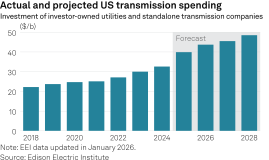
In January, the Edison Electric Institute published updated data showing that investor-owned utilities and standalone transmission companies planned to invest approximately $138 billion in the US power grid from 2026 to 2028. That would amount to roughly double the average annual rate of US transmission spending over the previous nine years, according to the Electric Transmission Competition Coalition, a consumer advocacy group.
"We think that capex is going to continue. Affordability is an issue," Obioma Ugboaja, director of North American Regulated Utilities for S&P Global Ratings, said during the July 9 discussion. "We're looking at every management team that comes to our offices, and we expect them to have a clear, articulated strategy around what they are doing about affordability."
Dumoulin-Smith said he expects energy inflation to remain high in a supply-constrained environment. The nation's ability to permit new natural gas delivery infrastructure currently lags expected demand growth, while renewable energy projects are encountering new permitting hurdles as interconnection challenges persist, he said.
Dumoulin-Smith said data center developers are facing increasing public resistance to their projects as customer bills rise.
"They know that they're at the losing end of this socially, and they need to make a pivot, and that's what you're going to see," he said. "Interestingly enough, they are going to be the ones that are most able to accommodate the inflationary environment in energy."
While meeting "large, concentrated" power needs presents a major challenge for the utility industry, the opportunity to allocate grid costs to new data center customers "is the closest thing to a silver bullet I've seen in a while," Dumoulin-Smith said.
"Their willingness to absorb disproportionate costs is transparent and obvious," he said. "Have we actually figured out transmission cost allocation back to data centers adequately? I would argue no, and I would argue that is the single most tangible opportunity as I think about transmission investing."
Risk of underspending
Bill Carlin, vice president of transmission rates and regulatory requirements at Eversource Energy, said "affordability is at the forefront" of every discussion at the company.
Transmission costs account for about 14% of the utility's customer bills in Connecticut, where Eversource does business through its subsidiary, The Connecticut Light and Power, he said.
Carlin said that some of the company's grid investments may increase the transmission portion of the bill, while lowering other pieces by reducing grid congestion costs or expanding access to lower-cost generation.
"The key is not to focus on that one piece; it's to look at the bill holistically," Carlin said July 9. "We're also looking at providing information to our customers because we don't want it really to be a black box."
Carlin said Eversource views balance as a key consideration.
"If you overspend, customers are paying for it. They're paying for spend that they don't need," he said. "But they're equally harmed if we underspend because if you underspend, there's going to be degradation in the system. It's going to be much costlier down the road."
