Energy Transition, Electric Power, Renewables
June 26, 2026
US SOLAR TRACKER: Additions expected to reach an all-time high of 38 GW in 2026
Editor:
HIGHLIGHTS
4.453 GW of solar generation capacity added in Q1
NP15 solar capture price down 28% year over year
Solar-powered generation led the US in clean energy generating capacity additions during the first quarter of 2026, accounting for 57.4% of total renewable installations, with expectations that solar will continue to lead in new clean energy additions this year.
The US added 4.453 GW of solar capacity in Q1, up 2.8% from the end of 2025 and an increase of 19.5% from a year ago, according to data from S&P Global Market Intelligence.
"The US power sector is on pace to have a record year in 2026, with total capacity additions expected to exceed 78 gigawatts, above the prior peak of roughly 70 GW set in 2002," said Shayne Willette, S&P Global Energy CERA senior research analyst. "Through the end of April, 16 GW are already in service, and another 62 GW, with targeted in-service dates before the year's end, are under construction."
Based on current progress and typical construction-to-completion rates, the pipeline supports a credible path to over 70 GW for 2026, with upside if year-end commissioning trends hold, he added.
"This year, solar additions are positioned to amount to 38 GW, an all-time high," Willette said.
Battery additions are also expected to reach an all-time high of 22 GW, compared to wind addition of 11 GW and natural gas additions of 7 GW, he added.
Market Intelligence data shows that 27.413 GW of solar is under construction or in advanced development and slated to come online this year. Looking further ahead, Texas leads the solar pipeline with over 14 GW of generating capacity under construction or in advanced development with expected online dates between 2026 and 2028. Arizona was next with 5.87 GW, followed by California with 3.54 GW.
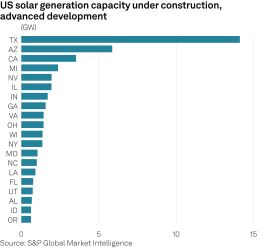
Fourteen states have over 1 GW in the pipeline, eight states have between 500 and 1 GW, 18 states have between 100 MW and 500 MW, and eight state have less than 100 MW in progress, according to Market Intelligence data.
Q1 capacity additions
Twenty-three states added solar capacity in Q1, ranging from Minnesota with 1 MW to Texas with 830 MW or 19% solar additions across the US, according to Market Intelligence data. Indiana followed with 650 MW or 15%, and then Florida with 596 MW or 13%.
"The regional breakdown of new capacity additions provides further insight into the market trends," Willette said. "Notably, [the Electric Reliability Council of Texas] is in the midst of a rapid expansion. The ERCOT market represents nearly one-third of all new capacity and is more than twice the size of the next-largest market, California. ERCOT's build-out is supported by a favorable regulatory environment, which typically reduces costs and development timelines, and by an overall abundance of resources."
Helping drive Texas solar development is the fact that the state has excellent solar resources plus relatively cheap, abundant and easily permitted land compared to other independent system operator regions, said John Murray, principal analyst at S&P Global Energy Horizons focused on North America renewable markets.
"Texas has low regulatory friction and is experiencing very high load growth," Murray said. "[The Inflation Reduction Act] tax credits are still available if construction begins by July 4, 2026, which is fueling a rush to build in Texas. But the IRA tax credits are being sunset early, which could impact solar development post 2027-2028."
Everything's bigger in Texas
Texas leads the US in solar capacity with 36.439 GW by the end of Q1, accounting for 22.2% of US solar capacity, according to Market Intelligence data. California ranks second with 24.968 GW or 15.2% of the US total, followed by Florida with 12.927 GW or 7.9% of US solar capacity.
In total, three states have over 10 GW of capacity, 26 states have between 1 GW and 10 GW, 18 states have between 100 MW and 1 GW, while two states have less than 1 GW. North Dakota remains the only state without any solar capacity, although the state has 200 MW in the project pipeline that is slated to come online in October 2027, according to Market Intelligence data.
At the grid operator level, ERCOT has the most solar capacity with 35.998 GW, followed by the SERC Reliability Corp. with 28.581 GW and the California Independent System Operator with 25.062 GW. The SERC Reliability Corp. was formerly known as the Southeast Electric Reliability Council.
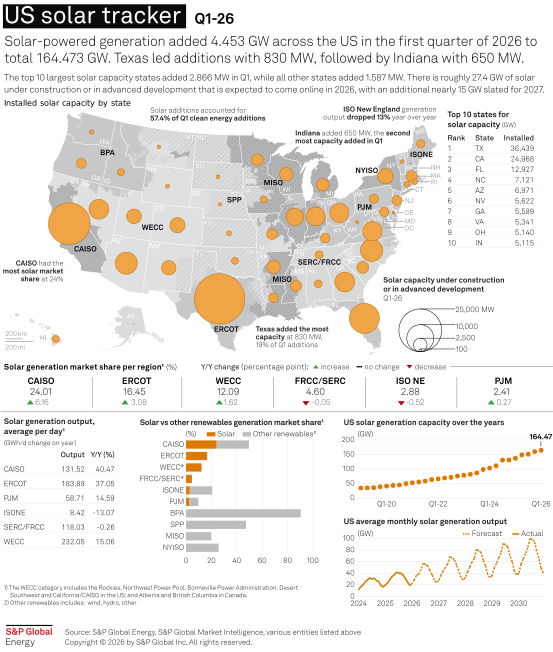
The Western Electricity Coordinating Council region had the most solar generation output in Q1, averaging 232.05 GWh/day, an increase of 15% year over year, according to S&P Global Energy CERA data. However, CAISO had the biggest year-over-year output increase at 40.5%, according to CAISO data.
In Q1, CAISO had the highest market share at 24%, an increase of 6.2 percentage points year over year, according to CAISO data. "CAISO leads the US in solar market share because it has very high solar penetration, and procurement rounds by the California Public Utilities Commission keep pushing that share up while energy storage additions shift solar into more profitable evening hours of demand," Murray said. "ERCOT generates more solar in absolute terms, but its total load is larger and growing faster, diluting ERCOT's percentage share even as its solar output increases."
WECC, specifically Arizona and Nevada, is a more plausible challenger to CAISO on a market share basis, given its high solar resources and growing solar-plus-storage project pipeline, he added.
Solar output across the lower 48 states averaged 29.245 GW in Q1, up 19% from the end of 2025 and 21% higher year over year, according to S&P Global Energy CERA data. Following seasonality, Q2 should have even more output. CERA forecasts the lower 48 states to average 47.456 GW solar output in Q2, which would be a 62.3% quarter-over-quarter increase and a 25.7% jump from a year ago, according to S&P Global Energy CERA data.
Solar capture prices
When it came to average capture prices, CAISO observed a mixed trend across its three trading hubs, with NP15 decreasing 28% year over year to $19.14/MWh in Q1, while SP15 and ZP26 combined averaged 85% higher than a year ago and remained in the lower teens at an average of $11.42/MWh, according to Platts data. Platts is part of S&P Global Energy.
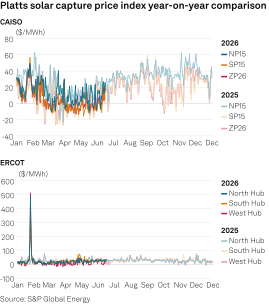
Supporting the uptrend in SP15 and ZP26, CAISO's average peakload demand in Q1 rose 6.20% year over year, reaching an average of 27.77 GW in Q1, according to CAISO demand data.
In Texas, ERCOT capture prices saw marginal increases, with year-over-year Q1 prices up by an average of 4.5% across its three hubs to average $21.83/, according to Platts data. This also tracked year-over-year changes in peakload demand, which rose 1% to an average of 57.76 GW in Q1, according to ERCOT data.
