Electric Power, Energy Transition, Renewables
June 16, 2026
CAISO sets wind, solar peak records on increased capacity, favorable weather

By Kassia Micek
Editor:
HIGHLIGHTS
Curtailments reach record high of 1.449 TWh
SP15 on-peak spot prices down 81% on year
The California Independent System Operator set a solar peak generation record of 22.849 gigawatts and a wind peak record of 8.312 GW, surpassing records set days earlier, according to the grid operator's latest Key Statistics report.
The May Key Statistics report showed that the solar peak record was reached at 1:47 pm PT June 10 and surpassed a May 20 record by 143 MW, while the wind peak record was reached at 1:41 am May 15 and surpassed a May 4 record by 564 MW.
"Capacity growth is the main driver as CAISO has added more solar and wind resources, which are now contributing to these totals," CAISO spokesperson Jayme Ackeman said June 16. "We've also added more battery storage resources to help capture some of the additional capacity these additions are bringing online. Approximately 17,000 MW as of now. Weather conditions this time of year also typically contribute to achieving these records. We typically see our highest outputs in spring as the days get longer and weather provides both stronger solar output and spring wind patterns."
Wind record
"The wind records are driven by the testing of the SunZia line," said Annie Gutierrez, S&P Global Energy CERA senior research analyst. "The project is set to be fully operational this month."
The SunZia wind and transmission system, touted as the largest clean energy infrastructure project ever in the US, was announced as fully operational June 2. The over 2.4-GW SunZia Wind South and nearly 1.1-GW SunZia Wind North projects in New Mexico connect to the Palo Verde substation in Arizona via a roughly 550-mile high-voltage transmission line that recently came under the California Independent System Operator's operational control.
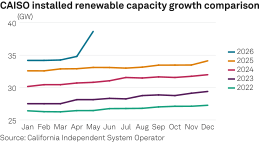
CAISO's installed wind capacity jumped 42% month over month or 3.651 MW between April and May, according to the Key Statistics report
Solar record
CAISO's installed solar capacity increased 1.3% month over month or 298 MW in May, according to the Key Statistics report.
For the first five months of 2026, utility-scale solar surpassed natural-gas generation in CAISO, as solar electricity generation was up 21% compared to the same period in 2024, and gas generation decreased 60%, according to the US Energy Information Administration. Utility-scale solar generated more electricity than natural gas on a daily basis on 82% of days in the first five months of 2026, up from 21% in 2024 and 2025.
"Solar records are driven by increased capacity and favorable spring/early summer weather conditions, though curtailment continues to eat into potential generation despite strong battery build-out," Gutierrez said. "We expect to see around 3 GW of solar added in 2026."
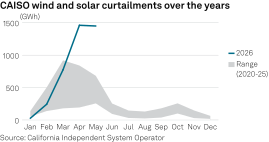
CAISO wind and solar generation curtailments jumped 221% year over year to a record 1,448,995 megawatt-hours in May, which followed a 98% increase in April, according to the Key Statistics report. Battery storage capacity continues to grow in the CAISO footprint, reaching 16.531 GW in May, up 33% year over year.
As curtailments and renewable capacity increased, spot prices plunged. SP15 on-peak day-ahead locational marginal price averaged $2.80/MWh in May, down 81% from a year ago.
Grid operations impact
These additional resources are an important factor as CAISO heads into the summer months where demand begins to peak, Ackeman said.
"As a result, we are expecting the grid to perform well through the extreme weather conditions typically seen during the summer barring any unexpected emergencies," Ackeman said. "During the Spring, we also increased our exports thanks to the increased output from new generation resources."
CAISO expects to add roughly 11.9 GW of wind and solar capacity through the end of 2026-end, in addition to the 5.142 GW that has achieved so far this year, she added.
"This would mark a record for us, if achieved, as the most resource brought online in a single year," Ackeman said. "That said, there is a possibility some of the 11,900 MW will get pushed into 2027."
