Maritime & Shipping, Crude Oil, Wet Freight
November 06, 2026
Russian crude exports fall on G7 tankers as Greek operators flee for better earnings
By Max Lin
Editor:
HIGHLIGHTS
Greek tankers exit Russian routes for profits, security
G7 tankers' market share in Russia hits 7-month low
Non-G7 fleet maintains shipments amid relief talk
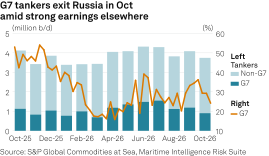
Russian crude exports on G7 tankers fell sharply in October as Greek operators were enticed by strong earnings elsewhere and steered away from Black Sea conflicts, according to S&P Global Commodities at Sea and Maritime Intelligence Risk Suite data.
The data shows tankers flagged, owned or operated by companies based in G7 countries and their allies, or insured by Western protection and indemnity clubs, loaded roughly 906,000 barrels per day of Russian crude in October, or 24.2% of total exports.
The share was the lowest in seven months. In September, G7 tankers lifted 1.2 million b/d, or 29.2% of total exports.
Shipments by tanker operators in Greece, the top shipowning nation within G7/EU, more than halved to 8.3 million barrels in October from 17.3 million barrels in September, according to CAS/MIRS. October's loadings were the lowest since December 2024.
The development came as tanker rates were around their all-time highs in mainstream markets, boosted by larger ship requirements from offshore transfers east of the Strait of Hormuz and high risk premiums during the ongoing US-Iran war.
October's average Suezmax time-charter-equivalent earnings for transporting Russian crude from the Baltic to West Coast India was $46,257.92 per day lower than the Global Suezmax Index, compared with a discount of $23,225.69/day in September, according to Platts assessments for non-scrubber, non-eco ships. Platts is part of S&P Global Energy.
In a research note published last month, CAS analysts said four Greek-owned Aframaxes and four Suezmaxes had migrated from Russian to mainstream trades where earnings environments were strong.
Greek tanker firms have also been avoiding operations in the Black Sea, with the CAS/MIRS data showing only one Greek-operated tanker lifting Russian crude in the region last month, compared with 11 in other regions.
The International Maritime Organization said more than 100 ships might have been hit in the Black Sea and Sea of Azov this year as part of the Russia-Ukraine war, potentially killing 38 seafarers.
Platts assessed the additional war risk premium for crude exports from the Black Sea at $5/b on Nov. 6, the highest since the assessment began in October 2022.
Shadow fleet
The non-G7 fleet, mainly composed of shadow tankers amassed by Russia and opaque owners to bypass Western sanctions, lifted 2.8 million b/d of Russian crude in October, according to CAS/MIRS. This compared with 2.9 million b/d in September.
Tankers operated by Hong Kong firms were responsible for shipments of 27.7 million barrels last month, Russian companies for 22.5 million barrels, and UAE companies for 15.6 million barrels.
US Energy Secretary Chris Wright last month said his country planned to allow legitimate businesses to acquire sanctioned tankers for non-sanctioned trades to reduce shipping costs in mainstream trades, though Washington has yet to announce a detailed relief proposal.
A total of 42 tankers have migrated from potentially illicit trades in Russia, Venezuela and Iran to mainstream markets so far this year, according to the CAS note, though none of them have been formally sanctioned by the US.
"Migrated vessels were rapidly absorbed into mainstream Middle East Gulf export chains following their transition into compliant employment," CAS analysts said, adding that a growing proportion of operators have opted to remain in compliant markets once migration occurs.
