Refined Products, Crude Oil, Natural Gas, Maritime & Shipping
November 03, 2026
India’s crude imports hit record high in Oct as refiners stock up for festivals, product exports
HIGHLIGHTS
Imports hit 5.54 million b/d, surpass March 2025 levels
Freight costs pressure Russian crude economics
Refiners maximize runs as crude supplies recover
Crude imports by Indian refiners rose to an all-time high of 5.54 million b/d in October, as refiners capitalized on improved availability to build supplies ahead of festival demand, while processing higher volumes to produce additional middle distillates for international markets facing supply tightness, industry sources and analysts said Nov. 3.
Domestic-bound crude imports in October were up 9% from both September and the same month a year earlier, according to data from S&P Global Commodities at Sea. The monthly average surpassed the previous high of 5.50 million b/d imported in March 2025.
"Russian imports have come off the peaks we saw in June and July, but they're still close to 2 million b/d in October. At the same time, we are seeing more barrels coming out of the Middle East, particularly from Saudi Arabia and Iraq, and Indian refiners are taking advantage of that availability ahead of stronger seasonal demand," said Premasish Das, executive director for oil analytics at S&P Global Energy CERA.
Russian crude shipments to India rose sharply in the first half of 2026, increasing from 1.17 million barrels/day in January to a peak of 2.43 million b/d in June, according to CAS. Flows eased to 2.05 million b/d in July, 1.98 million b/d in August, and 1.64 million b/d in September, but picked up to nearly 2.1 million b/d in October.
"An Oct. 16 US waiver reduced the immediate risk of additional measures affecting buyers of Russian crude. However, the waiver has no specified expiry and remains revocable, while existing Russia-related sanctions continue to leave importers exposed to renewed policy pressure," said Saransh Katiyar, liquid bulk analyst at CAS.
US President Donald Trump signed an executive order Oct. 16, waiving measures included in the Lindsey O. Graham Sanctioning Russia and Iran Act for the largest buyers of Russian oil, citing "national interests," days before they were due to take effect.
The legislation targeted buyers of Russian hydrocarbons, allowing the president to impose tariffs of up to 100% on goods imported from the five largest buyers of Russian crude oil or natural gas by total volume over the year before enactment, among other measures.
Countries such as India can continue to import Russian crude without immediately facing additional US penalties or tariffs. However, the waiver does not permanently revoke the law, and it can be withdrawn. As a result, buyers may choose to diversify their oil supplies and remain cautious about future sanctions risks, refining sources said.
Freight economics
CERA's Das added that the economics of Russian barrels were changing as freight costs remain high. Uncertainty around US concessions on Russian oil, the impact of drone attacks on Russian refining, and competition from Chinese buyers also mean Indian refiners will continue to look for opportunities across different sources of supply, depending on availability and relative attractiveness.
Platts, part of S&P Global Energy, last assessed Dirty Black Sea to West Coast India freight at a lumpsum of $28 million on Oct. 30, nearly double the year-to-date average of $14.5 million.
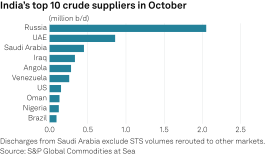
Analysts said the increase in October crude imports for Indian refiners was also supported by higher arrivals from Angola and the US.
"Favorable transatlantic arbitrage economics encouraged additional US crude flows into India, while stronger liftings of Angolan heavy-sweet and medium-sour grades also contributed to the rise," Katiyar said.
US crude flows in 2026 averaged 125,000 b/d over January-October, with inflows reaching 150,000 b/d in October, up 16% from September levels, CAS data showed.
In addition, Middle Eastern producers were making a clear effort to regain market share, giving Indian refiners a wider range of supply options and contributing to the increase in overall imports, Das said, adding that India's crude imports were likely to remain elevated, supported by strong refining margins and the start-up of new capacity.
Improving availability
"Indian refiners are swiftly capitalizing on improved crude availability to maximize utilization rates and secure more cargoes to meet both festive demand at home and export more volumes to deficit markets," said B. Anand, former CEO of Nayara Energy and founder of consultancy firm Meridian Partners.
Indian refineries processed 5.62 million b/d in September, the oil ministry's provisional estimates showed, reflecting 9.1% higher processing from a year earlier as imports by the world's third-largest buyer rose despite supply concerns due to the Middle East conflict.
The crude processed in September was 6.6% higher than the month's target of 5.27 million b/d, it said. The processed volume in September was 2.7% higher than 5.47 million b/d in August, the ministry said.
Analysts said India's increase in crude imports in October may partly reflect a buildup of delayed cargoes rather than a sustained change in buying patterns. The movement of crude through the Strait of Hormuz, which remained partially open, also affected the timing and routing of shipments, they added.
"While the headline number on India's crude imports looks impressive, it is still not business as usual and can be a factor of supplies being bunched and refiners looking at stocking up available barrels," said Rajat Kapoor, managing director for oil and gas at Synergy Consulting.
"Refiners have been buying any cargo they can find in order to run plants above nameplate capacity and keep the domestic market supplied ahead of the Diwali festival season," he said.
India's total seaborne crude discharges, including volumes transferred ship-to-ship and subsequently redistributed to other markets, rose 19% month over month to 6.4 million b/d in October, CAS data showed.
