Natural Gas, Refined Products, Crude Oil
October 23, 2026
US waiver eases risks for India, China, but won't alter Russian crude flows
HIGHLIGHTS
Waiver to reduce uncertainty over Russian crude: CERA
India, China to maintain Russian crude purchases
Refiners to seek alternatives amid policy risks
The US waiver on Russian crude has reduced uncertainty for Indian and Chinese refiners, giving them greater confidence to continue purchasing economically attractive Russian grades while keeping alternative supply options open in case the situation changes, analysts and industry sources said Oct. 22.
The waiver is expected to preserve, rather than materially alter, Russian crude flows to India and China. While it reduces the possibility of a sudden disruption to global oil supplies, the potential for the waiver to be reversed means political and compliance risks would continue to influence trade, shipping and pricing decisions.
"For refiners in India and China, the waiver is really about reducing the uncertainty rather than changing the crude supply picture," said Premasish Das, executive director for oil analytics at S&P Global Energy CERA. "Russian barrels were already flowing into these markets, but the waiver removes an immediate concern and gives refiners more confidence to continue buying grades that make economic sense."
"However, as the legislation remains in place, refiners may still want to keep alternative supply options open in case the situation changes," Das said.
US President Donald Trump signed an executive order Oct. 16, waiving measures included in the Lindsey O. Graham Sanctioning Russia and Iran Act for the largest buyers of Russian oil, citing "national interests," days before they were due to come into effect.
The legislation targeted buyers of Russian hydrocarbons, allowing the president to impose tariffs of up to 100% on goods imported from the five largest buyers of Russian crude oil or natural gas by total volume over the year before enactment, among other measures.
Countries such as India and China can continue to import Russian crude without immediately facing the threat of additional US penalties or tariffs. However, the waiver does not permanently revoke the law, and it can be withdrawn. As a result, buyers may choose to diversify their oil supplies and remain cautious about future sanctions risks, industry sources said.
"Markets are likely to view the waiver as a tactical reprieve rather than a durable policy settlement," said B. Anand, former CEO of Nayara Energy and founder of consultancy firm Meridian Partners. "Past US decisions not to renew waivers reinforce caution: buyers may use the procurement window, but longer-term commitments will depend on greater confidence in policy continuity."
Russian flows to Asia intact
Industry sources said India's demand for Russian crude is expected to remain strong in the near term. However, refiners would continue to diversify their supply sources as insurance against potential future US actions.
"As of now, it is a sixty-day pause only. So, we have to wait and watch how the tri-lateral deliberations of US, Ukraine and Russia unfold. We can hope for the best," said DLN Sastri, former director of oil refining and marketing at the Federation of Indian Petroleum Industry.
Russian crude discharges to India rose sharply in the first half of 2026, increasing from 1.17 million barrels/day in January to a peak of 2.43 million b/d in June, according to S&P Global Commodities at Sea data. Flows eased to 2.05 million b/d in July, 1.98 million b/d in August and 1.64 million b/d in September but remained well above January levels.
Russian crude discharges in China -- including pipeline imports -- remained strong but volatile in 2026, according to General Administration of Customs data.
Flows peaked at 2.72 million b/d in February before declining to 2.38 million b/d in March and 1.93 million b/d in May, GAC data showed. Discharges recovered, reaching 2.65 million b/d in August before moderating to 2.43 million b/d in September, according to GAC data. Despite fluctuations, China's Russian crude intake averaged about 2.35 million b/d over January-September, GAC data showed, underscoring sustained demand for discounted Russian barrels.
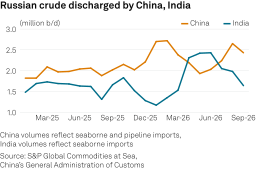
China is expected to continue importing Russian crude even without the exemption under the Lindsey O. Graham Act, unless Beijing decides to restrict access, according to Chinese industry sources and analysts.
Tariffs on China's Russian oil purchases could reignite trade tensions with the US while doing little to deter such purchases, given the economic appeal of discounted Russian crude for Chinese refiners.
Russian supplies accounted for 30.9% of China's total crude imports in the first nine months of 2026, GAC data showed.
Additional pressure on supplies
A Beijing-based policy analyst specializing in China-Russia relations said the tariffs may prove ineffective and could drive oil prices higher, putting additional pressure on the global economy.
"It would be another round of the tariff war without the exemption, repeating what happened last year," the analyst said.
The price of ESPO cargoes loaded in the Far East fell to ICE Brent plus $20/b on Oct. 23, down from a premium of $30/b a month ago on a DES Shandong basis, due to improving crude supplies in the global market, according to market sources.
China's independent refiners are expected to continue taking advantage of deeply discounted Russian crude that some Indian buyers and Chinese state-owned companies may avoid, even if the US tariff takes effect, industry sources said.
"We do not export anything to the US, and who does not like cheap feedstocks?" said an independent refiner in Dongying, illustrating why China's smaller refiners are relatively insulated from US trade measures.
China's independent refiners have limited financial exposure to international markets and are barred from exporting refined products, making them less vulnerable to US trade measures than globally active state-owned oil companies.
