Refined Products, Natural Gas, Crude Oil, Diesel-Gasoil, Gasoline
October 19, 2026
Trump waives Russia oil sanctions to preserve Ukraine peace talks

By Kate Winston
Editor:
HIGHLIGHTS
India, China are top importers of Russian oil
Lawmakers from both parties oppose the waiver
US President Donald Trump has indefinitely waived new legally mandated sanctions and tariffs on the largest buyers of Russian oil, saying he does not want to endanger talks to end the war with Ukraine.
"My decision on Russia is a very simple one. I am in the process of negotiating peace in the war between Russia and Ukraine, and don't want to do anything that will drive, foolishly, Russia away from the bargaining table," Trump said on his Truth Social media site Oct. 18.
Trump also said that Russia is doing little, if anything, to help Iran, and he wants to keep it that way, according to the post.
"Lastly, Zelenskyy is using Diesel Refineries in Russia as a target, knowing that these attacks are seriously hurting the world diesel markets, including those in the United States," Trump said.
Trump, on Sept. 18 signed comprehensive sanctions legislation targeting major purchasers of Russian oil and gas. The law gave Trump until Oct. 18 to impose the new sanctions, but also allowed the president to waive them.
The legislation allows the president to impose tariffs of up to 100% on goods imported from the five largest buyers of Russian crude oil or natural gas by total volume over the year before enactment, among other measures.
Executive order
Late Oct. 16, the White House issued an executive order waiving all sanctions and duties under the law, saying it is in the US national interest to do so. The waivers will remain until the president or the Secretary of State, in consultation with the Secretary of the Treasury and the Trade Representative, determines further action is needed.
While the White House has issued waivers for now, it may be keeping its options open for the future, ClearView Energy Partners said in an Oct. 17 note. The executive order sets the tariff on goods from the top five buyers of Russian oil and gas at 100%, the maximum under the law, if countries make new purchases of Russian oil or gas on or after Oct. 18, 2026, the note said.
"This comes as little surprise given the president's historical predilection for statutory tariff tools," the ClearView note said. The order also created a monitoring protocol to determine whether further action is needed, including regarding the waivers, the note said.
Analysts had expected that Trump would waive the sanctions and tariffs, saying that imposing new restrictions on Russian fossil fuels would contradict Trump's waiver allowing sales of Russian diesel fuel to the global market.
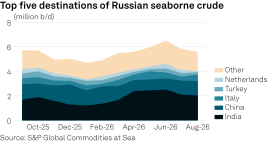
The five largest importers of Russian seaborne crude for the 12 months ending in August 2026 were India, China, Italy, Turkey and the Netherlands, according to data from S&P Global Commodities at Sea.
India imported an average of 1.8 million b/d, China imported an average of 1.2 million b/d, Italy imported an average of 445,000 b/d, Turkey imported an average of 302,000 b/d, and the Netherlands imported an average of 249,000 b/d, CAS data shows.
Congressional opposition
Lawmakers who supported passage of the law have voiced strong opposition to the waiver.
Senator Ted Cruz (Republican-Texas) said the waiver benefits Putin, which is not a good idea. "I wish the president hadn't done it. I think it was a mistake," Cruz said Oct.17 on Fox News.
Senator Richard Blumenthal of Connecticut, a lead Democratic sponsor of the legislation, also slammed the decision. "These waivers have nothing to do with our national security and everything to do with sucking up to Vladimir Putin," Blumenthal said Oct. 16 on X, formerly known as Twitter.
Representative Gregory Meeks (Democrat-New York) on Oct. 16 introduced legislation to block Trump's Russian diesel waiver, tighten sanctions on Russian energy and prohibit future licenses for Russian oil, petroleum products, diesel and natural gas purchase, sale, delivery, or offloading.
The measure would also prevent the US International Development Finance Corporation from supporting any energy deal owned by a Russian national, regardless of whether the assets are in Russia.
DFC is prohibited from supporting a project in a designated country of concern, including Russia.
