Energy Transition, Metals & Mining, Coal, Refined Products, LNG, Natural Gas, Crude Oil, Renewables, Diesel-Gasoil
October 20, 2026
EU weakens call for ban on Arctic oil and gas drilling

Editor:
HIGHLIGHTS
EU removes call for multilateral drilling ban
Continues to call for oil, gas to be left in ground
Follows Norwegian lobbying, Ukraine, Iran wars
The European Union has watered down calls for a ban on Arctic oil and gas drilling, following intense lobbying from key supplier Norway, but continues to call for hydrocarbons to be left in the ground, according to an updated strategy document.
In its previous plan, the 2021 Joint Communication on the EU Arctic Policy, the EU said it would pursue an international ban on new drilling in polar regions for environmental reasons and expressed direct opposition to oil and gas developments in the Arctic.
While its long-awaited update released Oct. 20 continues to call for Arctic oil, coal and gas to "stay in the ground" and for the region to develop renewable energy and "sustainable minerals", it drops calls to "work with partners toward a multilateral legal obligation not to allow any further hydrocarbon reserve development in the Arctic...nor to purchase such hydrocarbons if they were to be produced."
The tweak follows increasingly vocal comments from Norwegian officials, both in government and state-run Equinor, about the importance of exploration in its Arctic waters for Europe's energy security.
In August, Equinor CEO Anders Opedal told Platts, part of S&P Global Energy, that the EU was taking the "wrong direction" when it comes to Arctic drilling.
"What they call Arctic is where my people live and work," Opedal said in an interview on the sidelines of the ONS conference in Stavanger. "I think this is kind of the wrong direction from the EU." He added that Barents Sea fields are "a vital part of the energy security for Europe."
Speaking at the same event, Norway's energy minister Terje Aasland said that it was Norway's "responsibility" to seek out "great opportunities" for new oil and gas developments in the Arctic, while also accusing EU members of mixed messaging on the issue.
Addressing reporters at the launch on Oct. 20, Jozef Sikela, European Commissioner for international partnerships, said the EU remains committed to its Paris climate goals and 2050 net zero ambitions and would work with partners "to prevent hydrocarbon developments that pose a threat to [the] Arctic ecosystem".
However, Sikela added, "we respect the decision of Norway simply to open or at least explore the opportunities" for new developments.
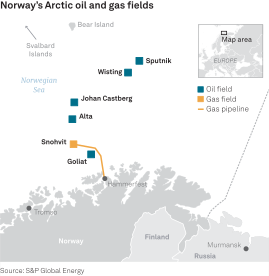
European countries already buy some 220,000 barrels/day of crude oil from Equinor's Johan Castberg field, a major Arctic development in the Barents Sea, which came online last year. According to S&P Global Commodities at Sea data, Sweden, the UK and the Netherlands are the biggest importers of Castberg crude.
A stand-alone development, Norwegian officials see Johan Castberg as a potential launchpad for a new era of Arctic exploration. Equinor is also eyeing a final investment decision on its long-delayed Wisting oil field even further north.
According to the Norwegian Offshore Directorate, the Arctic holds 62% of Norway's remaining undiscovered hydrocarbon resources.
The EU rethink follows the market-roiling US-Iran war, which slashed crude and product flows through the Strait of Hormuz, sending prices soaring.
With diesel cracks hitting record highs, Middle Eastern flows to Europe looking increasingly precarious, and the Russia-Ukraine war still ongoing, Norwegian oil and gas has become the cornerstone of European energy security.
It also comes against the backdrop of a tussle for control of the strategic Arctic region, exemplified by US President Donald Trump's threats to annex Greenland and increasing Russian and Chinese activity. Russia has LNG assets in the Arctic and a large fleet of Arctic icebreakers.
Launching the new strategy, Kaja Kallas, the EU's foreign policy chief, said the Arctic "has become the front line of global power competition" and said the bloc was prioritizing critical raw materials, clean energy and new trade routes.
