LNG, Natural Gas, Crude Oil, Metals & Mining
August 27, 2026
Norway's Arctic oil ambitions heat up despite EU opposition
By Charlie Mitchell and Matt Hoisch
Editor:
HIGHLIGHTS
Arctic vital for Europe energy security: officials
Follows startup of Johan Castberg field last year
Barents Sea 'holds largest resource potential on NCS'
Momentum is building for a significant drilling push in the Norwegian Arctic on energy security grounds, with Norwegian policymakers and companies determined to ramp up frontier exploration despite a European Union ban.
At the ONS energy conference, held in Norway's oil capital Stavanger over Aug. 24-27, the country's energy leaders called for major new developments in the Barents Sea to offset natural declines elsewhere on the Norwegian Continental Shelf – and to ensure sufficient oil and gas supply to Europe amid wars in Ukraine and the Middle East.
EU officials currently back a ban on new drilling in the Arctic on environmental grounds, with a moratorium agreed in 2021 as part of its Joint Communication on the EU Arctic Policy, although it is not a legally binding, enforceable ban.
The bloc has at times pushed for a more concrete, global ban, but is now considering revising its policy in response to energy security concerns and intense lobbying from non-member Norway.
In recent months, with the closure of the Strait of Hormuz and infrastructure attacks in the Middle East taking millions of barrels of oil and refined products off the market – as well as significant LNG volumes – players in the Norwegian oil sector have sharpened their rhetoric.
Norway's energy minister, Terje Aasland, said on a panel discussion on the European energy landscape that it was Norway's "responsibility" to drill in the Arctic, which boasts "great opportunities" for new oil and gas developments.
Aasland also lamented the EU's opposition, noting diverging attitudes of different member states. "When you are talking to Germans, they want that gas. When you are talking to Poles, they want that gas," he said. "Europe is 27 different energy markets – they don't talk to each other."
Equinor CEO Anders Opedal went a step further, telling Platts on the sidelines of the event that the EU is taking the "wrong direction."
"What they call Arctic is where my people live and work," Opedal said. "I think this is kind of the wrong direction from the EU." He added that Barents Sea fields are "a vital part of the energy security for Europe."
A European Commission spokesperson told Platts – part of S&P Global Energy – in a statement that the EU "remains committed to the approach set out in the 2021 Joint Communication on the EU Arctic Policy."
"Addressing climate change and environmental degradation and supporting sustainable economic development remain important objectives," the spokesperson added.
The debate comes against the backdrop of a recent boost in Arctic output following the startup of Equinor's huge 220,000 b/d Johan Castberg oil field in the Barents Sea last year.
The field, which lies 240 km northwest of the town of Hammerfest, is a standalone development that could usher in a new era of Arctic exploration, not least by acting as a staging post for accessing more remote fields.
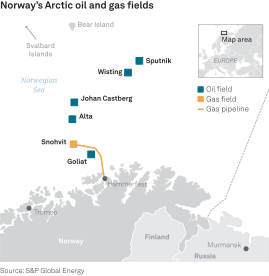
Opedal told Platts that "all the oil and gas we produce in the Barents Sea goes to Europe." Data from S&P Global Commodities at Sea shows that Johan Castberg crude has only ever shipped within Europe, with Sweden, the UK and the Netherlands its biggest buyers.
Equinor is eyeing a final investment decision in late 2027 on its delayed Wisting oil field, north of Castberg, which has been talked about as potentially Norway's last standalone oil development. The project holds some 500 million barrels of oil, but has faced logistical challenges, such as helicopter fuel capacity.
That could be just the start. On Aug. 23, Norway's three largest producers – Equinor, Aker BP and Var Energi – announced they would join forces to pursue major frontier exploration on the NCS, including in the Barents Sea.
The Norwegian Offshore Directorate says the Arctic holds the largest remaining resource potential on the NCS, with 62% of the country's undiscovered resources, making it capable of countering predicted production declines in the 2030s and beyond.
North American view
If Norwegian companies do not step up drilling activity in the Arctic, then others might.
Thomas Emanuel Dans, chairman of the US Arctic Research Commission, told the ONS conference that the Trump administration is prepared to push ahead with oil and gas development in icy Alaska.
"This is a key, defining signal change in terms of President Trump, which is, for the Arctic, that we as a nation are going... put a strong emphasis on developing our resources there," he said. "Our oil and gas reserves [in Alaska] are tremendous."
One key project there is ConocoPhillips' controversial multi-billion-dollar Willow oil development. The US company took FID on the 180,000 b/d crude project in late 2023.
"We think [more Arctic activity is] inevitable – activity is going to move north," Kirk Johnson, executive vice president of global operations and technical functions with ConocoPhillips, said Aug. 25 at ONS.
Canada could also see increased energy and mineral exploration in its massive Arctic region, an expert said.
"The North American landscape is changing," Robert Johnston, director of energy and natural resources at the University of Calgary School of Public Policy in Canada, said at ONS.
"The Carney and Trump governments have their differences, but I think they both share a strong motivation, and I think that's providing a tailwind to these kinds of projects," he said.
"Maybe more mining on the Canadian side, the oil on the Alaska side [and] LNG. So it'll still be slow, but I think it's going to be more than we've seen in the last two or three decades."
