Refined Products, Crude Oil, Diesel-Gasoil, Jet Fuel, Gasoline
October 13, 2026
India's middle distillate exports to remain robust as European diesel stocks tighten
HIGHLIGHTS
Sept. exports at one-year high of nearly 740,000 b/d: CAS
India cuts windfall gains tax on diesel, jet fuel exports
Strong product exports boost India's oil terms of trade: CRISIL
India's middle distillate exports rose to a one-year high in September, supported by robust overseas demand as European diesel inventories continued to decline, creating scope for shipments from the South Asian supplier to remain elevated in the coming months, refining sources and analysts said Oct. 13.
Additionally, New Delhi's lowering of export duties in September will continue to encourage private Indian refiners to tap overseas markets, at a time when tighter global product supplies are increasing pressure on policymakers amid surging prices worldwide.
"India's increase in product exports in September coincided with tightening European diesel inventories, which are expected to reach their lowest year-end level in more than a decade," said Saransh Katiyar, liquid bulk analyst at S&P Global Commodities at Sea.
India's middle distillate exports rose to nearly 740,000 barrels/day in September, accounting for about 57% of the country's total oil product exports. Gasoil outflows rose to 586,000 b/d, representing 45% of total exports and standing 43% above average loadings in the first half of 2026, CAS data showed.
India cut the windfall gains tax on diesel and jet fuel exports while retaining the previous rate for gasoline, according to an Oct. 1 gazette notification from the Ministry of Finance, providing some relief to domestic refiners as renewed geopolitical tensions in the Middle East pressure earnings.
The new rates will apply for two weeks from Oct. 1, according to the notification. The new rate of the windfall tax — also known as the special additional excise duty (SAED) — and road and infrastructure cess on diesel exports will be 16 rupees/liter, down from 20 rupees/liter earlier, the notification said. The new rate for jet fuel exports will fall to 10.5 rupees/liter from 15 rupees/liter.
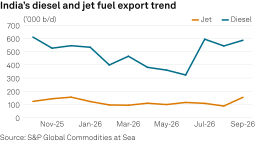
India's middle distillate shipments to Europe and the Mediterranean region reached a year-to-date high of 298,000 b/d in September, including 216,000 b/d destined for the Mediterranean. Gasoil accounted for 215,000 b/d of total shipments to the broader region, with about three-quarters of that heading to Mediterranean destinations. Of the gasoil shipped to Europe, 40,000 b/d was destined for Rotterdam, marking the resumption of flows to the port after February, CAS data showed.
"While Europe and the Mediterranean region have attracted a larger share of Indian cargoes amid disruptions to Middle Eastern refined products supply, early October data from Commodities at Sea suggests refiners are also expanding sales into Africa and Latin America, highlighting India's growing role as a flexible supplier to deficit markets," said Benjamin Tang, head of liquid bulk at CAS.
Global supply squeeze
India's jet fuel and kerosene exports nearly doubled month over month to 154,000 b/d in September, although volumes remained broadly in line with historical levels. The country exported an average of 151,000 b/d in 2025, predominantly to Europe and the Mediterranean region. Shipments to the region had remained limited since the start of 2026, aside from contracted deliveries to Italy.
Jet fuel and kerosene shipments to Europe and the Mediterranean region rose 11% month over month to 83,000 b/d in September. About 57,000 b/d was destined for the Mediterranean, while the remaining 26,000 b/d was shipped to Rotterdam in the Netherlands.
"Looking ahead, India's middle distillate exports could remain elevated if tightness in the European gasoil market persists," Katiyar said.
Loading activity remained strong in October. As of Oct. 12, India had loaded 747,000 b/d of middle distillates, with gasoil accounting for 79% and jet fuel and kerosene making up the remainder, CAS data showed.
The Asian ultra-low sulfur gasoil complex is expected to be volatile over Oct. 12-16, weighed by the G7's commitment to frontload the release of diesel stocks and the Russian government's partial lifting of its diesel export ban.
US President Donald Trump said Russia had agreed to supply global markets amid concerns over supply shortages and high prices. Meanwhile, China's estimated refined product export allocation of 4.5 million metric tons — well below prior expectations of 8 million mt — may provide some support to prices, brokers said.
The balance-month October gasoil exchange of futures for swap — an indicator of East-West arbitrage flows — was at minus $161.89/mt at the Oct. 12 close, compared with the Platts assessment of minus $219.24/mt at the Oct. 9 close.
Export outlook
"Given the global tight supplies of oil products, India's middle distillate exports will continue to remain elevated in the foreseeable future," said DLN Sastri, former director of oil refining and marketing at the Federation of Indian Petroleum Industry. "Private refineries will account for the bulk of the exports. Even state-run refiners like [Mangalore Refinery and Petrochemicals Ltd.] will be scouting for opportunities in overseas markets."
India will honor its overseas commitments for petroleum products, including diesel, Oil Minister Hardeep Singh Puri said Sept. 24, assuring global markets that the country would maintain supplies despite geopolitical tensions in the Middle East and the Russia-Ukraine conflict.
According to a Sept. 17 research by CRISIL, part of S&P Global, India's merchandise export growth of 18.8% so far in fiscal year 2026-27 (April-March) has been driven by a surge in petroleum exports, which rose 46% year over year, while non-oil exports increased at a slower pace of 14.4%. This marks a sharp reversal from the consecutive declines in petroleum exports recorded over the previous three fiscal years.
"India's oil terms of trade have improved since the onset of the West Asia conflict," said Dharmakirti Joshi, chief economist at CRISIL. "While crude oil import prices have risen sharply, export prices of refined petroleum products have increased even faster. Export volumes have also recovered in recent months after an initial disruption caused by the conflict."
"While exports to some markets have faced headwinds this fiscal year, shipments to newer markets have accelerated, partly offsetting the weakness. These markets are likely experiencing supply shortages from traditional suppliers such as West Asia and Russia amid geopolitical disruptions and reduced refining capacity," Joshi added.
