Crude Oil, Maritime & Shipping, Refined Products
September 15, 2026
Discounts on Russian crude narrow since mid-August on growing Middle East supply concerns

Editor:
HIGHLIGHTS
Russian crude output falls amid refinery attacks
EU, UK committed to sanctions on Russia
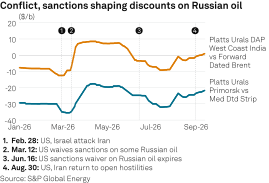
Discounts on Russian crude have narrowed since mid-August as escalating conflict in the Middle East raises global supply concerns and Russian crude output is dented by Ukrainian attacks, according to data from Platts, part of S&P Global Energy, and analysts.
Platts assessed Russia's Urals Primorsk crude at a discount of $21.65/barrel to Dated Brent Sept. 14, compared to a discount of $25.90/b Aug. 17.
Urals crude supplied to India has been trading at a premium since Sept. 8. Platts assessed Urals DAP west coast India at a premium of $1.05/b to Forward Dated Brent Sept. 14, compared to a discount of $3.20/b Aug. 17.
"Buyers are starting to get nervous, and are consequently bidding up any available crude, even that which is affected by sanctions," Ronald Smith of Emerging Markets Oil & Gas Consulting Partners said.
Independent energy analyst George Voloshin said the discounts have narrowed due to competition among Asian refiners, Russian upstream supply disruptions and Middle Eastern supply uncertainty.
"Escalating tensions and disruptions surrounding Gulf and Red Sea shipping routes have made Middle Eastern medium-sour grades riskier and more expensive to lift. Consequently, refiners in India and China have treated seaborne Russian grades as a more secure baseload alternative, bidding up delivered cargo prices," Voloshin said.
At the end of August, Iran and the US returned to open hostilities, with attacks on tankers increasing and supply via the Strait of Hormuz and the East-West Pipeline disrupted.
Tatiana Mitrova, a fellow at Columbia University's Center on Global Energy Policy, said that the narrowing reflects stronger competition for available Russian cargoes as buyers' alternatives become more constrained.
"It's not that Russian supply has become safer, but that buyers simply have fewer attractive alternatives," she said, adding that freight, insurance and intermediary margins can absorb part of that gain.
Output dip
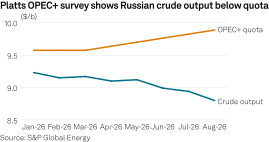
Supply disruptions in the Middle East have added to pressure from declining Russian crude output. Russia produced 8.8 million barrels/day of crude in August, well below its OPEC+ quota of 9.887 million b/d, according to the Platts OPEC+ survey.
Production fell from 9.23 million b/d in January as Ukrainian strikes have targeted Russian oil supply and processing infrastructure.
Analysts at S&P Global Energy CERA estimate that almost half of Russia's primary refining capacity was offline as of the end of August, pushing Russian crude runs to a 21-year low of 3.9 million b/d.
Smith estimates that logistical issues linked to Ukrainian drone attacks are likely imposing a 600,000-800,000 b/d output restriction.
Ukraine and Russia agreed to an energy truce, US President Donald Trump said Sept. 14 on his social media platform Truth Social, raising the prospect that some of these Russian barrels could return to the market.
The Russian Energy Ministry and its biggest oil producers, Rosneft, Lukoil and Gazprom Neft, did not reply to requests for comments on oil output and price levels.
Discounts on Russian crude have been volatile in 2026. At the start of the year, they widened in the wake of UK and EU sanctions on importing refined products made from Russian oil. However, the supply crisis resulting from the war in February led the US to introduce some temporary sanctions waivers on Russian crude between mid-March and mid-June.
Urals supplied to India traded at a premium for most of this period and Urals supplied via Primorsk hit its narrowest discount, of $17.65/b, in mid April, Platts data showed.
The US Treasury did not respond to a request for comment on whether it may introduce more Russian sanctions waivers in response to high oil prices.
EU Sanctions Envoy David O'Sullivan told Platts that the EU is committed to maximizing the impact of sanctions on Russia.
A spokesperson for the UK Foreign, Commonwealth & Development Office said it does not comment on potential future sanctions designations as to do so would lessen their impact, but it is committed to working with partners to constrain the Kremlin's energy revenue.
"Russian oil revenues continue to deteriorate; revenues in the first half of 2026 were around 23% lower than a year earlier, despite a temporary uplift in global oil prices from the Iran conflict. Russian crude continues to trade at significant structural discounts to Brent," the spokesperson said.
