Crude Oil, Natural Gas
September 09, 2026
US midterm elections to have little impact on oil output, analysts say

By Kate Winston
Editor:
HIGHLIGHTS
Democrats lack votes to override Trump vetoes
Iran conflict creates investment hesitation
Permitting reform faces bipartisan gridlock
The US midterm elections are expected to have little impact on domestic oil production, as ongoing price and demand uncertainties are more important to investment than the types of policies that could pass Congress with a narrow Democratic majority, energy market analysts said.
Even if Democrats were to flip both the House of Representatives and the Senate, they likely would not secure large enough margins to override President Donald Trump's veto power, the analysts said.
"Anything that is done legislatively that harms industry potential to continue to exercise energy dominance, as this administration puts it, is not going to pass," Kenneth Medlock, the senior director of the Center for Energy Studies at Rice University, told Platts, part of S&P Global Energy.
The election could, however, lead to more investigations or policy proposals that could divert agency resources away from the administration's deregulatory priorities and legislative permitting reform, according to Dan Naatz, executive vice president and chief policy officer for the Independent Petroleum Association of America.
"Our hope would be that it's not just endless hearing after hearing after hearing, looking to score political points, rather than trying to do something that would be important for the entire nation," Naatz said.
If Congress flips to Democratic control, there could be a slowdown of new policy unless it is done through executive order, said Bob Fryklund, chief upstream strategist at S&P Global Energy CERA.
"You could end up with a sort of lame duck president here that still will resort to executive orders, and so you'll get a lot more litigation," Fryklund said.
If Democrats win both chambers, they would fully control the appropriations process, potentially forcing policy compromises from the White House, said Kevin Book, managing director at ClearView Energy Partners. A Democrat-controlled Senate also would be able to limit or reject nominees to agencies pursuing policy objectives, he said.
The midterm election also could be a test for some of Democrats' more assertive and progressive positions ahead of the next presidential election, which could boost investment uncertainty, Book said.
"It could have the effect of chilling investment ahead of time, limiting appetites for some of the longer-horizon projects that might be getting sanctioned in 2027 or 2028, but fully exposed to political reversal in 2029 or thereafter," Book said.
Iran war
The biggest impact of the midterm election could be the indirect effects of the outcome of the conflict in Iran, because war-related damage to infrastructure and disruptions of oil flows through the Strait of Hormuz have helped energy producers and refiners to earn significant profits, Horizon Engage senior adviser Rachel Ziemba said. There may be sufficient bipartisan opposition to the war for Congress to try to constrain the administration after the election, particularly by limiting military spending.
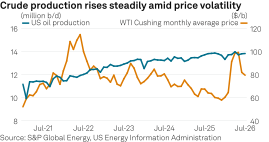
So far, producers have been reluctant to significantly increase capital expenditures and pursue substantial production increases because prices could drop if the war in Iran ends, Fryklund said. "They are being cautious just because there could be a settlement of the war, we could face some overproduction, and that could push prices back down in a fairly rapid way," Fryklund said.
US oil production has steadily increased over the past five years, reaching 13.82 million barrels/day in July 2026, according to US Energy Information Administration data. Growth over this period was driven in part by productivity gains and operational efficiencies that helped producers expand output despite price swings and restrained spending.
If a change in the control of Congress after the elections restricts the president's legislative options, Trump may become more assertive in the arenas of foreign policy and geopolitics that are firmly in the executive branch's purview, Book said.
"One of the things that calls oil production out of the ground is a high price, and more geostrategic engagement post-election could be a catalyst for that higher price," Book said.
Medlock argued that the market impact of the Iran war will be transitory because major producers in the region will find ways to bypass the Strait of Hormuz to export their oil and gas over the next two and a half years.
Middle Eastern national oil companies are also looking at investment opportunities in Argentina, Brazil, Guyana and the US Gulf Coast, Medlock said. "Once you start building things and investing in places, it's more permanent."
The growth of bypass routes and Western Hemisphere investment do not necessarily temper US oil production, Medlock said. If the need for that much new infrastructure is driven by oil prices north of $75/b or $80/b, that is still beneficial for US producers, he said.
Permitting updates
Permitting reform is still a possible point of bipartisan compromise after the election, but the timing could be slow, and negotiations would be tough, Naatz said. If either chamber flips, Democrats may be reluctant to pass legislation in the lame duck session after the election, and they would likely want to go back to square one to draft new legislation, Naatz said.
Ziemba agreed that permitting reform after the election is a question mark. "At the moment, both sides want there to be permitting reform, but they don't want to give the other side the chips to sort of win on that," Ziemba said.
In addition to permitting reform, Democrats could pursue policies to increase taxes and oversight of oil companies.
Senator Sheldon Whitehouse (Democrat-Rhode Island) and Representative Ro Khanna (Democrat-California) in March introduced legislation (S. 4111, H.R. 7960) that would increase taxes on large oil companies that have earned higher profits because of the Iran war. And Senator Adam Schiff and Representative Dave Min, both California Democrats, introduced legislation (S. 4715, H.R. 9034) in spring that would increase operating standards and oversight for offshore oil and gas producers.
