Crude Oil, Maritime & Shipping
September 09, 2026
Not all barrels are equal: Iran war creates sour crude shortfall
By Charlie Mitchell and Eklavya Gupte
Editor:
HIGHLIGHTS
Complex refineries scramble for substitutes
Demand for Norway's Johan Sverdrup has surged
Strategic releases struggle to alleviate imbalance
The US-Iran war has upended global crude trade flows not just by limiting the volume of oil reaching the market, but also by creating a structural deficit in the specific type of crudes that the world's more complex refineries need most.
Not all barrels are created equal, as is illustrated in the Platts Periodic Table of Oil, which highlights 150 of the key crude streams in the global oil market.
When it comes to medium and heavy sour barrels, the Middle East is the primary source, with grades including Saudi Arabia's Arab Medium and Arab Heavy, Iraq's Basrah Heavy, and Kuwaiti, Omani and Iranian crudes forming the staple diet of many complex refineries configured precisely for these grades' API gravities, sulfur levels and yields.
These are the very crudes hardest hit by a war that has struck at the heart of Middle East energy infrastructure.
The Strait of Hormuz, which prior to the war had daily transits of around 20 million barrels of oil, has seen flows severely restricted since March, triggering what market participants describe less as a crude quantity crisis than a quality one.
According to ship-tracking data from S&P Global Commodities at Sea, exports of sour barrels from the Middle East Gulf averaged just 5.88 million b/d in the second quarter, down from 16.88 million b/d in the same period of 2025, a drop of 65%.
Although there have been significant releases to the market to fill shortfalls, from strategic reserves to additional US WTI Midland exports, much of this has been lighter and sweeter grades that do little to address the quality gap — and underscoring how difficult it is to substitute the specific qualities now missing from the market.
This collapse in sour supply pushed the Brent-Dubai spread — the difference between the Atlantic Basin light sweet benchmark and its Middle Eastern medium sour counterpart — to a record high of $18.49/b on March 31, having rarely breached $2/b in the preceding two years, according to Platts assessments.
The front-month Brent-Dubai Exchange of Futures for Swaps, or EFS, was assessed at $9.37/b as of Sept. 8, Platts data showed.
US Strategic Petroleum Reserve releases this yearhave included substantial sour crude allocations,but with the SPR having fallen to its lowest level since 1982 — at 286.6 million barrels at the end of August, according to the US Department of Energy — its ability to alleviate sour market tightness is diminishing.
Scramble for alternatives
The Middle East crisis has sent refiners scrambling for alternatives, with sour crudes from the North Sea, Russia, Africa and the Americas attracting increased interest, and producers attempting to respond.
CAS data shows sour crude exports from a cluster of competing producers, including Canada, the US, Russia, Norway, Brazil and Venezuela, rose to an all-time high of over 5.5 million b/d in the second quarter, an increase of 1.3 million b/d year over year.
Johan Sverdrup, Norway's flagship medium sour grade, has been a notable winner.
Typically it would trade at a discount to light sweet crudes, but in the early weeks of the war and at various points since, the grade has been at a larger premium to Dated Brent than Ekofisk, a light sweet that also comes from the Norwegian Continental Shelf.
In mid-April, Sverdrup surged to a record premium to the Dated Brent benchmark in mid-April of just under $17/b, according to Platts data. Differentials have come off significantly since May but it has remained at a premium to Dated Brent and was last assessed at plus $1.74/b on Sept. 8, the highest in almost a month.
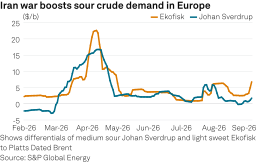
"[With the] Middle East outage [being] heavy barrels, naturally we would expect the substitute grades (Guyana, Angola, Johan Sverdrup, Kirkuk, Mars etc) to rise to reprice the market," a Europe-based crude trader said. "So the [Sverdrup] value does not surprise."
Traders and market participants point out that supply and demand dynamics for specific crudes are influenced by numerous factors, from regional refining maintenance and field shutdowns to freight costs.
But with no easy way to replace medium and heavy barrels from the Middle East, stock levels waning, and no end in sight to the Iran war, the structural shortfall in sour crude supply looks set to persist.
