Agriculture, Vegetable Oils, Biofuels, Grains, Oilseeds
September 09, 2026 · Updated September 10, 2026
IRS guidance affirms feedstock restrictions for US clean fuel tax credit

Editor:
HIGHLIGHTS
IRS sets 2026 emissions rates for biofuels
Feedstocks limited to US, Mexico, Canada
Farm manure data now factors into credits
The Internal Revenue Service issued long-awaited guidance on the Section 45Z Clean Fuel Production Tax Credit on Sept. 8, publishing the 2026 emissions rate table and clarifying rules for manure-derived fuels and regenerative agricultural practices. These decisions could expand the pool of domestic biofuel producers eligible to claim billions in production subsidies.
The guidance, published as Notice 2026-53, will allow farm-specific manure management data and low-carbon crop practices to be factored into emissions calculations, the IRS said. The guidance also implements key amendments to Section 45Z made by Republicans' 2025 budget reconciliation bill, formally restricting feedstocks produced outside the US, Mexico and Canada, which reshaped eligibility rules for fuels produced after 2025.
The credit, which applies to eligible clean transportation fuels produced domestically and sold by Dec. 31, 2029, is calculated based on a fuel's lifecycle greenhouse gas emissions rate relative to a baseline of 50 kilograms of CO2e per million British thermal units. Lower-emission fuels qualify for larger credits, creating a direct financial incentive tied to carbon intensity reductions across the biofuel supply chain, the agency said.
"Today's guidance helps America's farmers, ranchers, and fuel producers access growing opportunities in the domestic biofuels market," IRS CEO Frank Bisignano said in a statement.
Feedstock rules
Among the most consequential changes implemented by the guidance are new restrictions on feedstock origin and revised rules for calculating emissions from animal waste. Under Republicans' 2025 budget reconciliation bill, transportation fuel produced after Dec. 31, 2025, must be derived exclusively from feedstocks produced or grown in the US, Mexico or Canada — a restriction with direct implications for trade flows in used cooking oil, tallow, and other imported biofuel feedstocks.
The guidance confirmed that fuel produced after 2025, from imported non-Canadian/Mexican used cooking oil, is no longer eligible for the Section 45Z credit. However, for fuel produced in 2025 only, producers using such feedstocks may use a forthcoming pathway in the 45ZCF-GREET model, the IRS said. The June 2026 version of the 45ZCF-GREET model, released June 12, added Canadian and Mexican used cooking oil as eligible primary feedstocks.
Since its passage in 2025, Republicans' decision to exclude non-North American feedstocks has drawn praise from US corn and soy producers and criticism from biofuel producers who imported used cooking oil and other feedstocks under the original 45Z credit passed by Democrats in the 2022 Inflation Reduction Act.
Despite elevated volumes mandated under the 2026 and 2027 Renewable Fuel Standard, biodiesel imports that historically supplemented domestic supply effectively ended in the first half of 2026, contributing to fuel production and RINs compliance pressures on refiners.
According to the US Energy Information Administration, 191,000 barrels of biodiesel imports arrived in the US in June -- after just 75,000 barrels total were imported in the first five months of the year.
Platts assessed 2026 D4 RINs at $2.1925/RIN Sept. 8, at an unchanged 5.50-cent premium to D6 2026 RINs. Platts is part of S&P Global Energy.
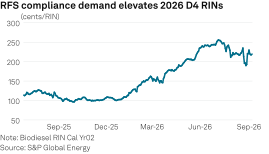
Meanwhile, the new rates for fuels must exclude indirect land use change emissions, a key change in the 2025 reconciliation package, which could lower the carbon intensity of crop-based biofuels such as corn ethanol and soybean-derived renewable diesel, potentially increasing credit values for those pathways.
Regenerative agriculture
The 2026 emissions rate table published in the notice covers a broad range of fuel types and feedstocks, including ethanol from US corn starch, sorghum grain, and corn stover; biodiesel and renewable diesel from US soybean oil, canola oil, distillers corn oil, and intermediate crops such as carinata, camelina and pennycress; and pathways using US, Canadian and Mexican used cooking oil and tallow. All non-sustainable aviation fuel pathways use the most recent version of the 45ZCF-GREET model as the allowed methodology, according to the notice.
For manure-derived fuels, the notice establishes distinct emissions rates for dairy manure and swine manure in the 2026 table. The US Department of Energy is expected to update the 45ZCF-GREET model later in 2026 to incorporate poultry manure and beef manure as primary feedstocks.
The guidance allows producers to use farm-specific prior manure management practices — such as uncovered lagoons, deep pits, or solid storage — to calculate avoided emissions in the 45ZCF-GREET model, provided they can substantiate those practices for all collected manure. The IRS and the Treasury Department said they are studying how to set emissions rates for new farms to prevent intentional inflation of avoided emissions, according to the notice.
On regenerative agriculture, the guidance provides a safe harbor for fuel produced in 2025 and 2026, deeming pre-application nutrient budget requirements satisfied for feedstocks planted before the US Department of Agriculture published its final technical guidelines on June 29. Producers must still substantiate nutrient applications and removals entered into the 45Z-specific Feedstock Carbon Intensity Calculator, according to the notice.
