Refined Products, Agriculture, Gasoline, Diesel-Gasoil, Biofuels, Vegetable Oils
August 12, 2026
US refiners face RIN crunch as biofuel mandate outpaces supply

Editor:
HIGHLIGHTS
D4 RIN generation hits 43% of mandate by midyear
Refiners may cut gasoline supply or draw RIN banks
Zero biodiesel imports compound compliance pressure
US refiners are confronting a potential fuel production bottleneck in the second half of 2026 as surging biofuel blending mandates collide with insufficient Renewable Identification Number availability, threatening to constrain gasoline and diesel output if compliance gaps widen further.
"If the RIN bank is not large enough, and refiners cannot acquire enough RINs, they could be forced to throttle gasoline supply," PBF Energy CEO Matt Lucey said on the company's second-quarter 2026 earnings call. "Obviously, that would be a disaster in today's marketplace."
The American Fuel and Petrochemical Manufacturers warned that Renewable Fuel Standard mandates could cost refiners over $106 billion over two years at current RIN price levels, drawing down the RIN bank at an unsustainable pace.
The Environmental Protection Agency's final 2026 Renewable Volume Obligation set the biomass-based diesel mandate at 8.86 billion RINs -- up 65% from 2025 levels -- while simultaneously stripping RIN credits from imported volumes.
But domestic production has failed to keep pace. By midyear, D4 RIN generation reached only 3.9 billion RINs, or 43% of the full-year obligation, according to S&P Global Energy Horizons analysts.
A linear extrapolation projects the D4 category will end 2026 at just 78% of its mandate, creating a compliance shortfall that could force refiners to draw down banked RINs or, in a worst-case scenario, throttle gasoline supply to avoid enforcement exposure.
Compliance crunch
The compliance pressure stems from a structural mismatch between mandate ambition and physical supply.
US renewable diesel production hit an all-time high of 245,000 barrels/day in May, but demand ran 70,000 b/d below that figure, with the California market saturated and tank space constrained.
Biodiesel imports, which historically supplemented domestic supply, have effectively ceased; multiple months in the first half of 2026 recorded zero imports, according to EPA RIN generation data and US Customs figures.
The 45Z Clean Fuels Production Credit, which replaced the Blender's Tax Credit in January 2025, explicitly restricts eligible feedstocks to those sourced from the US, Mexico and Canada, effectively locking out Chinese used cooking oil and tilting feedstock flows toward domestic soybean oil, tallow and qualifying UCO imports.
This policy shift has reinforced the domestic production tilt but has not yet generated sufficient volumes to close the compliance gap.
D4 RIN prices averaged 240 cents/RIN in July, near record highs, providing more than $4/gallon in pure margin uplift to producers of RD and biodiesel.
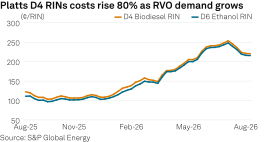
The elevated prices are incentivizing maximum domestic biofuel production, but obligated parties -- primarily refiners and blenders -- are bearing the cost.
Lucey said the RFS/RINs program is imposing approximately $14/barrel of cost on refiners, much of which is ultimately passed through to consumers at the pump.
SRE wild card
A key structural wild card remains the 34 pending Small Refinery Exemption petitions for the 2025 compliance year, for which the EPA has set no resolution timeline.
The EPA's Aug. 3, 2026, ruling on 2024 compliance year petitions granted only one full exemption and two 50% partial exemptions, covering approximately 160 million RINs, well below market expectations. D4 and D6 RINs both jumped 7.50 cents/RIN on the day, underscoring the market's sensitivity to even modest SRE relief in a tight compliance environment.
S&P Global's RIN availability analysis shows the overall Renewable Fuel Standard mandate tracking toward approximately 94% fulfillment on the conventional biofuels -- D6 -- category, while the biomass-based diesel -- D4 -- category faces material shortfall risk.
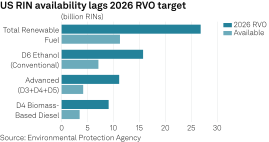
The cellulosic and total advanced categories remain well short of their mandated targets.
The compliance gap in D4 is a key commercial driver: producers with domestic feedstock supply chains are best positioned to capture elevated RIN values, while obligated parties face increasing pressure to source additional biomass-based diesel volumes or draw on banked RINs to meet obligations.
