Agriculture, Refined Products, Biofuels, Jet Fuel
September 09, 2026
APPEC: Singapore sees centralized SAF buying sharpening Asian price signals
By Mia Pei and Melvin Yeo
Editor:
HIGHLIGHTS
Fixed levy allows volumes to adjust to prices
SAFCo to combine policy-driven, voluntary demand
First levy-funded procurement tender due by end-2026
Singapore's centralized procurement of sustainable aviation fuel could help develop price signals that better reflect Asian market fundamentals, while its fixed-levy model will limit air travelers' exposure to volatile SAF prices, speakers at APPEC 2026 said Sept. 9.
SAF transactions in Asia have historically referenced pricing signals from more established overseas markets, SAFCo CEO Tan Seow Hui said in her keynote.
However, Asia is increasingly emerging as a distinct SAF market, with its own supply-demand dynamics, feedstock landscape, regulatory requirements, and logistics patterns, she noted.
Larger procurement programs such as SAFCo's, combined with wider market participation, could support "price discovery, more transparent pricing signals and greater investment confidence across the value chain," Tan said.
"Procurement is not just about securing SAF supply," she added. "It is also about creating the market foundation needed to support SAF adoption in this part of the world over the long term."
Singapore will implement its national SAF target through a fixed levy rather than a blending mandate, allowing SAFCo to procure within the budget collected instead of requiring a fixed volume regardless of market prices.
"At the current scale of the SAF market, we don't think that it makes sense to go on the mandate route," Civil Aviation Authority of Singapore Chief Sustainability Officer Daniel Ng said at a separate APPEC session. "There's just too little supply, too high price volatility, and as a small country, we wanted to shield our air transport users from this volatility."
The levy rates will remain fixed while in effect, with SAFCo maximizing the amount of SAF and associated environmental attributes it can purchase with the resulting fund.
"Simplistically, this is a 'buy what you can afford' approach," Ng said. Higher SAF prices would result in smaller purchases, while lower prices would allow SAFCo to procure more, in contrast with what Ng described as the "buy at all costs" approach under a mandate.
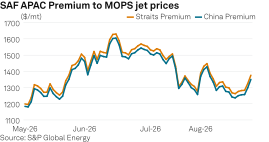
Responding to a question about substantial announced production capacity in China, Singapore, and Malaysia, Ng said that on-paper capacity did not eliminate price risk. SAF premiums remain more volatile than conventional jet fuel prices, reflecting market tightness, he noted.
Platts assessed Sustainable Aviation Fuel HEFA-SPK FOB Straits, reflecting CORSIA-certified cargoes, at $2,540/metric ton Sept. 9, unchanged day over day. The SAF FOB Straits premium was assessed at $1,247.50/mt over Platts Jet Kero FOB Singapore forward curve (MOPs), up $3/mt from Sept. 8.
Aligning with wider market
Singapore has set a 1% SAF uplift target from 2027 and aims to raise it to 3%-5% by 2030, subject to global developments and SAF availability. Ng said Singapore would align the pace of the increase with international developments and regional airline commitments, adding that the city-state remained cautious about moving too far ahead of the wider market.
The levy will apply to origin-destination passenger tickets and general and business aviation services sold from Oct. 1, 2026, for flights departing Singapore from Jan. 1, 2027.
Implementation for air cargo has been deferred by one year, covering services sold from Oct. 1, 2027, for departures from Jan. 1, 2028.
SAFCo, a nonprofit company wholly owned by CAAS, will collect the levy, aggregate demand, and procure SAF and SAF environmental attributes. It plans to issue a request for proposals for the first levy-funded procurement by the end of 2026.
The policy-driven demand will provide a "foundation" that voluntary corporate and airline buyers can access through the same infrastructure, benefitting from economies of scale without establishing separate procurement systems, Tan said.
Any additional SAF purchased voluntarily by airlines would be separate from Singapore's 1% national target, Ng noted.
Under the framework, Scope 1 environmental attributes will be allocated to eligible aircraft operators in proportion to their levy contributions. Scope 3 attributes, along with any unallocated Scope 1 attributes, can be sold to organizations seeking to reduce emissions from business travel or air freight. Proceeds from those sales will return to the SAF Fund to finance additional SAF purchases.
SAFCo completed its first voluntary procurement trial with nine partners in August, testing processes spanning demand aggregation, procurement, physical delivery, and environmental-attribute allocation.
"Voluntary demand is real," Tan said, adding that pooling purchases simplified participation and created greater scale and efficiency. The trial had given SAFCo confidence that the wider model could be expanded, she said.
"The next phase of SAF is no longer about proving the concept," Tan said. It is instead about establishing trusted infrastructure and market conditions that allow SAF demand to scale sustainably over the long term, she added.
