Refined Products, Crude Oil, Maritime & Shipping, Diesel-Gasoil, Gasoline, Jet Fuel, Wet Freight
September 09, 2026
APPEC: Asia faces high energy costs on tight tanker flow, refining capacity
HIGHLIGHTS
Disrupted routes inflate Asian crude costs
Tanker shortage drives up freight expenses
Refiners face limited alternative supply
Asia's energy costs are likely to remain elevated for some time as disruptions to tanker flows and constrained refining capacity keep supply chains under pressure, even though crude oil prices have yet to fully reflect the market's security risks, according to industry executives at the APPEC 2026 conference in Singapore Sept. 9.
The current crude price contains too little of the risk premium associated with the US-Iran conflict and disruptions around the Strait of Hormuz, according to Jeff Currie, non-executive director at Abaxx Markets, Takeshi Hashimoto, chairman of the board at Mitsui O.S.K. Lines, and Abdel Karim Alawin, vice chairman of the board of directors at Jordan Petroleum Refinery Company, during a panel discussion at APPEC, hosted by S&P Global Energy over Sept. 7-10.
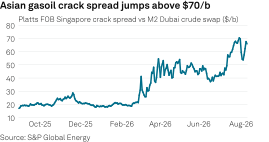
Refined products, however, are already signaling tighter conditions, with diesel prices at record or near-record levels alongside elevated gasoline and jet fuel prices, according to the executives.
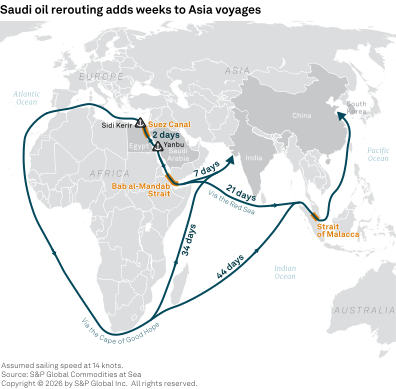
"The market is underpricing the 'security premium,'" Currie said. In addition to the Strait of Hormuz, various other transportation bottlenecks are constraining oil and product flows, including reduced ship transits through the Panama Canal due to El Niño-related drought, vessel attacks in the Bab al-Mandab Strait, and the lengthy process of delivering Arab Light crude from the port of Yanbu to Asia via the Suez Canal and Sidi Kerir in the Mediterranean before routing around the Cape of Good Hope.
The market's relatively muted response to crude risk reflects expectations that the conflict will end quickly and that a large global supply surplus — estimated by some market participants at around 4 million barrels per day next year — will eventually emerge, Currie said.
The key question, Currie added, is whether that surplus can materialize smoothly when as much as 6 million-7 million b/d of supply is currently disrupted and may not be easy to restore.
Chinese refining capacity coming back online could provide some relief, but the executives said that once this capacity is absorbed, few additional options remain.
Costly alternative crude
As far as logistics are concerned, alternative crude supplies will not provide a cheap solution for Asian buyers, according to Hashimoto and Alawin.
Flows from North America, Latin America and Africa require substantially longer voyages than Middle East shipments, increasing both freight costs and the number of tankers needed to deliver the same volume of energy, they said.
Several Asian refinery industry delegates attending APPEC echoed Hashimoto's view. On the sidelines of the conference, plant operations and logistics managers from Thailand, South Korea, Malaysia and Japan told Platts, part of S&P Global Energy, that the overall cost of procuring crude grades from the Americas and Africa — including freight, insurance and port charges — is generally higher than the cost of importing Middle Eastern crude.
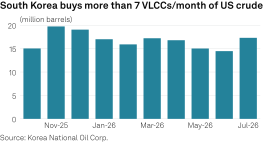
Asia's top US crude importer South Korea, for one, received 148 million barrels from the Americas in the first seven months and the average cost per barrel was $92.15 for the period, more than the average cost of $88.07/b for 348 million barrels of Middle Eastern crude imported over January-July, latest data from state-run Korea National Oil Corp. issued Aug. 27 showed.
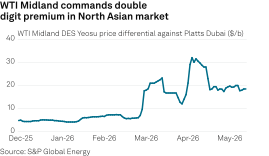
Platts assessed WTI Midland crude at an average premium of $15.09/b against Platts front-month Dubai on a DES Yeosu basis, more than a threefold jump from the 2025 average premium of $4.55/b.
Alawin said Jordan Petroleum Refinery Company had switched to Arab Extra Light crude, but shipping disruptions forced it to return to Saudi Arab Light delivered from Yanbu to Aqaba.
"Arab Light, linked to [Platts] Dubai and Oman benchmarks, had traded at a significant premium to Dubai earlier in the year, raising procurement costs," Alawin said.
Asian consumers would have to absorb higher logistics costs as buyers source more crude from distant regions. The longer routes will require additional shipping capacity, and the tanker market was already tight before the current crisis because shipowners had been cautious about ordering new vessels amid decarbonization pressures and expectations of slower long-term oil demand growth, Hashimoto said.
Potential pipelines from Iraq, Saudi Arabia or Kuwait could improve regional supply security, but such projects would take several years to finance, approve and construct. In the meantime, Asia is likely to face a costly combination of higher crude procurement expenses, longer voyages, tighter tanker availability and elevated product premiums, according to Alawin.
