Refined Products, Maritime & Shipping, Crude Oil, Naphtha, Wet Freight
September 02, 2026
Rerouting after Hormuz cuts clean tanker cargoes, yet fleet expands
By Thomas Washington and Alara Tizer
Editor:
HIGHLIGHTS
Longer routes boost voyage times over 30 days
LR2 fleet grows 13% despite clean-to-crude shift
Combined Hormuz shuttle ops jump to 7 mil b/d
Amid ongoing disruptions from the Strait of Hormuz standoff, clean tanker trade is being sustained by longer routes and shuttle operations, but with more newbuild ships on the way industry professionals are warning of a market reset.
Shuttle and ship-to-ship operations have expanded sharply to bypass risks, sustaining flows that require far more clean tonnage than before.
"While the closure of the Strait of Hormuz reduced order volumes, the loss was more than offset by longer haul movements and extensive trade rerouting. Fewer barrels moved, but they traveled significantly further," Jacob Balslev Meldgaard, CEO of Torm, said Aug. 26.
That rerouting has boosted the duration of voyages. Torm's LR1 vessel Innovation was fixed to load in Yanbu for discharge in Asia via the Bab al-Mandab Strait before security concerns forced a diversion through Suez and around the Cape of Good Hope, Meldgaard said.
"A single voyage extension of more than 30 days effectively removes a vessel from the market for an additional month. When this is replicated across the industry, the impact on effective supply becomes significant," Meldgaard said.
"This is unlikely to be a temporary market event. It looks increasingly like a structural reset," Meldgaard said. Inventory rebuilding could add "approximately 1% to 2% to global trade volumes over the next 12 months with further upside," Meldgaard said. Reopening the Strait "should not be viewed as the end of the story, but rather as the beginning of a new phase of market adjustment that can continue to support tanker demand," Meldgaard said.
If Hormuz disruptions ease in the fourth quarter, product tanker demand should be broadly flat this year, ranging from a 2% decline to no change, before rising 2.5%-4.5% in 2027, BIMCO, which represents around two-thirds of the world's shipping tonnage, said Aug. 26.
The product tanker fleet is expected to grow 13% over the same period, with LR2 ships making up more than half of the tonnage on order, BIMCO said.
The dirty-up phenomenon
Executives highlighted the impact on supply of LR2 vessels migrating from clean products to crude trading.
Nearly 100 LR2s were delivered between January 2025 and July 2026, yet the segment saw a net reduction of 71 vessels trading in the clean segment, Carlos Balestra di Mottola, CEO of D'Amico International Shipping SA said July 30.
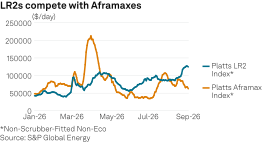
"That has tightened the product tanker market for all the other segments, and we have benefited from that. That has happened, of course, because the Aframax market has been extremely strong and has outperformed and is still outperforming the LR2 clean market," di Mottola said.
Sanctions are compounding the tightening. Nearly 20% of the overall tanker fleet in deadweight tonnage terms has been sanctioned, di Mottola said, adding that ageing is a parallel constraint, with 22% of the MR and LR1 fleet now above 20 years old, rising to around 25% by the end of 2027.
However, LR2 deliveries have accelerated while the fleet continues to compete for long-haul middle distillate and naphtha movements, Fotios Katsoulas, a shipping analyst at S&P Global Energy, said Sept. 2. Increased availability has reduced owners' negotiating leverage and created a more competitive chartering environment than seen during the disruption-driven peak periods, he said.
The Platts clean tanker index, for non-scrubber-fitted, non-eco vessels, was at $124,640/day Sept. 1, up 95% from the start of the year. Platts is part of S&P Global Energy. The Platts Aframax index for equivalent vessels was at $62,497/day, up 30% from the start of the year, indicating less incentive at present for clean tankers to migrate to the crude trade.
Inefficiencies, lower volumes
Shuttle and ship-to-ship operations have expanded sharply as a workaround. Volumes moving via shuttle trade have risen to roughly 6 million b/d of crude and 1 million b/d of clean products, up from about 1 million b/d combined previously, Meldgaard said, adding that sustaining such flows could require "close to 50 LR2s" versus roughly 15 previously.
The key driver remains the structure of global trade rather than outright product demand growth, Katsoulas said. Middle East refining capacity additions continue to support export volumes, while Asian import requirements remain robust enough to sustain long-haul movements, he said.
Amid this, there are strong refining margins driven partly by reduced Persian Gulf refined volumes and Russian export curtailments following Ukrainian strikes on refineries, Balestra di Mottola said.
The Platts Northwest Europe cracking Forties margin was $54.7/b Sept. 1, a multi-year high and above a five-year average of $12.61/b.
China's crude import cuts of "around 5 million to 6 million b/d" since the war began have cushioned the broader market impact, Balestra di Mottola said.
"Volumes available to be transported are much lower than they were previously," with inefficiencies and longer distances only partially compensating, Balestra di Mottola said.
