Maritime & Shipping, Crude Oil, Wet Freight, Dry Freight, Containers
July 22, 2026
Middle East shipping insurance costs rise on Hormuz risks: Marsh
By Thomas Washington and Max Lin
Editor:
HIGHLIGHTS
Strait of Hormuz rates hit 7.5%-10% of hull value
Less appetite for underwriters to offer spot coverage
Red Sea premiums rise on Houthi threats
Marine insurance premiums for ships transiting the Strait of Hormuz have surged as attacks on tankers intensify, with underwriters growing increasingly reluctant to provide coverage, while the Red Sea situation remains nuanced, according to a senior manager at insurance brokerage Marsh.
The sharp increase in war risk insurance costs threatens to further disrupt crude flows from the Persian Gulf, where recent strikes on multiple tankers have prompted some shipping companies to halt operations through the strait.
Additional war risk premiums in the region have jumped from 1%-3% of hull value weeks ago to 7.5%-10% currently, Marcus Baker, global head of marine, cargo and logistics at Marsh, told Platts, part of S&P Global Energy, July 22.
"I think the more of this we start to see, there is a danger that the market starts to just pull their horns in quite a bit in terms of actually offering cover," Baker said.
The senior broker said the insurance market's capacity to absorb risk remains substantial, with global hull coverage capacity estimated at $2.5 billion-$3 billion. Most vessels trading through the Strait of Hormuz are valued at less than $100 million, meaning coverage could theoretically be placed 25 times over. However, underwriters are increasingly reluctant to offer spot terms, despite war risk historically being profitable for insurers, Baker said.
The escalating insurance costs come as Iran has intensified attacks on commercial ships passing Hormuz via Omani waters. The UN's International Maritime Organization recorded eight ships hit during July 13-20.
The heightened risk has created a two-tier market, with more risk-averse tanker operators hovering outside the strait while others attempt shuttle runs through the waterway.
"The fewer ships that go through, of course, that means there are fewer targets, but maybe a concentration of opportunity for the Iranians," Baker said.
There were 10 transits through the Strait of Hormuz on July 21, down from 16 on July 20, according to data from S&P Global Commodities at Sea. This highlights the limited level of commercial activity in the waterway, which handled 20% of global oil and LNG seaborne flows and saw over 130 daily transits before the Middle East war broke out Feb. 28.
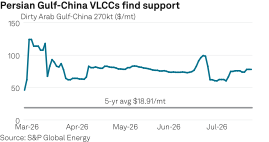
Platts assessed the rate to carry a 270,000 metric ton cargo of crude from the Persian Gulf to China at $77.96/mt July 22, stable since July 20, when it had edged up from $73.80/mt at the previous assessment.
The immediacy of news and vessel-tracking technology has enabled insurance rates to adjust with unprecedented speed and frequency, Baker said, comparing current market conditions to the Iran-Iraq war of the 1980s, when Lloyd's of London opened on Saturday mornings to handle the volume of business.
Red Sea caution
In the Red Sea, risk premiums and perceptions of risk have risen, though not to a great extent, as Houthi threats have not always led to action, Baker said.
Premiums for vessels transiting the Bab al-Mandab Strait currently stand at 0.5% of hull value, according to Baker. Reuters reported the premium level at 0.3% before the Yemen-based militants declared a maritime embargo on Saudi shipping July 20. Premiums are 0.1% for ships calling at West Coast Saudi Arabia without requiring passage through the chokepoint, Baker said.
"The Bab al-Mandab escalation that we've seen over the last two days has certainly put the insurance market in a slightly more concerned space," Baker said. "Whether the Houthis actually end up doing anything, I think we just have to wait and see."
Bab al-Mandab transit activity fell sharply July 21, with total crossings dropping to 29 vessels from 41 on July 20, a decline of nearly 30%, CAS data showed. The downturn was led by tanker traffic, which fell to seven crossings from 16 the previous day, according to CAS. Security consultancy Vanguard TECH said July 22 that five tankers and one car carrier have been diverted from Bab al-Mandab since the Houthi announcement.
The Red Sea situation is complicated by a resurgence in piracy activity that appears unrelated to the Houthi threat, Baker said. An Asana chemical tanker was boarded July 7, with another vessel boarded July 21, suggesting opportunistic attacks are increasing in the region.
Once ships started avoiding the Red Sea in large numbers in December 2023, the perceived Houthi threat has had relatively limited impact on traffic through the Bab al-Mandab Strait: "The intensity and frequency of Houthi attacks appeared to have little bearing on the volume of maritime transits, which [have] only fluctuated slightly," Luca Nevola, senior analyst for Yemen and the Gulf at conflict monitoring group ACLED, said in a research note in June.
Houthi threats to impose a blockade on Saudi exports via the Red Sea are "overstated," analysts at HSBC Global Investment Research said July 22. Even if the Bab al-Mandab became at risk, believe the route north via the Suez Canal and the SUMED corridor, which have spare capacity, is a workable alternative.
"The trade-off would be longer sailing times to Asia and a greater reliance on ship-to-ship transfers and smaller vessels, pushing up freight costs," HSBC said.
