Natural Gas, Chemicals, Crude Oil
August 31, 2026
US-Venezuela pact seeks 1.5 million b/d of oil output: Rodriguez
By Eamonn Brennan and Mery Mogollon
Editor:
HIGHLIGHTS
Agreement spans 17 fields over 25 years
US secures 55% stake in new joint venture
Venezuelan Interim President Delcy Rodriguez said Aug. 29 that a newly signed binational oil agreement with the US targets production of more than 1.5 million b/d from 17 strategic fields over a 25-year term.
Rodriguez, speaking in a televised statement, said the accord would generate more than $100 billion in investment and $209 billion in tax revenue for the Venezuelan state, doubling down on figures she first outlined in an Aug. 29 statement posted on X.
She explained that taking a price of $65 per barrel as a reference — which could be higher or lower — Venezuela's revenue would total $209.335 billion. "In concrete terms, this means that for every barrel produced and sold, nearly $19 goes directly to our country," Rodriguez said.
Eight fields are located in the Maracaibo Basin, and nine fields are in eastern Venezuela, in the Orinoco oil belt.
Trump announced the agreement Aug. 28 on his Truth Social media platform, saying it gives Washington majority control over more than 65 billion barrels of proven Venezuelan reserves and was struck "at my direction" by Secretary of State Marco Rubio and Secretary of War Pete Hegseth, working with Rodriguez "through a partnership with private business" and "at no cost to the American Taxpayer."
According to a US official, the deal "will secure the United States 55% effective output of a new private joint venture that will be the second-largest private oil company by reserves in the world, split between holding company equity and at-cost off-take for the US government."
The private company will be a "joint project of the US government and an experienced private operator in Venezuela," the official said. "This new entity will be the second largest corporate holder of proven reserves after Saudi Aramco."
No details were provided on the private operator in Venezuela. According to media reports, North American Blue Energy Partners (NABEP) could be a candidate. The company, headed by Alejandro Betancourt, already operates in Venezuela.
NABEP could not be reached for comment.
Oil production from the company will "go toward filling the US strategic petroleum reserve and fulfilling the supply needs of our Great US Military," the official said.
Deal terms
Rodriguez said the agreement rests on a division of labor: "Venezuela contributes oil, its industry, and the expertise of its workers accumulated over more than a century. The United States contributes the capital and technology needed to recover and develop those assets."
She said the project includes eight new greenfield blocks in the Orinoco Oil Belt carrying minimum royalties of 16% and a 34% income tax, a sharper fiscal term than the 1% royalty and 34% tax applied three decades ago when Venezuela last opened four greenfield Orinoco blocks to foreign partners during an earlier liberalization drive.
Rodriguez said Caracas' ambitions extend beyond the binational framework, citing separate negotiations involving Chevron, Repsol, Eni, Shell and BP as part of a broader push to become "an energy powerhouse, a major oil producer, a significant natural gas exporter and a leader in national petrochemical development."
Venezuela's oil production has risen to 1.21 million barrels/day in July, driven primarily by Chevron joint ventures with PDVSA.
Chevron is close to signing a deal this week in Caracas with the Venezuelan government that will cover multiple aspects, including production increase, a source familiar with the deal told Platts Aug. 31.
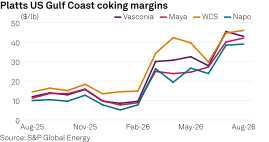
Venezuelan crude exports have increasingly been redirected toward US refiners. US Gulf Coast refiners are able to process the heavy Venezuelan crude, and are currently seeing elevated margins.
Additional Venezuelan heavy barrels would compete with crudes such as Western Canadian Select, which is also exported to USGC refiners.
Financing, political questions
The reported ownership structure has drawn scrutiny from legal experts, who said it raises unresolved questions about its basis under Venezuela's constitution and hydrocarbons law.
Analysts at ClearView Energy Partners said the agreement's structure remains unclear and outlined three possible investment models that Washington could pursue.
"Among our many unanswered questions, we are left to wonder at the structure of the deal Trump announced tonight," ClearView Energy Partners analysts said in a report. "At a high level, we can envision three modes of investment: (1) passive U.S. ownership stake in a new joint venture with one or several operators organized to manage and develop the fields in question; (2) a U.S. stake (also passive) in one or several existing operators developing resources in Venezuela; or (3) active U.S. investment in Venezuela, potentially orchestrated by a new federal entity."
Each of those scenarios "could come with a price tag in the double-digit billions of dollars," the analysts said.
Unless a new joint venture or existing operators agree to grant equity to the US government at no cost, the White House would need to secure substantial funding, according to the analysts.
"At risk of understatement, we see little room for bipartisan agreement to this end in an annual appropriations bill," the ClearView analysts said, pointing to Democrats' rejection of a first Trump administration proposal during the 2020 oil price decline to purchase wells from at-risk domestic operators as an addition to the Strategic Petroleum Reserve as precedent.
Political uncertainties
Political and logistical uncertainties in Venezuela could also loom over the arrangement, Jason Marczak, vice president and senior director of the Atlantic Council's Adrienne Arsht Latin America Center, told Platts.
"Given the fact that there's probably going to be an election in Venezuela next year, will all of these deals that were inked in this interim period be respected?" he said. "I would assume, because these are deals with the United States, and US backing is going to be absolutely critical to not only the electoral process but to the winner of that electoral process. But there are a lot of unanswered questions."
A future non-interim government in Caracas would have to provide "clarity" on the deals negotiated under Rodriguez, he said, and whether deals struck under interim authorities were constitutionally viable.
Meanwhile, with many US companies citing a need for long-term political and judicial stability in Venezuela, Marczak said the timing of the announcement was "meant to accelerate more US investment in Venezuela's oil sector" before a political transition.
"The key is showing US business the long-term commitment of the US government," he said. "These wells don't come on overnight. It takes years and significant investment — and this is the first announcement of something in Venezuela that is very long term and that the US is committed to."
