Refined Products, Crude Oil, NGLs, Diesel-Gasoil, Naphtha
August 28, 2026
Legal questions cloud reported US stake in Venezuela oil fields
Editor:
HIGHLIGHTS
Venezuela crude exports to US near 520,000 b/d in August
CERA cites 364 billion barrel reserves, diluent bottlenecks
Constitution bars ceding reserves, scholar cites referendum need
Reports that the Trump administration is exploring an ownership stake in Venezuela's oil resources have raised questions among legal experts about whether such an arrangement is permissible under Venezuelan law.
Axios reported Aug. 27, citing unnamed US officials, that discussions are underway over a possible ownership structure covering Venezuelan oil fields.
"There is talk of creating a new US-Venezuelan company, but that's all we know so far; it's an issue being handled on a government-to-government basis," a PDVSA official, who spoke on condition of anonymity, told Platts Aug. 28.
The White House and State Department could not be reached for comment Aug. 28.
Venezuela holds close to 364 billion barrels of oil equivalent in reserves, according to S&P Global Energy CERA, among the largest crude endowments of any country.
Legislation signed by Venezuelan President Delcy Rodriguez in July "should provide a consistent operational, financial and legal framework, replacing outdated regulations, and open the room for private investment in Venezuela assets with ownership up to 100%, without the mandate of having PDVSA or a Venezuela government entity as a partner," CERA analysts said in a report.
Venezuela's reopening to international oil investment is beginning to draw experienced executives back to the country. Most recently, Gustavo Baquero, managing director of Harbour Energy Mexico, said Aug. 26 he will leave the company in November to dedicate himself "100% to the reconstruction of Venezuela's energy sector."
"Time to rebuild where it started — Venezuela!" said Baquero, a veteran of ExxonMobil, Repsol, BP and Equinor, in a LinkedIn post.
Baquero did not disclose his next position, but called to connect with operators, investors, service companies, multilaterals and Venezuelan talent at home and abroad.
Baquero could not be reached for comment.
Venezuela's oil production has risen to 1.21 million barrels/day in July, driven primarily by Chevron joint ventures with PDVSA.
According to a Wall Street Journal report on Aug. 28, Chevron is expected to expand its operations in Venezuela. Chevron would not comment on the story.
Flows shift
News of the potential deal comes as Venezuelan crude exports have increasingly been redirected toward US refiners. So far in August, roughly 520,000 b/d of Venezuelan crude has been exported to the US out of total exports of 1.1 million b/d, according to S&P Global Commodities at Sea data. That compares with 728,000 b/d in July and just 123,000 b/d in December. China, once the single largest buyer of Venezuelan crude, has not taken any barrels since December 2025, the data showed.
Refining margins for heavy crudes on the US Gulf Coast have soared, driven largely by strength in diesel prices.
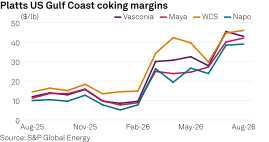
The shift underscores the stakes of any arrangement that formalizes US access to Venezuelan barrels, even as upstream bottlenecks persist.
CERA analysts said giant fields in the Orinoco Oil Belt's Boyaca and Junin blocks face "persistent obstacles due to limited accessibility, infrastructure deficiencies, and lack of basic services," and that a shortage of diluents such as naphtha, condensate or medium crude needed to move ultra-heavy crude "has directly impacted production continuity and efficiency" across the region.
Venezuela is ramping up imports of US light crude and naphtha to blend with its extra-heavy oil as it seeks to restore production.
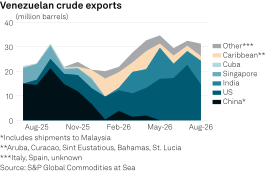
Legal risk
Legal experts said the reported structure — variously described as a new joint venture or a long-term lease — raises unresolved questions about its basis under Venezuela's constitution and hydrocarbons law.
"One is whether there is a constitutional and legal basis for a lease under the Venezuelan Constitution and its new hydrocarbons law," said David Goldwyn, chair of the Atlantic Council Global Energy Center's Energy Advisory Group.
Goldwyn said there is "no precedent for having the US government enter into a lease to operate oil fields," and questioned whether interposing Washington between private operators and Caracas would even achieve the intended legal protection.
Goldwyn also questioned the commercial logic.
"If the US government has the leverage to secure a concession for operating numerous oil fields under favorable terms, why wouldn't it just use this leverage to oblige the Venezuelan government to produce a competitive fiscal framework and let them auction the fields off like other countries?" he said, adding that large operators would be reluctant to commit to a single buyer "without knowing future market conditions."
Dolores Dobarro, professor of hydrocarbons law at the Universidad Metropolitana in Caracas and a former deputy minister of mines, said Venezuela's constitution designates hydrocarbon and mineral reserves as "inalienable and imprescriptible" public assets that cannot be pledged, leased or ceded to foreign states, even temporarily.
"Pledging reserves in the field is not possible, as it would violate the National Constitution and current laws," Dobarro said, adding that amending the constitution to permit such a change would require an approval referendum.
Dobarro said the terminology in the Axios report needed clarification.
"We'd have to see what they understood and whether the source is correctly cited, because as far as I know, what we have so far are quite a number of negotiations with US companies, but it's important to note that these companies are private — the US government does not own any companies," she said.
Rachel Ziemba, a senior adviser at Horizon Engage, said any US stake in Venezuelan acreage could introduce new political risk for investors.
"They raise a question on what the state take will be and of course expose investors to political cycles in both the US and Venezuela," Ziemba said. "They also raise questions about what the role of non-US companies will be in Venezuela and how much advantage US companies will have."
