Refined Products, Crude Oil, Agriculture, Gasoline, Diesel-Gasoil, Biofuels
August 26, 2026
US has few options to boost refining amid global diesel shortage: analysts

Editor:
HIGHLIGHTS
High US refinery rates, overseas loss limits policy options
Short-term actions seen as incremental
Export bans not likely
Despite US Energy Secretary Chris Wright's suggestion that Washington could enact policies to help domestic refiners raise output, US plants reaching peak capacity and short supply overseas have left the federal government with few levers to meaningfully expand domestic production quickly, analysts said.
Wright, during comments at an Aug. 17 event in Midland, floated federal action without detailing specific measures, even as he acknowledged that US refinery utilization is already elevated and pointed to idled capacity in the Middle East as part of the problem.
Diesel cracks have reached record highs, and US refineries are running at near-full capacity amid peak summer driving demand and unusually strong margins.
The US Gulf Coast diesel crack against WTI was at $91.06/b on Aug. 25, up from $30/b on Aug. 25, 2025, Platts data shows. Platts is a unit of S&P Global Energy. Global prices have rallied on constrained flows out of the Middle East as well as Russia.
Gasoline prices have also risen, with the NYMEX front-month RBOB crack against WTI at $40.43/b on Aug. 25, up from $16.40/b on Aug. 25, 2025.
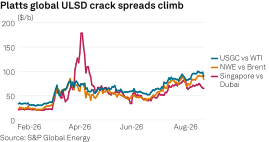
The central constraint is that the shortage is global, not domestic, analysts told Platts, leaving the US government with minimal internal policy recourse.
"This is a global problem," ClearView Energy Partners head of research Kevin Book said. "There's no US-only solution to this."
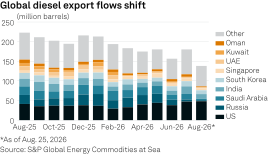
Somewhere between 2 million and 3 million b/d of products are missing from global supplies, Book noted, with the International Energy Agency estimating 4.7 million b/d in lost throughput versus 2025. For the week ended Aug. 21, US refineries ran at 97.4% of capacity, the highest in nearly eight years, even as ULSD stocks tightened.
"It's not like the United States refinery fleet has an extra 4.7 million b/d of excess capacity available to ramp up," Book said.
Domestic actions, dwindling options
On Aug. 20, the US Environmental Protection Agency issued a gasoline blending waiver that allowed US refiners to blend winter-grade gasoline two weeks early -- beginning Sept. 1, rather than Sept. 15. In a press release, the EPA claimed the policy would allow an increase of "hundreds of thousands of barrels per day."
That waiver could also allow refiners more time and flexibility to run down summer gasoline volumes, William O'Neil, principal analyst for Atlantic Basin and Eurasia Fuels & Refining at S&P Global Energy CERA, said. But a combination of logistical and political considerations has reduced the remaining options.
"US refinery utilization is already near operational maximum levels and has been for several months," O'Neil said. "Outside of directly paying refiners to delay September-November turnarounds, which would be costly and potentially politically difficult, there's really not much available."
Other potential domestic actions have largely already been taken.
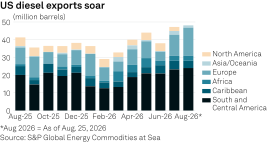
The Trump administration announced its first round of Jones Act waivers -- suspending requirements that any goods shipped by water between two US ports be carried on ships that are US-built, US-owned, US-flagged and US-crewed -- on March 17. Those waivers have led to over 200 foreign-flagged crude and refined products shipments from the US Gulf Coast to the Atlantic and West Coasts, though the price impacts have been difficult to isolate, O'Neil said.
The administration has said it is actively tracking shipments and continues to believe the waivers are driving an increase in domestic fuel deliveries.
A permissive approach to upcoming small refinery exemptions for biofuels blending could be another path to reduced retail fuel costs, alongside changes to the EPA's 2026 Renewable Volume Obligations. On Aug. 26, US diesel and gasoline prices fell with RINs as refiners weighed a potential EPA decision to relax blending mandates and grant wider exemptions to smaller refiners.
Less incremental policies would be slower to implement. In a statement to Platts, Keith Petka, director of downstream for the American Petroleum Institute, proposed regulatory reforms to EPA's "Begin Actual Construction" requirements and Risk Management Program, which "could help streamline new energy infrastructure while providing additional flexibility and regulatory certainty."
Spokespeople for EPA and the Department of Energy did not respond to requests for comment.
Book and Mark Finley, a fellow at Rice University's Baker Institute, both noted an April presidential memorandum proposing financing for refinery and logistics investment, a mechanism to fund expansions rather than compel output. Finley pointed to further fuel-specification flexibility, coordination with states on gasoline formulations, and the use of drag-reducing agents in product pipelines, such as Colonial, as short-term potential measures, while restarting mothballed plants or permitting new capacity would take years.
Book cautioned against reading a short-term crisis as a case for large capacity additions.
"There's a shortage in the world, but not necessarily in the Atlantic Basin, which has been rationalizing to deal with overcapacity," Book said. "If you're losing refineries in one part of the world, adding them in another isn't necessarily a solution. It's a precarious time to be talking about very significant expansions."
"Whatever conversation is taking place, you want to be careful not to undercut the long-term viability of the sector because of short-term price pressures," he added.
Global approach
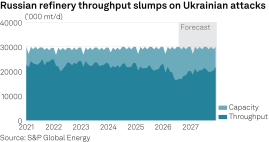
Missing global capacity traces largely to Ukrainian drone strikes on Russian refineries — compounded by US sanctions dating to the Biden administration — and to reduced Persian Gulf operations following disruption at the Strait of Hormuz. Finley said the US's most powerful fix lies abroad.
"Moves that really open up the Strait of Hormuz would not only improve the availability of crude oil and lower crude prices, but the Gulf has been a significant exporter of refined products as well," Finley said. "Returning to normal operations of flows coming out of those countries would significantly impact the global marketplace — as long as refineries in the region haven't been significantly damaged."
For now, Finley said, the clearest path is diplomatic: pressing other countries to defer maintenance and lift run rates, since refineries outside the US, Russia and the Middle East are largely operating well below American levels.
For domestic producers, restricting exports to other countries -- floated in past crises -- remains unlikely. API and other industry groups have routinely decried the idea, while the administration has denied any plan to restrict crude or fuel exports.
O'Neil said an export ban would be "at the extreme/unlikely end" of the policy spectrum. Finley said a ban on products would depress refining economics without clearly freeing up supplies.
"Still, we do know in times of crisis, previous administrations, both Democratic and Republican, they're going to talk about whether to reimpose those bans," Finley said. "Given the political and economic consequences of spiking prices at the pump, it's easy to see how things that might be unattractive to the industry could look politically popular."
