Crude Oil, Maritime & Shipping, Refined Products, Wet Freight
August 05, 2026
FACTBOX: After Hormuz, Bab al-Mandab disruptions deepen concerns for India, China
Editor:
HIGHLIGHTS
Asian oil importers face dual maritime choke point risks
South Korea, Japan less exposed than India, China
Indian and Chinese oil importers are facing unprecedented supply chain vulnerabilities, as concurrent disruptions in both the Strait of Hormuz and the Bab al-Mandab Strait compel refiners to reassess procurement strategies and accommodate increased costs.
Although both Asian countries have secured near-term supplies, the simultaneous risks at two key maritime choke points threaten to substantially increase freight costs, compress refinery margins and tighten global refined product markets in the fourth quarter.
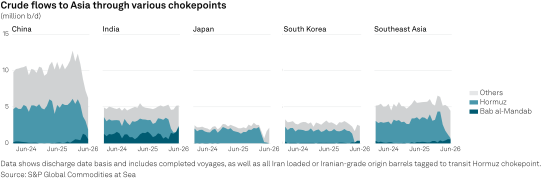
The Bab al-Mandab Strait, which connects the Red Sea to the Gulf of Aden, mainly facilitates crude flows from Middle Eastern producers destined for Asia and Europe. For India and China, the Bab al-Mandab Strait serves as a secondary route that has gained importance amid disruptions in the Strait of Hormuz, especially for crude originating from Saudi Arabia's western terminals, as well as Persian Gulf parcels transported via the East-West pipeline to Yanbu.
Northeast Asian importers such as Japan and South Korea are also exposed to disruptions in the Red Sea, but to comparatively smaller volumes than India and China, as they primarily source crude from the Middle East's Gulf terminals, which ship eastward through the Strait of Hormuz without transiting the Bab al-Mandab Strait.
Trade flows
- China's crude imports from the Middle East, including Iran, averaged 4.47 million barrels/day in the first six months, according to customs data. The volume dropped 29% year over year from 6.27 million b/d during the same period in 2025, while market share fell to 44.6% from 55.4%.
- Chinese independent refiners returned to the Iranian crude market in late July as discounts widened to $4-$5/b versus Brent for September-delivery cargoes, following the revocation of the 60-day waiver on Iranian oil sales.
- According to S&P Global Commodities at Sea, about 98.4 million barrels of Iranian crude were on water as of July 28, down from 115.4 million barrels a month earlier, with only 32.2 million barrels expected to be delivered to China.
- In late July, Chinese independent refiners were reported to be reselling regular Middle Eastern cargoes, including Upper Zakum, Basrah Medium, Oman and Al Shaheen, while replacing them with cheaper Iranian barrels, according to trade and refinery sources.
- Russian ESPO prices for September delivery rose to 50 cents-$1/b over ICE Brent on a DES Shandong basis, up from a $4/b discount in mid-July for August cargoes, trade and refinery sources in Shandong said.
- India imported crude from more than 40 countries in the first half of 2026, according to government sources. Russia remained the top supplier at 1.82 million b/d, CAS data showed.
- Total Indian crude imports declined to 5.02 million b/d in H1 2026 from 5.04 million b/d in H1 2025, according to CAS, reflecting geopolitical tensions and logistical uncertainties.
- Indian imports from the UAE and Brazil rose significantly in H1 2026, while purchases from Iraq and the US dropped sharply as refiners diversified away from traditional suppliers, CAS data showed.
- India and China have the option to increase imports from Russia, West Africa, including Nigeria and Angola, and Latin America, including Brazil, though these alternatives entail longer transit times and higher costs, according to refining sources and analysts.
- China can partially diversify its crude imports through Russia's ESPO pipeline and the Kazakhstan-China pipeline, though the volumes are limited relative to seaborne flows through major maritime choke points, refining sources said.
Prices
- Heightened risks in the Bab al-Mandab Strait have prompted some crude cargoes bound for the Far East to divert via the Cape of Good Hope, adding time and cost to voyages. Freight rates for a VLCC on the route have risen to about $20 million per voyage, nearly matching US Gulf Coast-to-Far East shipping costs, according to estimates from brokers.
- Platts, part of S&P Global Energy, assessed the VLCC freight rate for the Yanbu-Far East route at w290 on Aug. 4, up from w165 on July 20.
- Red Sea-to-Japan clean tanker freight rates have also risen. Platts assessed the route at w450 on Aug. 4, more than double its level a month earlier.
- VLCC freight rates for the 270,000 mt Yanbu-to-Far East route via the Bab al-Mandab Strait rose 83.6% week over week to $66.87/mt on July 28, Platts data showed.
- A VLCC was tentatively fixed with a Cape of Good Hope routing option at about $76/mt on July 28, nearly matching the $73.70/mt freight cost for US Gulf Coast-China shipments and altering the economics of crude flows to Asia, according to market sources.
- West African crude has emerged as a beneficiary, as Platts assessed the VLCC freight rate from West Africa to the Far East at $51.76/mt on July 28.
Infrastructure
- Maritime traffic through both critical choke points has declined sharply, while alternative routes add significant time and cost to crude deliveries.
- The Bab al-Mandab Strait that leads into the Red Sea had only 21 ship crossings on Aug. 3, down from 36 ships the day before, while 15 ships crossed the Strait of Hormuz, compared with 19 ships the day before, CAS said in an Aug. 4 report.
- Bab al-Mandab Strait traffic was the lowest since June 1, with only three ships linked to Saudi Arabia, CAS said. On July 20, Yemen's Iran-backed Houthis declared a maritime embargo and blockade on all Saudi-linked ships attempting to cross the Bab al-Mandab Strait, Saudi Arabia's key gateway for Yanbu crude liftings.
- Several Cosco-managed and China Merchants VLCCs carrying Yanbu-loaded Saudi crude successfully crossed the Bab al-Mandab southbound July 23-26, according to CAS. However, the operators have not committed additional ships to the route despite the successful passages, CAS data showed.
- Insurance industry participants said some underwriters suspended war-risk cargo cover for Saudi-linked ships in the Red Sea amid uncertain security conditions, leading to low maritime traffic through the Bab al-Mandab Strait.
- India has fewer direct pipeline alternatives compared with China and is therefore more dependent on diversifying its supplier base through longer maritime routes around the Cape of Good Hope, which could result in increased voyage times and costs, according to refining sources.
