Maritime & Shipping, Crude Oil, LNG
July 24, 2026
Singapore says SE Asia must brace for prolonged Middle East instability, jolted energy markets

By Mia Pei
Editor:
HIGHLIGHTS
Broader geopolitical rivalry to persist: official
Singapore prioritizes maritime law
ASEAN cooperation key to resilience
Southeast Asia should prepare for a prolonged period of geopolitical instability in the Middle East that could periodically disrupt energy supplies, shipping and trade, rather than expecting a quick resolution to the conflict in the region, Singapore's Ambassador-at-Large of the Ministry of Foreign Affairs Ong Keng Yong said on July 23.
The remarks come as energy markets continue to be jolted by renewed risks to shipping in the Strait of Hormuz and potential threats to Saudi Arabia's operations in the Red Sea.
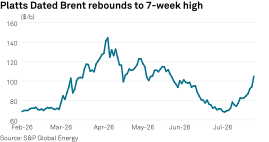
Platts Dated Brent benchmark rose to $104.92/b on July 23, up 11.4% day over day. Platts cash Dubai, the Asian-facing medium sour crude benchmark, was also sharply higher on July 23, with its differential up $6.95/b day over day at a $13.17/b premium against Dubai futures July 22, a near two-month high; on an outright basis, the marker rose $7.78/b to $97.19/b over the same period.
Speaking at the OCBC Global Markets Economic Forum, Ong, who is also Singapore's Non-Resident Ambassador to Iran, said governments and businesses in the region needed to adjust to the prospect of recurring disruptions across the region's energy supply chains and maritime trade routes as tensions between Iran, Israel, and the US are unlikely to be resolved quickly.
"I don't think we're going to find a settlement very soon," Ong said, noting that while ceasefires and diplomatic announcements may occur periodically, the broader geopolitical rivalry is likely to persist.
"People have to get used to the idea that there could be disruption" affecting energy supplies, fertilizers and travel, he said.
The ICE September Brent futures contract climbed $6.62/barrel, or 7%, to settle at $100.69/b July 23, the highest since May 22; the front-month NYMEX September WTI contract settled up $5.36/b, or 6.2%, at $92.19/b, the highest since June 4.
Oil economics
Beyond crude oil, Ong said the conflict also poses risks to natural gas markets, noting that many Southeast Asian economies have increasingly incorporated natural gas into their long-term energy strategies.
"The economics of oil," as well as other hydrocarbons such as natural gas, are becoming increasingly important, he said, adding that many countries in Southeast Asia have developed national energy plans based on gas supplies.
S&P Global Energy's AltView analyst noted that higher freight rates, insurance costs, on top of significant crude premiums, have continued to weigh on refinery economics in Asia. Runs in June remained under pressure in South Korea (down 433,000 b/d year over year), and China (down 2.68 million b/d year over year).
Shipping law
Ong said Singapore's foremost concern extends beyond oil prices to the preservation of international maritime law governing strategic waterways.
The key question is whether developments in the Middle East further undermine international legal principles governing navigation through major maritime chokepoints, such as the Strait of Malacca and Singapore.
"This waterway is vitally important for us in Singapore as well as to Malaysia and Indonesia," he said.
About one-third of global seaborne oil trade passes through the Strait of Malacca and Singapore, with about 100,000 ships transiting the route each year, Singapore had emphasized.
Ong highlighted that upholding international law on the freedom of navigation is Singapore's "first overriding interest."
Asked whether ASEAN could remain cohesive amid rising geopolitical tensions, Ong acknowledged that the bloc's integration remains gradual as member states differ over how quickly common objectives could be pursued. "Over time, with more meetings and interactions, we can work things out," he said.
ASEAN has also been strengthening its energy security architecture. Member States are working to ratify the renewed ASEAN Petroleum Security Agreement, which aims to establish coordinated energy emergency responses and voluntary joint stockpiling systems. However, experts warned that such joint energy resilience measures face implementation challenges.
