Maritime & Shipping, Crude Oil, Wet Freight
July 23, 2026
Oil tops $100/b after Houthis attack two Saudi tankers in Red Sea
Editor:
HIGHLIGHTS
Encelia fire confirmed, crew safe, says SPA
Iran tells Houthis to prepare route closure
Bahri's Layla oil tanker also said to be attacked
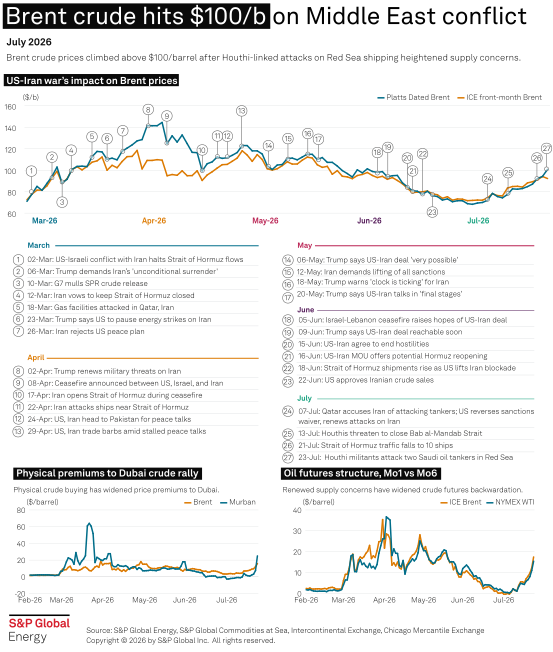
Oil prices extended gains to above $100/barrel on July 23 as the first Houthi-linked attacks on Red Sea shipping in a year heightened concerns about how crude supplies will be delivered, with the Strait of Hormuz already nearly shuttered and the Bab al-Mandab Strait to the Red Sea now at risk.
The ICE September Brent futures contract climbed $6.62/b (7%) to settle at $100.69/b July 23, the highest since May 22. Meanwhile, the front-month NYMEX September WTI contract settled up $5.36/barrel (6.2%) at $92.19/b, the highest since June 4.
The Yemeni Armed Forces attacked the Saudi-flagged crude oil tanker Layla as well as the products tanker Encelia in the Red Sea for allegedly violating a maritime embargo imposed on Saudi shipping, the Iran-backed Houthi militants said in a statement on their website July 23.
Saudi Arabia has diverted crude shipments through the East-West pipeline to the Red Sea to avoid risks presented by ship attacks in the Strait of Hormuz between Iran and Oman.
Middle East crude price differentials sharply widened. Platts, part of S&P Global Energy, assessed the prompt Brent-Dubai spread at $15.80/b at the London Platts Market on Close assessment process, up 31.12% on the day. The premium for Murban crude versus Dubai surged $17.58/b to $24.98/b -- the highest since April 7.
Crude and refined product flows completing Bab al-Mandab Strait transits averaged 2.6 million barrels/day over July 1-20, according to S&P Global Commodities at Sea data, down from 5.5 million b/d in June, when more than 3 million b/d was bound for Asia. At least five tankers departing Yanbu and initially sailing south toward the Bab al-Mandab Strait have since altered course.
Concerns surrounding prompt supply were reflected in a sharp widening of backwardation along crude oil forward curves. The sixth-month ICE Brent contract settled at a $17.48/b premium to the front-month on July 23, opening the widest backwardation since May 18. The same spread for NYMEX WTI surged to $15.47/b, the widest since May 20.
Physical markets rally
The Dated Brent benchmark crude was assessed by Platts at a seven-week high of $104.92/b on July 23, up $10.755/b on the day.
September cash Dubai was assessed July 23 at $97.19/b, up $7.78/b (8.7%) on the day.
"The market is trying to gauge the physical market, given we are now in a two-headed disruption with [Strait of Hormuz] and Red Sea. Opening this new front is difficult to gauge where prices could go on the high side," Bannockburn Capital Markets Managing Director, Commodities, Darrell Fletcher said.
Sour crude prices also rallied on the day amid uncertainty surrounding forward supply. Norway's Johan Sverdrup values surged to a $5.01/b premium over the North Sea Dated Brent strip on an FOB Mongstad basis July 23, up $2.905/b on the day.
Ship fire
The attack on the Encelia was confirmed by the official Saudi Press Agency on July 23, citing an official source at the Public Transport Authority. The official source said the ship was attacked in the Red Sea, resulting in a fire at the ship's bow. The crew is safe, and steps have been taken to protect the marine environment, it said.
The attacks are the first connected to the Houthis since July 2025.
US President Donald Trump said on his social media site, Truth Social, on July 22 that any time Iran shoots at a ship in the Strait of Hormuz, the US would bomb one bridge or power plant. Ship traffic through Hormuz has tumbled since Trump declared the ceasefire with Iran to be over on July 8. Traffic through the Bab al-Mandab Strait has now also declined after the Houthis threatened to attack Saudi ships in the Red Sea on July 20.
The Strait of Hormuz counted 20 ship crossings on July 22, double the amount on July 21, while 44 ships traversed the Bab al-Mandab Strait, up from 30 ships, over the same period, according to CAS.
"We're dealing with the problem of small numbers, and the joint force can be exceptionally good at preventing the majority of attacks on shipping," said S. Clinton Hinote, a senior nonresident associate at the Center for Strategic and International Studies and former deputy chief of staff for strategy, integration and requirements for the US Air Force.
The military could be 98% successful, but "it's that last 2% that the joint force just has the most difficulty stopping because you just can't stop everything when there are these mountainous, rugged shores that Iran controls, and they can use that as cover to attack shipping," he said during a CSIS webinar.
"I call 98% pretty militarily successful, but it's that last 2% that the insurance companies cannot accept," he said.
Limited alternatives
The Encelia is managed by Jeddah-based Bihar International, and Layla is a crude tanker managed by National Shipping Co. of Saudi Arabia's Bahri Ship Management DMCC, according to CAS.
Bahri and Bihar International were not immediately available to comment.
Shippers have few alternatives to the Bab al-Mandab Strait, as fully laden VLCCs cannot transit Suez and must transfer some cargo to smaller tankers, which could unload crude through the 2.5 million b/d SUMED pipeline that runs from the Red Sea through Egypt to the Mediterranean Sea, S&P Global Energy CERA analysts said July 23. That route would lengthen the Yanbu-Singapore voyage to more than 40 days, compared with 13-19 days via the Bab al-Mandab Strait, the analysts said.
The UK Maritime Trade Operations also cited a ship attack on July 22 located 70 nautical miles southwest of Al Shuqaiq, Saudi Arabia. It was attacked by an unknown projectile, which caused an onboard fire, it said, without identifying the ship name.
Iran has told the Houthis to "stand ready to close the Red Sea oil route should the US strike Iranian power infrastructure," the US Navy-backed Joint Maritime Information Center said July 21, citing "regional reporting."
The last report of a ship incident near the Bab al-Mandab Strait was on July 5, when a cargo ship located 30 nautical miles southwest of Al Hudaydah, Yemen, issued a distress alert following an attack by armed assailants. However, the Houthis were not mentioned in that report.
Before that, the last reported ship attack by the Houthis in the Red Sea was in July 2025 when the Greek dry bulk Eternity C sank after being attacked by the Houthis.
The Houthis claimed to have attacked more than 130 ships linked to Israel, the US and the UK during 2023-24, before narrowing their targets in 2025 to shipping companies involved in Israeli trades.