Agriculture, Energy Transition, Refined Products, Biofuels, Renewables, Jet Fuel
July 17, 2026
Taiwan’s SAF ambitions run through ethanol market development: industry experts

By Mia Pei
Editor:
HIGHLIGHTS
Think tank picks ATJ pathway for SAF production
E10 mandate needed to support ethanol supply
Taiwan lacks announced domestic SAF projects
Taiwan may need to build a domestic fuel ethanol market before it can scale a sustainable aviation fuel industry, given that alcohol-to-jet (ATJ) technology is identified as key pathway for its SAF market development, according to S&P Global Horizons and Chung-Hua Institution for Economic Research.
A policy white paper released by Taiwan's Chung-Hua Institution for Economic Research in June argues that ATJ should become Taiwan's principal SAF production pathway through 2035 because the island lacks sufficient waste oils to support large-scale hydroprocessed esters and fatty acids (HEFA) production.
However, Horizons analyst Chua Wei Jun said Taiwan lacks a nationwide E10 gasoline mandate that can support ATJ production over the longer term.
"A nationwide E10 mandate can act as a stepping stone for domestic ATJ supply development in the longer term, as higher electric vehicle penetration can divert a surplus of fuel ethanol toward a stable feedstock supply for ATJ production," Chua said.
Taiwan currently does not have nationwide ethanol blending, with E3 gasoline available only at selected retail stations, he said, adding that its fuel ethanol is almost entirely imported rather than domestically produced.
"Mandating nationwide E10 will require infrastructure upgrades, such as blending and storage facilities, as well as upgrades to existing pump stations," Chua said. Horizons estimates a nationwide E10 mandate would require about 1 billion liters/year of fuel ethanol.
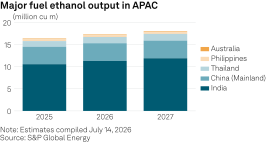
Although an ethanol blending policy would initially increase ethanol demand, higher EV adoption over the longer term could free surplus ethanol previously blended into gasoline, creating a stable domestic feedstock pool for ATJ production.
This echoes LanzaJet's view on the ATJ outlook. Flyn van Ewijk, LanzaJet's Asia Pacific regional director, told Platts, part of S&P Global Energy, in an interview that increasing electrification of road transport would fundamentally reduce gasoline blending demand.
"Alcohol-to-jet is the next technology to scale after HEFA," van Ewijk said. "As we get more EVs on the roads, you're going to have more ethanol available for SAF."
Unlike HEFA, which relies largely on limited supplies of waste oils and fats, ATJ can utilize ethanol regardless of how it is produced, van Ewijk said.
He said concerns that ATJ would compete with road fuel markets are likely to diminish over time, making ethanol an increasingly attractive long-term SAF feedstock compared with waste oils, which face structural supply constraints.
The Chung-Hua Institution for Economic Research's report also highlighted ATJ's greater scalability over the longer term as the market can draw on internationally certified ethanol imports while leveraging Taiwan's refining and petrochemical expertise.
The report also urges Taiwan to establish a national SAF mandate and long-term investment support mechanisms before 2030, highlighting the policy certainty needed for production investments.
Platts data showed that as of July 7, there were no announced or speculative SAF projects in Taiwan.
However, the Asia Pacific region's overall HEFA production capacity, based on announced plants with a max diesel or modulated configuration, stands at around 8 million metric tons in 2026 and 11 million mt in 2030.
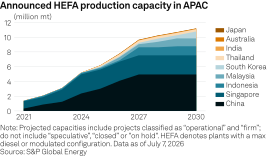
The announced capacity of ATJ-SPK projects in the region stands at 46,000 mt in 2026 and 906,000 mt in 2030. The estimated capacity of speculative ATJ-SPK projects is projected at over 2.7 million mt in 2030, bringing the total ATJ-SPK capacity to nearly 4 million mt then, based on the data.
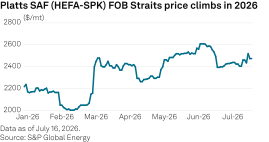
Platts assessed SAF (HEFA-SPK) FOB Straits at $2,475/metric ton on July 16, unchanged day over day.