Agriculture, Energy Transition, Refined Products, Biofuels, Renewables, Jet Fuel
July 16, 2026
ATJ poised for post-2030 growth as EVs free ethanol supply; policy remains key hurdle: LanzaJet

By Mia Pei
Editor:
HIGHLIGHTS
HEFA remains dominant SAF pathway until 2030
EV adoption frees ethanol for ATJ
Policy gaps hinder APAC SAF scaling
Alcohol-to-jet (ATJ) sustainable aviation fuel could emerge as the next major production pathway after 2030 as rising electric vehicle adoption frees ethanol currently blended into gasoline, easing concerns over future feedstock constraints, Flyn van Ewijk, LanzaJet's regional director for Asia Pacific, told Platts, part of S&P Global Energy.
While hydroprocessed esters and fatty acids (HEFA) will remain the dominant SAF technology through the end of the decade, ethanol-based SAF is well-positioned for commercial expansion beyond 2030 because ethanol availability and production are expected to increase rather than tighten, van Ewijk said in a sideline interview at the SAF APAC Summit in Melbourne.
"Alcohol-to-jet is the next technology to scale after HEFA," van Ewijk said. "As we get more EVs on the roads, you're going to have more ethanol available for SAF."
Unlike HEFA, which relies largely on limited supplies of waste oils and fats, ATJ can utilize ethanol regardless of how it is produced, said van Ewijk.
"We already produce around 120 billion liters of ethanol globally every year," van Ewijk said. "The technology doesn't care where the ethanol comes from."
Platts assessed SAF (ETJ) Cost of Production w/o Credits USGC at 158.25 cents/gal July 15, down 7.63 cents/gal from the previous day.
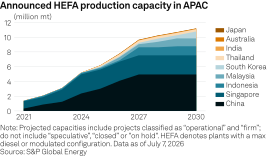
He expects HEFA to remain the dominant SAF pathway until around 2030 but said several industry outlooks indicate that feedstock constraints could begin to emerge around then, creating an opportunity for ATJ technologies to scale.
Asia-Pacific could become one of the largest ATJ markets globally, given its rapidly expanding aviation sector and abundant agricultural resources, van Ewijk said, highlighting Australia, Thailand, and India as countries with strong domestic ethanol industries, while Japan, South Korea, and Singapore could develop significant import-based production models.
S&P Global Energy data show that, as of July 7, HEFA production capacity in the Asia Pacific region, based on announced plants with a max diesel or modulated configuration, stands at around 8 million metric tons in 2026 and 11 million mt in 2030.
The announced capacity of ATJ-SPK projects in the region, however, stands at 46,000 mt in 2026 and 906,000 mt in 2030. The estimated capacity of speculative ATJ-SPK projects is projected at over 2.7 million mt in 2030, bringing the total ATJ-SPK capacities to nearly 4 million mt then, based on the data.
Policy hurdle
Despite the favorable feedstock outlook, van Ewijk said the biggest obstacle facing the industry is no longer technology or raw materials but policy.
"SAF is a policy-enabled market. It wouldn't exist without those policies," he said.
"The key bottleneck to really scaling up in Asia-Pacific is getting the right mix of demand-side and supply-side policies."
He said governments across the region have made significant progress in introducing production incentives, but demand-side measures remain underdeveloped, with Australia illustrating that imbalance.
The country has introduced grant funding through the Australian Renewable Energy Agency, production incentives under the A$1.1 billion Cleaner Fuels Program, and financing support through government investment vehicles.
However, "the missing piece has always been demand-side policy," van Ewijk noted.
The Australian government announced earlier that it would soon launch industry consultation on the demand-side policy.
Supply-side incentives help lower production costs, while demand-side measures create guaranteed markets and de-risk long-term offtake agreements needed to secure project financing, he added.
Without mandates, airlines remain reluctant to sign long-term SAF purchase agreements because doing so voluntarily could put them at a competitive disadvantage compared with rivals who continue to use conventional jet fuel. "Mandates level the playing field," said van Ewijk.
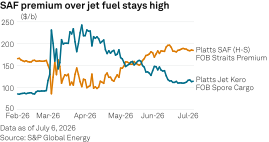
He cited Japan as one of the region's policy leaders, pointing to its 10% SAF target by 2030 and generous government support for project development. South Korea's blending mandate and Singapore's SAF levy model are also closely watched across the industry.
Van Ewijk added that geopolitical developments have further strengthened governments' interest in domestic SAF production.
"The biggest change over the past year has been energy security," he said, noting that disruptions arising from the Middle East conflict underscored the vulnerability of fuel-importing countries such as Australia and New Zealand.
Domestic SAF production, he said, offers not only emissions reductions but also greater resilience against future fuel supply disruptions.
The US-based SAF company licenses its alcohol-to-jet technology. Its Freedom Pines Fuels facility in Georgia, which can produce up to 10 million gal/year of sustainable fuels, became fully operational in 2025, based on LanzaJet's website.
The company is also advancing projects with Jet Zero Australia, Cosmo Oil in Japan, Air New Zealand, and Indian Oil, and raised $47 million in new capital in February 2026 to support its global expansion, according to the company website.
