Refined Products, Jet Fuel, Diesel-Gasoil
July 17, 2026
India's move to raise gasoil, jet fuel export taxes signal renewed supply concerns
HIGHLIGHTS
Duty increase may not curb exports immediately
Move pushes refiners to prioritize domestic market: CERA
India's move to raise export taxes on diesel and jet fuel signals a policy preference for prioritizing domestic supply over export opportunities amid renewed concerns about crude and product flows from the Middle East, analysts and market sources said July 17.
However, they added that the revision -- normally carried out every two weeks to align with international oil prices -- may not be large enough to make a significant dent in exports immediately, unless further increases follow.
India's finance ministry reviews and adjusts export duties every two weeks in line with global crude prices. Effective July 16, it raised the diesel export tax to Indian Rupees 15.5/liter (16 cents) from Rupees 8.5/liter, while the aviation turbine fuel duty was increased to Rupees 14.5/liter from Rupees 7.5/liter. By contrast, the export duty on gasoline was lowered to Rupees 2.5/liter from Rupees 4/liter.
"The move reflects growing concerns about crude and product availability amid renewed uncertainty in the Middle East. But more importantly, it signals a clear policy preference for protecting domestic supply rather than maximizing export opportunities during a period of elevated geopolitical risk," said Premasish Das, executive director for oil analytics at S&P Global Energy CERA.
He added that diesel and jet fuel markets remain considerably tighter than crude markets. Therefore, an increase in export duties sends a strong signal that ensuring adequate domestic availability of these fuels is currently a higher priority than capturing the full benefit of exceptionally strong export margins.
"Whether the latest adjustment materially reduces exports remains to be seen, as margins are still attractive. But it does increase the incentive for refiners to prioritize the domestic market. Given India's role as a major supplier of diesel and jet fuel, regional buyers will closely monitor any impact on export availability," Das said.
Ship crossings through the Strait of Hormuz fell to 16 on July 15, reversing a brief rise the previous day, S&P Global Commodities at Sea said in a July 16 report.
Renewed price, supply concerns
Crude oil futures edged down July 16 as weak Chinese crude demand added headwinds, even as US-Iran tensions showed little sign of easing. NYMEX August WTI settled 84 cents/barrel lower at $78.28/b, while ICE September Brent fell 72 cents/b to end the session at $84.23/b.
Supply risks persisted after the US reportedly struck a tanker headed for Iran's oil export hub Kharg Island, the first attack on a commercial ship since Washington reimposed its Navy blockade. US Central Command said July 15 that US forces disabled the unladen VLCC Belma as it attempted to sail toward Kharg Island.
Iran has threatened to halt all crude oil and natural gas exports from the region after its own exports were blocked from entering the Indian Ocean, according to a statement from the Revolutionary Guard media office July 15.
"The increase in taxes may not make a big impact on actual diesel and jet fuel export volumes, but it will give a chance for the government to get a share from the higher export earnings by refiners who are exporting, given that overseas demand is strong," said DLN Sastri, former director of refining at the Federation of Indian Petroleum Industry.
Platts, part of S&P Global Energy, assessed the FOB Singapore 10 parts per million sulfur gasoil front-month swap crack spread against front-month Dubai swap -- a measure of the product's relative strength to the crude from which it was refined -- up 17.3% day over day at a 14-week high of $64.68/b on July 14. It was last higher on April 7 at $72.94/b. The gasoil crack has since eased to $61.58/b at the July 16 Asian close, but remained above the June average of $44.98/b.
The Platts FOB Singapore jet fuel/kerosene front-month swap crack spread against front-month Dubai reached an 11-week high of $69.68/b on July 14, up from $52.64/b in the previous session. It was last higher on April 27 at $72.96/b. The jet crack has since eased to $60.98/b at the July 16 Asian close, but remained above the June average of $44.86/b.
Multiple objectives
The latest revision underscores the government's effort to balance multiple policy objectives -- ensuring adequate domestic availability of diesel and aviation fuel, mobilizing additional revenue amid elevated crude prices and preserving the international competitiveness of gasoline exports, refining and industry sources said.
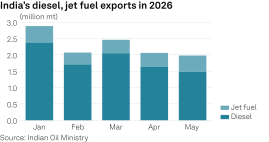
The higher diesel export duty could also help reinforce domestic supply ahead of the peak agricultural demand season, particularly as below-normal monsoon rainfall linked to a possible El Niño pattern has increased the need to run more irrigation pumps, an industry analyst said.
By contrast, the reduction in the gasoline export duty aims to enhance the competitiveness of Indian gasoline exports. The lower levy should help refiners market surplus gasoline abroad, sustain refinery utilization rates and avoid an accumulation of domestic inventories, another Indian refinery official said.
