Maritime & Shipping, LNG, Crude Oil
July 16, 2026
Energy markets face coming stress if no new US-Iran deal reached: analysts

Editor:
HIGHLIGHTS
Gulf oil flows still 50% from pre-war levels
Iran distrusts US diplomacy, seeks guarantees
US left with diminishing options
Oil, refined products and LNG markets will face mounting stress into the fall absent a significant change in the conflict between the US and Iran that leads to a lasting reopening of the Strait of Hormuz, as Iran grows more skeptical of US diplomacy, energy and geopolitical analysts said at a July 16 International Crisis Group webinar.
The Strait's brief reopening in the first week after the US-Iran memorandum of understanding was signed on June 17 was meant to buy time, but gained little tangible benefit for the US, said Robin Mills, CEO of Qamar Energy. Roughly 100 million barrels of crude trapped inside the Gulf -- effectively floating storage -- have since cleared to market, he said, but outflows have recovered to only about 80% of pre-war levels as global stocks continue drawing.
With fighting resumed and tankers again under attack, most shipping has halted. Vessel crossings through the Strait of Hormuz fell to 16 on July 15, reversing a brief uptick the previous day, S&P Global Commodities at Sea said in a July 16 report. Including bypass pipelines to the Red Sea and Fujairah, total Gulf flows are now around 50% of pre-war levels, down at least 10 million b/d.
"We're not much better off than the worst phase of the crisis back in April and May," Mills said. "The ceasefire has broken down, but I'm sure we'll be promised that it's going to be renewed very soon, and ships will start moving. In fact, we've been told several times they are moving -- contrary to the evidence of our eyes."
Talk of a glut during the ceasefire was premature, Mills said, reflecting released tankers arriving in Asia at once rather than a genuine oversupply. China remains the key swing factor, having sharply cut imports while drawing strategic and commercial stocks and trimming refining runs, though Chinese buying is now showing early signs of recovery, Mills noted.
Platts, part of S&P Global Energy, assessed Dated Brent at $70.9/b Feb. 27, one day before the first US and Israeli attacks on Iran. Prices peaked at $144.42/b April 2. On June 18, after the MOU was signed, prices had fallen to $77.50, and fell to a low of $68.16/b July 2.
But recent attacks and US President Donald Trump's declaration that the ceasefire was no longer in effect have lifted prices, with Platts Dated Brent moving above $85/b before session close on July 16.
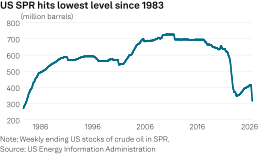
Gasoline, diesel and jet fuel prices also remain elevated, refining margins are exceptionally high, and US product stocks have fallen to multi-year seasonal lows, pointing to visible stress by late summer, Mills said. Qatar has not restarted LNG exports since the tanker strike, and European storage is failing to refill ahead of the October heating season. Unlike crude, Gulf LNG cannot bypass the strait.
Mills attributed the absence of a spike toward $200/b to reduced Chinese imports, higher US exports, southern-corridor shadow runs, finite IEA strategic-stock releases, and repeated White House assurances that have made traders wary.
Should the conflict stay confined to shipping rather than energy infrastructure, Mills predicted a slower-burning crisis biting between September and year-end. Bypass routes — Saudi Arabia's East-West line to Yanbu, the UAE's lines to Fujairah, and proposed Iraqi options via Syria or Turkey — will erode the strait's leverage over time, but the next UAE pipeline is not due until 2027, and most others run two to four years out.
A prolonged conflict would durably raise prices while cutting revenues for the GCC, Iraq and Iran alike, Mills said, accelerating a structural shift toward renewables, EVs and nuclear.
"This really changes a bit the zeitgeist of let's say a couple of years ago, when people started saying, 'Oh, we were too hasty on net zero,'" Mills said. "Actually, we do need oil and gas for energy security, they're reliable, and so on. That narrative has been given a severe kick by this war, because now this clearly shows that oil and gas are not as reliable as many people thought."
"That, long term, is bad news for the Gulf capitals and for Tehran," he said.
Political stalemate deepens
Tehran now believes no credible diplomatic offer exists and cannot trust Washington to implement one, said Johns Hopkins Professor of International Affairs and Middle East Studies Vali Nasr. With war damage estimated at around $300 billion and the World Bank projecting a roughly 6% contraction in Iran's GDP, the country's leadership sees sustained pressure on the global economy — via the Strait of Hormuz and potentially the Bab el-Mandeb — as its only path to a durable settlement, including guarantees against future strikes and meaningful sanctions relief.
Nasr said reports of decisive divisions within the Iranian leadership are overstated, complicating US efforts to return to the June 17 MOU or to reach a new diplomatic agreement.
Some of the language that came out of former Iranian Ayatollah Ali Khomeini's funeral "was much harder than the positions that Iranian leaders have even taken," Nasr said. "Ultimately, as much as Iran is an authoritarian state, there is still sensitivity to public opinion."
"At this moment, there is much more of a sense of an existential fight," Nasr said.
Brookings scholar Philip Gordon said he saw no coherent US strategy and argued that domestic politics, market sensitivity and depleted munitions still constrain US President Trump, making a return to full hostilities -- and potentially greater leverage in negotiations with Iran -- difficult. Infrastructure strikes, he said, would be a costly mistake unlikely to produce a deal.
Gulf states, the conflict's principal economic victims, view a forever war as unsustainable but diverge on solutions, said Crisis Group's Yasmine Farouk. Saudi and Emirati retaliation during the 40-day war was calibrated to signal a return to talks, she said, warning that fresh strikes on Gulf infrastructure risk drawing them in more directly.
