Agriculture, Energy Transition, Refined Products, Biofuels, Renewables, Jet Fuel
July 16, 2026 · Updated July 24, 2026
China focused on voluntary SAF markets over demand mandates: CAAC research body official
Editor:
HIGHLIGHTS
China leads Asia-Pacific SAF output
Certification, traceability build market trust: official
CAAC developing sustainability certification scheme
China has prioritized building sustainable aviation fuel ecosystems and fostering voluntary demand over issuing demand-side policies such as mandates, said Eason Chen, chief operating officer of the SAF Center at the Civil Aviation Administration of China (CAAC), July 16.
At an industry webinar, Chen said China is developing SAF certification, traceability, voluntary markets and book-and-claim mechanisms rather than immediately relying on blending mandates similar to the EU's RefuelEU Aviation regulation.
"China's approach is different from Europe," Chen said. "If we really want to meet a target, we need to ensure we can get it done ... voluntary markets are an important way to help airlines gain greater access to SAF."
Chen said SAF has been designated a national priority after being incorporated into China's 14th Five-Year Plan, a strong policy signal for SAF producers and investors, and will remain a focus in the upcoming Five-Year Plans.
China's SAF Center operates under the Second Research Institute of CAAC and serves as a technical advisory body to CAAC, which issues aviation regulations.
China has pledged to peak carbon dioxide emissions before 2030 and achieve carbon neutrality before 2060, Chen said, noting that aviation, as a hard-to-abate sector, remains a key part in achieving the goal.
On the production side, Chen said China is currently leading SAF production in the Asia-Pacific, while manufacturers continue to expand outputs.
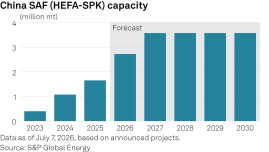
S&P Global Energy data showed that China's HEFA-SPK production capacity based on announced plants as of July 7 stands at 2.7 million metric tons, projected to rise to 3.6 million mt in 2030. China's SAF export quota currently stands at 1.7 million mt/year.
On the demand side, China's SAF pilot program has also expanded rapidly, said Chen.
Initially launched in 2024 with four international airports and a limited number of airlines, the program has since broadened to cover domestic flights, with more than 10 airports upgraded with SAF blending and into-plane fueling infrastructure.
Chen said the success of voluntary SAF markets depends on establishing confidence in sustainability claims through robust certification and traceability systems. "If we want voluntary markets to work well, we first need to build trust."
"Sustainability certification is the key. We need to ensure carbon reductions are genuine, accurately calculated, and supported by full feedstock traceability," Chen said.
Chen added that China is developing its own sustainability certification scheme that is fully aligned with ICAO's CORSIA framework while incorporating local feedstocks and resources to lower compliance costs.
CAAC's SAF Center is also developing AnchorTrace with CNAF to support book-and-claim transactions, enabling airlines to sell SAF environmental attributes to corporate customers seeking Scope 3 emission reductions.
"China's green transition is irreversible. By 2035, we hope China will become one of the global leaders in SAF, not only in production, but also in application and technological developments," said Chen.
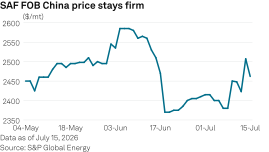
Platts, part of S&P Global Energy, assessed SAF FOB China at $2,462/mt on July 15, down $45/mt day over day.