Crude Oil
July 15, 2026
US strategic oil reserve falls to lowest level since 1983

Editor:
HIGHLIGHTS
US oil reserve drops to 316.5 million barrels
Energy Department SPR exchanges slow
SPR infrastructure under pressure: GAO report
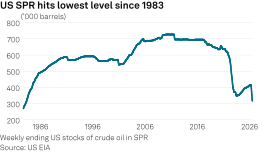
US Strategic Petroleum Reserve crude stocks fell to 316.5 million barrels in the week ended July 10, down 3 million from 319.5 million barrels the week before, US Energy Information Administration data showed July 15, as the Department of Energy continued its 172 million-barrel emergency release amid the ongoing US conflict with Iran.
The SPR has not held so little crude since April of 1983. The lowest SPR volume on record was in 1982, when the reserve held 270.5 million barrels.
The drawdown stems from a coordinated release announced March 11, when the Trump administration committed 172 million barrels to counter supply losses from the conflict with Iran, which began Feb. 28 and disrupted shipping flows through the Strait of Hormuz. The release was the US portion of an International Energy Agency-coordinated 400 million barrel action by 32 member nations. The DOE said at the time the release would take roughly 120 days to deliver.
Exchanges slowing
Unlike previous SPR drawdowns, the current release is structured as an exchange, in which companies borrow SPR crude and return the original volume plus a premium at a later date. DOE has awarded more than 133 million barrels across a rapid series of solicitations since mid-March, securing return premiums that have ranged from 18% to as much as 28% on individual tranches, according to the agency.
At an interview at CERAWeek by S&P Global in March, US Energy Secretary Chris Wright said for every barrel the agency released, "we're going to get back more than 1.2 barrels of oil that will go back into the reserve next year."
The reserve has shed close to 99 million barrels since early March, when it stood at about 415 million barrels. Flows accelerated to nearly 10 million barrels in a single week in mid-May before easing in recent weeks. The June 10 week's 3 million barrel draw is among the smallest since the program began, coinciding with a partial recovery in Hormuz traffic and ongoing US-Iran talks before the return of heightened tensions and attacks on shipping in recent days.
According to the DOE, the agency awarded just one contract to exchange crude in its latest solicitation, offered June 10, when Vitol took 500,000 barrels of the 40 million available.
"Bidders may have anticipated a more significant flattening at the front of the curve as the Strait reopened," ClearView Partners wrote in a client note June 24, six days after the US and Iran memorandum of understanding.
At 316.5 million barrels, the SPR remains above its statutory minimum of 252.4 million barrels, which prevents certain limited drawdowns under the Energy Policy and Conservation Act.
Infrastructure pressure
The drawdown has intensified scrutiny of the reserve's physical condition. In a report made public in early July, the Government Accountability Office warned that the SPR's effective withdrawal capability had fallen to about 61% of its original design capacity as of December 2025, with refill capability at 56%, and cautioned that the reserve may struggle to meet future drawdown directives without significant investment.
"The SPR's operational capability to meet mission demands is at risk," the GAO report said.
The watchdog said the caverns themselves remain generally sound but flagged the integrity of the SPR's aging wells -- many decades past their design life -- as a growing concern, citing Sandia National Laboratories' findings that well deformations were outpacing DOE's ability to remediate them at current funding levels.
GAO also noted that the decade-long, $1.4 billion Life Extension Phase 2 modernization effort has faced repeated delays and scope reductions, and that DOE has not updated its long-term SPR strategy since 2016.
