Agriculture, Energy Transition, Refined Products, Biofuels, Renewables, Jet Fuel
July 15, 2026
Airbus urges faster APAC SAF policy to unlock investments, improve price discovery

By Mia Pei
Editor:
HIGHLIGHTS
Regional SAF demand strengthens
Australia potentially net exporter of low-carbon fuels
More trading needed to improve price discovery
Governments across the Asia Pacific need to move quickly to finalize SAF policy frameworks and stimulate trading activities to unlock investment decisions and improve price discovery, as the market enters a new phase of growth, Stephen Forshaw, Airbus chief representative for Australia, New Zealand, and the Pacific, told Platts, part of S&P Global Energy.
"We've now got a number of proponents with very serious proposals," Forshaw said at an interview during SAF APAC Summit 2026, citing projects in Thailand, Malaysia, Indonesia, Australia, and potentially Japan and South Korea.
While most projects have yet to reach a final investment decision, he said the industry already has two essential ingredients needed for growth: available capital and growing demand.
"There are pools of capital available for financially sound projects that are investment-ready... and there is demand for the product," Forshaw said. "The onus is then on the producers to develop sound investment cases."
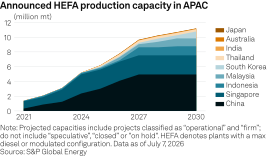
S&P Global Energy data shows that, as of July 7, HEFA production capacity in the Asia Pacific region, based on announced plants with a max diesel or modulated configuration, stands at around 8 million metric tons in 2026 and 11 million mt in 2030.
However, the streaming of speculative capacity will increase the region's HEFA production capacity by an additional 7 million mt, bringing total capacity to nearly 19 million mt in 2030, according to S&P Global Horizons' biofuels outlook, released in late June. Asia's SAF production could more than double by 2030 to nearly 23 million mt per year if speculative capacity also streams.
Demand is strengthening as more Asia-Pacific governments introduce SAF usage targets or other demand mechanisms, including Singapore, Japan, and South Korea, while airlines are increasingly pursuing voluntary decarbonization targets and seeking to monetize Scope 1 and Scope 3 carbon reductions, Forshaw said.
Horizons forecasts that SAF demand in Asia will reach 31 million mt, accounting for around 19% of the jet fuel pool by 2060. This means the region will require an additional 25 million mt of SAF production capacity by 2060 to meet demands, of which 18 million mt will have to come from ATJ or other pathways, according to Horizons.
Trading liquidity
Besides policy support, Forshaw said the market also needs more physical trading to establish transparent pricing and improve liquidity.
"We're still in the early stages of price discovery," he said, noting that a larger number of SAF transactions would allow buyers and producers to better understand the market's clearing price and reduce uncertainty for future investments.
He said mechanisms such as mandates and growing voluntary demand help create a functioning market by increasing transaction numbers, enabling participants to develop clearer price signals and more standardized commercial arrangements.
"The more SAF that's bought and sold, the more comfortable financiers and project developers become because they can see where the market is pricing the product," he said, adding that mature price discovery ultimately supports long-term contracting and investment decisions.
Platts assessed SAF (HEFA-SPK) FOB Straits at $2,520/mt and SAF FOB China at $2,507/mt July 14.
Australia's evolving role
Australia has announced a low-carbon liquid fuels support package as part of its 2026-2027 federal budget and intends to introduce demand-side measures, but detailed consultation has yet to conclude.
Forshaw said Australia now needs to move beyond policy consultation and provide investors with certainty, noting that delays risk more premium domestic feedstocks being exported rather than processed locally into SAF.
"We've heard commitments to consult. Great, let's get on with it. Let's see urgency," Forshaw said. "The longer we take to set policy in Australia, the more and more our feedstock gets exported, and I don't want that window to close."
If Australia's first commercial SAF facilities are successfully built, larger projects should follow, creating economies of scale and positioning the country as a major producer of low-carbon liquid fuels, he said.
Looking further ahead, Forshaw said Australia could become "the Saudi Arabia of liquid fuels" if abundant renewable electricity and green hydrogen enable competitive power-to-liquids production.
"That may take a couple of decades to get to the right price point, but I'm trying to look at this with a long-term vision, not a three-year election cycle," he said.
Nonetheless, he noted that recent geopolitical disruptions have reinforced the importance of domestic low-carbon liquid fuel production beyond climate policy. "A year ago, I warned we were sleepwalking our way into a fuel security crisis by being so heavily dependent on imported jet fuel."
On aircraft readiness, he noted that Airbus has already successfully flown aircraft on 100% SAF during test flights, and the remaining hurdle is regulatory certification.
"The issue for regulatory certification is understanding the long-term impact on engines and aircraft components. That's what regulators are studying."
Current Airbus aircraft are certified to operate on blends of up to 50% SAF, while the company is working with regulators toward certification for 100% SAF use.
"There's absolutely no chance that globally we can be at anything like 100% SAF by 2030. There's just not enough supply."
Instead, Airbus is focusing on helping airlines decarbonize through fleet renewal, investment in SAF production and technology, and support for policy development.
The company has invested alongside Qantas in Australia's SAF sector and recently expanded investments into earlier-stage technologies through Climate Tech Partners, which Forshaw said is intended to identify future winners, including power-to-liquids and other next-generation fuels.
