Agriculture, Energy Transition, Refined Products, Biofuels, Renewables, Jet Fuel
July 14, 2026
SAF supply constraints outweigh airport readiness in Asia-Pacific: ACI

By Mia Pei
Editor:
HIGHLIGHTS
Only 26 Asia-Pacific airports supply SAF
Regional trade key to matching demand, capabilities
Urges that policy pair targets with supply incentives
Singapore, Japan, China lead SAF ecosystem
Only 26 airports across nine Asia-Pacific countries have supplied sustainable aviation fuel for aircraft operations, even though most airports are technically capable of handling it, as the region's SAF market continues to face supply chain and long-term financing constraints, according to Ken Lau, head of sustainability at Airports Council International Asia-Pacific & Middle East.
Because certified SAF is a "drop-in" fuel blended with conventional jet fuel before reaching airports, "existing airport fuel hydrants and fuel farms require absolutely no upgrades to begin handling SAF today," Lau told Platts, part of S&P Global Energy, during an interview at the SAF APAC Summit 2026 in Melbourne over July 8-9.
"It is crucial to emphasize that driving this change does not require massive immediate infrastructure overhauls," Lau said.
According to the International Civil Aviation Organization's SAF airports map, cited by Airports Council International, 26 airports across nine Asia-Pacific countries have supplied SAF for aircraft operations, including nine in China, four in Japan, three in Malaysia, two each in South Korea, Thailand, Indonesia and Singapore, and one each in Australia and New Zealand. Of these, only 13 airports have established continuous SAF deliveries, while the remaining 13 have handled one-off pilot or batch deliveries.
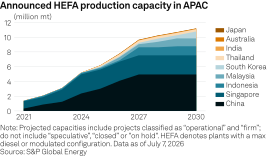
Lau identified four key barriers to wider SAF adoption in the region: limited supply chain maturity, SAF's price premium over conventional jet fuel, space and permitting constraints for airports seeking to develop dedicated blending or segregated storage facilities, and the capital investment required for such projects.
Of these barriers, feedstock availability remains a major challenge to scaling up SAF production and use.
"The availability of feedstocks, particularly waste-based lipids like used cooking oil in Asia, remains constrained by fragmented collection infrastructure," Lau said.
SAF also remains "significantly more expensive than conventional jet fuel," requiring long-term policy interventions and financial mechanisms to stimulate economies of scale, according to Lau.
Platts, part of S&P Global Energy, assessed SAF (HEFA-SPK) FOB Straits at $2,436/mt on July 13, down $25/mt day over day.
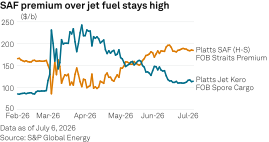
Lau said airport infrastructure is not a major barrier to SAF adoption, as the capital required for SAF readiness at airports is relatively modest.
"The specific capital expenditure required strictly for SAF-readiness at the airport gate is not a significant financial barrier," he said. "The massive financial burden of scaling the SAF supply chain falls almost entirely on upstream energy producers and fuel suppliers, rather than airport operators."
Lau noted airports' evolving role in the aviation energy transition, from traditional infrastructure providers to facilitators that aggregate demand through stakeholder partnerships.
Airport master plans are also increasingly reflecting a shift toward becoming "multimodal energy hubs" that integrate SAF, renewable electricity, and, eventually, hydrogen, Lau said.
Regional harmonization
As governments introduce national SAF strategies, the Asia-Pacific region faces the dual challenge of strengthening domestic production while avoiding the emergence of fragmented regional markets, Lau said.
National policies understandably aim to bolster energy security by developing local feedstocks such as used cooking oil and agricultural residues, but mismatches between production capability and aviation demand across the region make international SAF trade indispensable.
"To achieve commercial scale, international trade and regional harmonization will be essential," Lau said. "Divergent national standards could complicate airline operations, which is why cross-border alignment on certification, book-and-claim systems and blending targets is critical to establishing a coherent regional market."
Lau said Europe's ReFuelEU Aviation mandate underscores the importance of providing long-term policy certainty to attract investment, but cautioned that blending mandates introduced without parallel supply-side incentives could distort markets and lead to "carbon leakage," with airlines sourcing cheaper conventional jet fuel from neighboring jurisdictions that do not impose such mandates.
"Asia-Pacific policymakers should aim for a holistic approach that pairs targets with investment incentives," Lau said.
Leading ecosystems
Airports Council International identified Singapore, Japan and China as the Asia-Pacific region's most advanced SAF ecosystems, albeit through different policy approaches.
Singapore has paired the integration of SAF into Changi Airport's common hydrant system with a transparent passenger levy to support the financing of its planned 1% SAF blending mandate for departing flights.
Japan is building commercial viability through domestic feedstock development, long-term supply agreements and airline purchase commitments ahead of its target of achieving a 10% SAF blend by 2030.
China, meanwhile, benefits from its dominant position in used cooking oil feedstocks and expanding refining capacity, positioning the country's major airport hubs for larger-scale deployment.
Lau expects most of Asia-Pacific's primary international gateways to establish continuous SAF supply chains by the end of the decade, driven by emerging mandates in markets including Japan, Singapore, India and Southeast Asia.
He said that airports where physical SAF delivery remains uneconomic would rely on book-and-claim systems to participate in aviation decarbonization.
