Refined Products, Crude Oil, Gasoline, Jet Fuel, Diesel-Gasoil
July 14, 2026
Global diesel market tightens as Russian export ban, Ukraine strikes bite
By Alexandra Vladimirova and Sophia Aung
Editor:
HIGHLIGHTS
Up to 60% of Russian refining may be offline due to Ukraine attacks
European diesel cracks surge as supply tightens
Russia plans to import refined products from July
The global diesel market is tightening fast, as Russia, the world's second-largest exporter of the fuel, bans exports of key refined products amid escalating attacks on its energy infrastructure by Ukraine, while the war in the Middle East threatens flows from the region again.
Europe, Latin America and Africa, as importing markets, are set to feel the biggest pinch, according to Eleanor Budds, director of fuels and refining research at S&P Global Energy CERA.
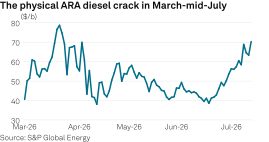
Benchmark European diesel margins have already ballooned since Russia announced a full export ban of the fuel on July 8, in addition to existing jet fuel and gasoline restrictions. The diesel and gasoline bans run until the end of July, while the jet fuel ban stays in force until end-November.
The physical ARA diesel crack reached $70.3/b on July 13, the highest since March 23, according to Platts, part of S&P Global Energy.
While the EU, which banned imports of Russia's refined products in 2023, will not miss Russian barrels directly, it will feel the impact of the ban as other regions draw supplies away to replace lost volumes from Moscow, according to analysts.
Russia itself will also be importing diesel to meet domestic demand, the country's government said.
"Europe will need to source these barrels from somewhere by the fall. Less Russian diesel on the market will tighten the East Med, which could then have a knock-on effect in ARA," CERA senior principal analyst James Bambino said, adding that diesel stocks are already tight in key hubs such as the US Gulf Coast.
Drone attacks
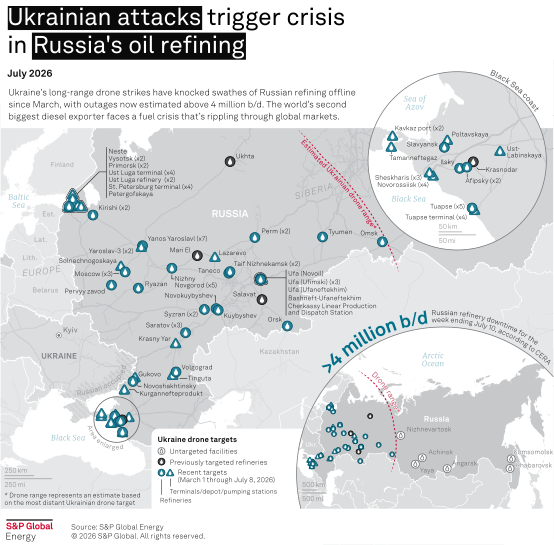
Ukrainian strikes have knocked out a growing share of Russian refining capacity, with outages climbing sharply through June and into July as attacks intensified.
At the end of June, CERA analysts estimated that more than 2.5 million b/d of Russian refining capacity, more than a third of the country's total, was offline, taking Russian crude runs to a 17-year low as a direct result of strike damage. A separate assessment from CERA's global refinery outage team put total Russian refining downtime above 4 million b/d for the week ending July 10, capturing the cumulative impact of a fresh wave of attacks in early July alongside other unplanned outages. Based on Russia's estimated refining capacity of 6.9 million b/d, the latest figure implies almost 60% of Russian refining capacity is offline following the strikes.
In addition to the intensity, Ukraine has expanded the scale of its attacks on Russia.
Refining facilities with a combined nameplate capacity of 5.6 million b/d were targeted in Russia from March 1 through July 10. At least 12 refineries were attacked more than twice during this period, and the 300,000 b/d Yanos Yaroslavl refinery was struck at least seven times.
The 240,000 b/d Moscow refinery was put out of action in June after the third attack since the beginning of March.
This triggered significant fuel shortages in Russia's capital. Another threshold was crossed with the attack on the 428,000 b/d Omsk refinery on July 6, which is not only the largest refinery in the country but also the furthest from Ukraine's border reported to come under strike.
Fuel shortages were reported in almost all Russian regions in the past month and a half, forcing authorities and fuel distributors to take measures ranging from restricting supply to nearly stopping it altogether. Local media reported people waiting in line for more than 24 hours to fill up with gasoline or diesel.
Russian crisis
Russian diesel and gasoil exports began to decline significantly from the end of May. They totaled 14.8 million barrels in June, down from an average of 24 million barrels/month from March to May and 30.5 million barrels in January, according to S&P Global Commodities at Sea data. Russia exported 293.9 million barrels in 2025 overall, or 805,000 b/d, the second highest volume after the US.
The main buyers of Russian diesel were Turkey and Brazil, with the remainder going to Egypt, Morocco and other primarily African countries.
"The loss of Russian supplies comes at a time when the market was already losing significant volumes from the Middle East, which has made the situation acute," global head of price risks at the commodities trading firm Hartree Rob McLeod told Platts.
"If the Iran war were resolved and Middle East refining recovered, allowing exports to rebound, the situation would be much easier to manage through the usual supply levers such as higher run rates and yield shifts," McLeod added.
Traders reported tightening supply conditions in the European market, particularly in the Mediterranean region. The Mediterranean is trading at a premium to Northwest Europe, drawing barrels from the US.
The Mediterranean diesel cargo price benchmark was assessed by Platts at $1,149.25/mt CIF Med on July 13, the highest since May 22, and $34.50/mt higher than the CIF NWE assessment.
Turkey has begun importing diesel from India, a shift from previous trade patterns.
Import needs
Europe typically imports nearly 1 million b/d of diesel in addition to its domestic production to meet demand. Before the start of the conflict between the US, Israel and Iran, Europe sourced around 27% of its imports from the Middle East, excluding intra-European flows. After the effective closure of the Strait of Hormuz, Europe had to find missing volumes elsewhere, with imports from the US increasing from the previous year in March-May.
"Now the US has been increasing gasoline yields, which may come at the expense of diesel. Additional export will reduce US diesel stocks, which will also drive crack strength," Bambino said.
Meanwhile, Russia plans to start importing oil products in July, according to Deputy Prime Minister Alexander Novak. Officials did not specify importers or volumes and there is no clarity in the market on where the barrels will come from. India's oil minister said on July 3 that the country has the capacity to export oil products to Russia.
The Russian refining crisis will also affect neighboring countries, such as landlocked Tajikistan, Mongolia, and Kyrgyzstan, which rely heavily on Russian rail exports, according to CERA.
In addition, Kazakhstan will need to address fuel tourism and cross-border fuel smuggling from Russia, incidents of which have already been reported. Local media reported in July that around 60 police checkpoints began operating at Kazakhstan's border crossings to address smuggling.
