Crude Oil, Refined Products, LPG
July 08, 2026
Strait of Hormuz oil traffic steady after attacks as IMO urges caution
HIGHLIGHTS
Hormuz ship traffic remains stable at 47-48
36% of vessels now sail dark without signals
IMO urges suspension of Hormuz transits if not safe
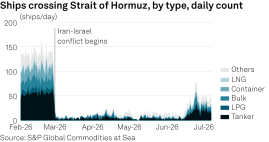
The number of ships traversing the Strait of Hormuz on July 8 was 48 compared with 47 on July 7 as more ships turned off their location signals following three tanker attacks, S&P Global Commodities at Sea said in a July 8 report.
Just one ship used the route closest to Oman while 36% of the total operated dark -- without signals -- compared with a July average of 21%, CAS data showed. Only 18 VLCCs and LPG tankers crossed Hormuz, or 38% of the total, the lowest energy share since June 28, CAS said.
The International Maritime Organization urged shipping companies to suspend their Hormuz transits following the recent attacks unless safety can be assured.
"As long as the safety and security of crews cannot be assured, I urge flag states, shipowners, ship operators and all relevant authorities to avoid exposing seafarers to unnecessary danger by transiting the strait," IMO Secretary-General Arsenio Dominguez said in a July 8 statement.
Preliminary data from CAS shows the laden VLCC Lila Vadinar from Kuwait and the small tanker Prestige Pirce from the UAE are back in the Persian Gulf after attempting to exit the Strait of Hormuz via the Oman route on July 8.
But the VLCC Mercury Hope with UAE and Qatari crude exited the Strait of Hormuz via the Iranian route and is on its way to China, while the ballasting MR tanker Ratta, Handysize tanker Nereida and small tanker Pahal entered the Persian Gulf sailing through Iranian waters, CAS data showed.
The total traffic through the Strait of Hormuz on July 7 included seven VLCCs, six product tankers, five LPG tankers and 10 bulk carriers, the data further showed.
One LNG carrier and two oil tankers were attacked by drones when sailing in Omani waters transiting Hormuz on July 6-7, prompting the US to revoke sanctions relief on Iranian oil sales and launch air strikes on Iranian targets in retaliation.
Iran has threatened to completely shut down the strait in case of further US military strikes, state-run Press TV reported July 8, citing an unnamed security source.
Dark crossings
Traffic heading into the Persian Gulf was about 25% of the total, the lowest since June 12, CAS said. It may indicate more caution or a greater share of ships transiting without their signals on, CAS said. "Dark crossings tend to be identified and tracked retroactively due to time lag," CAS said.
Ships heading out of the Persian Gulf on July 7 included five VLCCs and one LPG tanker, all sailing dark, while four oil product tankers, two VLCCs, and three LPG ships crossed with their signals on, most of them using the route closest to Iran as the Islamic Republic has demanded, according to CAS.
Two of the seven VLCCs that sailed outbound are linked to South Korea's Sinokor, one to Abu Dhabi National Oil Co., and three to Japanese owners, the CAS report said.
The seventh is Pertamina Pride, which has been in the Persian Gulf since February and is laden with Saudi crude, CAS said. It is bound for Pertamina's Cilacap refinery in Indonesia, CAS said.
Another outbound ship, Tara Gas, which usually carries Iranian LPG, appears to have loaded cargo at Ras Laffan, in Qatar, for the first time, CAS said. QatarEnergy did not respond to a request for official comment from Platts, part of S&P Global Energy, on July 8.
Also exiting was the Vietnam-flagged NV Aquamarine, which loaded LPG in Bahrain around July 2, CAS said.