Crude Oil, NGLs, Maritime & Shipping, Wet Freight
July 07, 2026
Iranian floating crude storage decreases in June as sanctions relief clears cargoes
HIGHLIGHTS
Crude on tankers drops 50% as sanctions ease
Chinese refiners cut Iranian imports by 43%
Regular Middle East crude regains competitiveness
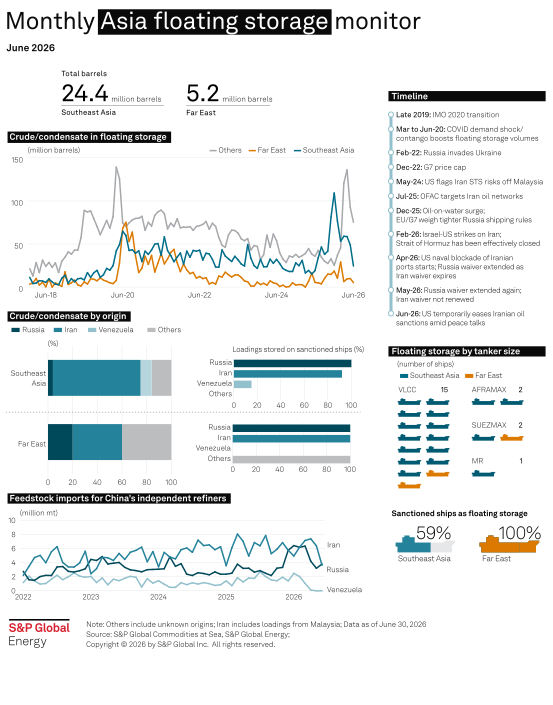
Floating storage of crude and condensate in East Asian waters declined month over month in June, with Southeast Asia volumes returning to the year-ago level as the Iranian crude overhang, which had built up since late 2025, unwound.
The fall came as the US has suspended its blockage on seaborne Iranian trades since mid-June and issued a wide-ranging sanctions waiver on Iran's oil sales, removing much of the country's logistical obstacles.
Floating storage in Southeast Asia fell more than 50% to 24.45 million barrels at end-June from 49.02 million barrels a month earlier, amid a 55% reduction in Iranian crude, according to S&P Global Commodities at Sea data. This extended the easing trend that began in April, bringing the amount down to the 20-million-barrel level last seen in June 2025.
Far Eastern volumes also declined to 5.2 million barrels from May's 9.92 million barrels amid a drawdown of both Iranian and Russian crude.
According to CAS, a ship is considered floating storage if it is laden and does not move more than 10 nautical miles per day for at least seven consecutive days.
Chinese buying
Chinese independent refiners imported 3.64 million metric tons of Iranian crude in June, down from 6.41 million mt in May, when the sector aggressively purchased discounted Iranian crude, according to data from Platts, part of S&P Global Energy.
Imports of Russian crude by the sector rose slightly to 3.81 million mt in June from 3.21 million mt in May.
The drawdown coincided with the shift in market dynamics amid the US-Iran peace deal, which took effect June 17.
Washington's 60-day general license temporarily eased restrictions on Iranian oil trade, allowing previously stranded cargoes to be sold, financed and delivered more easily. The widening pool of buyers for Iranian crude eroded the steep discounts that had long attracted China's independent refiners.
At the same time, the gradual normalization of shipping through the Strait of Hormuz increased the availability of regular Middle Eastern grades, whose prices became increasingly competitive against Iranian barrels, restoring flows of regular Middle Eastern crude into Asia.
Shandong-based sources said the independent refining sector is back in the regular oil markets as the prices of regular crudes are lower than those of Iranian crude.
Two independent refineries in central Shandong have taken at least two VLCCs of Middle Eastern crudes for August delivery, one carrying Iraqi Basrah Heavy and the other Qatari Al Shaheen, according to refinery and trade sources. The last time these two plants took regular Middle Eastern crude was in March 2025, Platts data showed.
The Al Shaheen cargo settled at a discount of $5/b to ICE Brent futures on a DES Shandong basis, while Iranian Light was offered at a discount of $2/b on the same basis, according to the sources.
