Agriculture, Energy Transition, Refined Products, Biofuels, Renewables, Jet Fuel
July 07, 2026
INTERVIEW: FedEx sees production incentives key to Asia-Pacific SAF growth

By Mia Pei
Editor:
HIGHLIGHTS
Assesses Asia-Pacific region's SAF amid supply gaps
Mandates risk becoming tax without supply: Orme
Marks Australia as key market to watch
FedEx Corp. is actively assessing sustainable aviation fuel supply in the Asia-Pacific region, but direct procurement by cargo operators will depend on local availability and economic viability, Rebecca Orme, managing director of legal and sustainability Asia Pacific at FedEx, said July 7.
"FedEx is actively looking at competitively priced sustainable aviation fuel, including in our APAC markets," Orme told Platts, part of S&P Global Energy, in an interview ahead of the SAF APAC Summit 2026 being held in Melbourne July 8-9.
Physical development in the region is still hindered by local supply constraints and costs, she said.
"There simply isn't enough SAF available at our major cargo hubs," she noted.
While predictable policy is needed, Orme warned that mandates could backfire if they are introduced before an adequate local supply is available.
"Mandates without adequate, affordable local supply are simply a tax on aviation," she said, adding that if carriers are required to buy SAF that does not exist locally, they may end up paying penalties or importing the fuel at high cost, raising prices for end-consumers.
Mandates should therefore be tied to production capacity and include book-and-claim flexibility, she said.
"For direct procurement, close to price-parity mechanisms, harmonized regional standards, and universally accepted book-and-claim registries should increase SAF production," she said, adding that different national standards on what constitutes "sustainable" feedstock create compliance challenges.
SAF deployments
The more significant development in the Asia-Pacific region, Orme said, could be the maturation of book-and-claim systems.
"This potentially allows us to support SAF production in a hub like Japan or Singapore while distributing the scope 3 emissions benefits across our network, without the challenges of routing specific planes to specific SAF-equipped gates," she said.
Orme said FedEx's most realistic Asia-Pacific SAF deployment points are where high flight frequencies overlap with strong government support and existing infrastructure.
Guangzhou and Osaka emerge as FedEx's "primary regional hubs and natural candidates," given the company's sheer uplift volumes there, she said. Singapore and Tokyo are also highly realistic because of proactive policy and supply-chain investments, including Neste's presence in Singapore and Cosmo Oil's commercial SAF plant in Japan.
"We must deploy SAF where the supply chain already exists," Orme said, noting progress in EcoCeres production in China and Malaysia as part of the region's emerging SAF supply base.
Tight-margin business
Since May 2025, FedEx has executed five offtake agreements designed to bring more than 16.5 million gallons of blended SAF online at a minimum blend ratio of 30% across Los Angeles, Chicago O'Hare, Miami, Dallas Fort Worth and New York-JFK airports.
But Orme said Asia-Pacific still faces a key adoption barrier -- pricing.
"The premium is still too high for an industry operating on tight margins," she said, adding that SAF premiums, often two to four times the cost of conventional jet fuel, do not support broad commercial adoption without external support.
Platts assessed SAF (H-S) FOB Straits Premium at $1,497.50/metric ton and SAF Premium FOB China at $1,472.50/mt July 7.
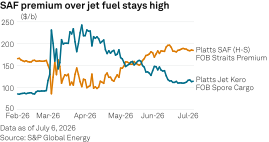
Express logistics is highly cost-sensitive, meaning a workable premium would need to be absorbed through government incentives, such as tax credits adopted in the US, or passed on to customers willing to pay for scope 3 emissions reductions, she said.
That makes policy support critical for long-term procurement.
"Voluntary corporate demand is great, but policy is the true enabler," Orme said, adding that voluntary demand is "too fragmented to bridge the current two-to-four-times price gap" at the scale required by large operators.
"To sign a five-to-10-year offtake agreement, we need certainty on price and supply."
Predictable, low-risk, full-term policy support -- particularly production incentives or subsidies -- can help de-risk investment for producers and bring costs down to a level that allows long-term contracts, she added.
Governments should first focus on de-risking the supply side through production incentives, tax credits, grants, or loan guarantees for refineries, Orme said.
"Governments should work together to harmonize sustainability standards across the APAC region so that fuel produced in Australia, for example, is recognized seamlessly in Singapore or Japan."
Australia's potential
Australia is a key market to watch because it has the potential to become a future SAF production base rather than just a feedstock source, Orme said.
Australia already exports 70% of its canola and more than 80% of its tallow and used cooking oil to markets in Asia and the US to feed major biorefineries, she said.
"There is great potential for those feedstocks processed locally," Orme said, adding that government policies, such as the A$1.1 billion clean fuels program, could help build a sovereign SAF supply chain.
30% by 2030
FedEx is committed to working toward its goal of using 30% blended SAF by 2030, Orme said, but meeting that target will require more than scaling the dominant hydroprocessed esters and fatty acids-based supply.
Commercial-scale facilities must diversify beyond traditional waste-oil feedstocks into coprocessing, alcohol-to-jet and e-fuels, she said, noting that SAF production will increasingly compete with renewable diesel for the same lipid feedstocks.
"It is important for book-and-claim to be universally accepted by global accounting standards and national governments ... and the current premium drop through a combination of mature technology, scaled production, and intelligent, harmonized regional policies," said Orme.
