Crude Oil
June 30, 2026
India needs to move from ad hoc crisis response to strategic oil stockpiling: analysts
HIGHLIGHTS
Current reserves fall short of IEA's 90-day target
New Delhi looking to accelerate SPR phase 2 plans
Adopt hybrid strategy combining scale, flexibility: CERA
India needs to urgently fortify its energy security by transitioning from an ad hoc crisis response to a strategy of sovereign crude oil stockpiling, thereby guarding against future disruptions in global oil supply chains, think tanks and advisory agencies said.
While the country has initiated efforts toward building Strategic Petroleum Reserves, the existing storage capacities are quite insufficient and must be augmented to serve as a true macroeconomic shield, they added.
"Considering India's specific vulnerabilities in relation to fuel, there may be a need to strengthen India's energy security by building strategic reserves to minimize the impact of excessive volatility in their supply and prices on India's overall growth," a June 26 report by EY India quoted DK Srivastava, its chief policy adviser, as saying.
"Building strategic reserves requires decisions regarding optimum size of stock, building of infrastructure to hold the reserves, timing of purchase, carrying costs, timing of release from stock, and maintenance of a suitable balance of inflows and outflows," he added.
The volume of crude imports is generally price inelastic, implying that demand does not fall significantly even when prices rise. As a result, the pricing factor dominates, increasing the economic burden. Additionally, rising prices and growing shortages of crude tend to exert pressure on exchange rates. These interdependencies amplify India's exposure to crude oil supply shock risks, the EY report said.
"With respect to crude, while India has initiated efforts toward building SPRs, current levels need to be considerably augmented," the EY report said.
Short of IEA requirements
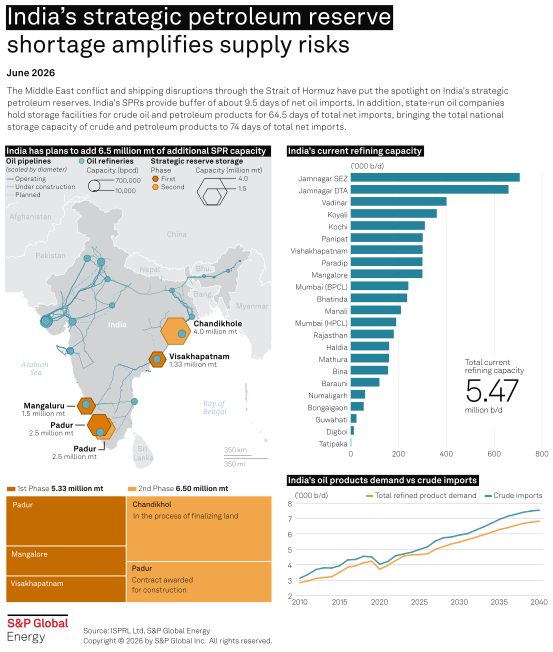
In its first phase, India established SPRs at three locations with a combined capacity of 5.33 million metric tons: 1.33 million mt at Visakhapatnam, 1.5 million mt at Mangalore and 2.5 million mt at Padur in Karnataka. In the second phase, Indian Strategic Petroleum Reserves Ltd. plans to expand capacity by adding another 6.5 million mt of SPRs at two sites: 4 million mt at Chandikhol in the eastern state of Odisha and 2.5 million mt at Padur.
The SPRs provide coverage of about 9.5 days of net oil imports, while state-run oil companies hold crude oil and petroleum products storage equivalent to 64.5 days of net imports. This brings the country's total national storage capacity for crude and petroleum products to roughly 74 days of net imports, according to the petroleum ministry data.
That falls short of the 90-day minimum required for International Energy Agency member countries. India joined the IEA as an associate member in 2017, and in 2024, ministers from IEA member countries pledged to begin discussions on India's full membership, underscoring the South Asian country's strategic importance in addressing global energy challenges.
"With 90% import reliance and heavy dependence on Gulf supplies, India remains vulnerable to disruptions near the Strait of Hormuz. Comparisons with the US, China, and Japan highlight India's shortfall against IEA's 90-day stock requirement," the Centre for Peace Studies, a New Delhi-based think tank, said in a June research note.
"Despite financial and institutional challenges, India is accelerating SPR development to safeguard energy security amidst West Asian instability."
Premasish Das, executive director for oil analytics at S&P Global Energy CERA, added: "India's current approach, which is focused primarily on building physical storage capacity, is a necessary first step, but global experience shows that SPR effectiveness depends on a broader system design rather than infrastructure alone. India should therefore adopt a hybrid strategy combining China's experience of scale and flexibility with Japan's efforts of institutional framework. The end goal should be to move toward a higher number of days of coverage -- not necessarily to IEA norms -- to improve energy security."
Swift government action
Earlier in June, India asked state-owned Oil and Natural Gas Corp. to construct a new SPR facility in Karnataka state, a move that will help to accelerate the expansion of petroleum storage amid global supply disruptions and rising domestic demand, a senior ONGC official and the former CEO of ISPRL said.
The new facility in Mangalore, with a crude oil storage capacity of 1.75 million metric tons, will be in addition to the second phase of expansion pursued by ISPRL and will be built at a cost of $1.6 billion.
The US-based think tank Atlantic Council said in a June research report that US policymakers should aim to operationalize the 2020 US-India Strategic Petroleum Reserve memorandum of understanding.
"The United States could support India's Phase II SPR expansion through technical cooperation and development finance, while negotiating long-term US crude supply contracts to fill the expanded Indian reserves. This is a medium-term project, better suited for when markets stabilize -- but initiating formal planning now would position both governments to move quickly once that happens," the Council said.
Under a deal announced May 15, Abu Dhabi National Oil Co. said it aims to boost its crude holdings in India's SPRs to up to 30 million barrels amid wars in the Middle East and Russia and growing domestic demand. Under a separate agreement, India will explore the potential to store crude at the UAE's eastern oil hub Fujairah, which would form part of India's SPRs.
"With the UAE storing 30 million barrels of crude in India's strategic reserves, India will have assured access to a major emergency crude buffer bucket without bearing the cost of purchasing the oil. Amidst growing geopolitical unpredictability and volatile global oil markets, these measures will act as a back-up system and safeguard from wars, geopolitical tumult, natural disasters, severe market volatility," the Centre for Peace Studies said.
ADNOC holds about 5.86 million barrels of capacity at the Mangalore SPR in India, according to company officials.