Refined Products, Crude Oil
June 24, 2026
East Asian refiners seek sanctions clarity before buying Iranian crude
HIGHLIGHTS
South Korea, Japan, Thai, Taiwan refiners seek sanctions clarity
Refinery configuration adjustments needed for Iranian crude
Platts assessed South Pars at $5.11/b discount to DFC
Refiners in South Korea, Japan, Thailand and Taiwan are holding back from buying competitively-priced Iranian crude, as buyers await clarity on long-term trade and sanctions relief before committing to spot and term purchases, industry and trading sources said over June 22-24.
Reintroducing Iranian grades would require reviewing refinery configurations, crude assays, blending plans and LP models to determine how light and heavy grades fit into existing feedstock slates, product yield targets and unit constraints, feedstock managers at major South Korean, Japanese, Thai and Taiwanese refiners told Platts during market discussion and engagement sessions over June 22-24.
As a result, refiners are unlikely to commit to Iranian crude unless they have a strong assurance that purchases can continue freely over the long term without the risk of renewed sanctions or payment, feedstock and trading managers at two South Korean refiners based in Daesan and Ulsan, as well as Japan's ENEOS, told Platts, part of S&P Global Energy.
"Geopolitical tensions in the Persian Gulf remain elevated, with uncertainty around the Strait of Hormuz compounded by Israel's attacks in Lebanon," South Korea's top refiner SK Innovation said in its market analysis report June 23, quoting analyst Lee Choong-jae. There is still no certainty that free tanker passage through the Strait of Hormuz can be sustained or that full sanctions relief for Iranian oil trade will ultimately materialize, Lee added.
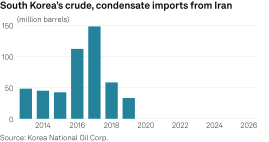
Prior to the sanctions on Tehran, South Korea was among the top three buyers of Iranian crude oil and Asia's largest importer of Iranian condensate. In 2017, South Korea bought 148 million barrels of crude and condensate from Iran, data from state-run Korea National Oil Corp. showed.
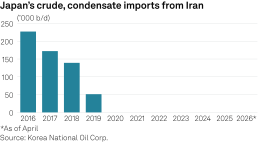
Iran was Japan's sixth-largest crude supplier in 2017, as Asia's fourth-largest crude importer took 172,216 b/d that year, data from the Ministry of Economy, Trade and Industry showed. Japan last imported 17.10 million barrels of Iranian crude in 2019, representing 1.5% of the year's total crude imports, METI data showed.
"Going forward, we will give top priority to ensuring stable supply and procure crude oil and petroleum products from all available sources... [However,] we will refrain from responding to specific, individual matters and countermeasures," a spokesperson at ENEOS told Platts.
A temporary waiver, such as one lasting only 60 days, would not be enough to justify the operational disruption and re-optimization costs, according to feedstock managers at ENEOS and at a Ulsan-based refiner.
"For many buyers, the economics would only make sense if sanctions relief is durable, and Iranian crude can be purchased without restriction on a sustained basis," said the feedstock manager at the Ulsan-based refiner.
Competitive Iranian crude
While refiners still require greater certainty over long-term or permanent sanctions relief before fully resuming Iranian crude purchases, the commercial appeal of Iranian barrels remains strong, feedstock and trading managers at South Korean, Japanese and Thai refiners told Platts.
In the event of complete sanctions relief, Iranian South Pars condensate, as well as various light and sour Iranian grades, would spur new competition, especially among Middle Eastern producers, for a share of the Asian demand, according to the South Korean, Japanese and Thai refinery feedstock managers.
Asian refiners and petrochemical makers have relied heavily on Qatar and Australia for condensate supply over the past several years. The return of more competitively priced Iranian South Pars condensate would broaden supply options and weaken sellers' pricing leverage, potentially improving downstream margins through lower feedstock costs, a feedstock manager at a major South Korean refiner based in Incheon said.
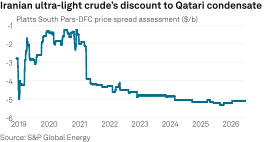
Platts assessed Iran's South Pars condensate at an average discount of $5.11/b to Qatar's Deodorized Field Condensate this year to date.
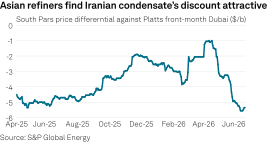
In terms of spot market price differentials, Iranian ultra-light crude has been pegged at a discount for many months and years. Platts assessed South Pars condensate at an average discount of $5.27/b against front-month Dubai so far in June. In May, the monthly discount averaged $3.57/b, and April's discount averaged $1.48/b.
Only Chinese and Indian refiners have been purchasing Iranian crude over the past few years, but South Korean refiners are likely next in line to buy Iranian crude and condensate if there's clarity on permanent sanctions removal, according to a trader at Hanwha TotalEnergies.
