Crude Oil
June 22, 2026
Starmer exit opens door for potential UK oil and gas policy shift
By Charlie Mitchell and Eklavya Gupte
Editor:
HIGHLIGHTS
Andy Burnham tipped to take over as PM
Rosebank, Cambo, Jackdaw await approval
UK crude output has slumped to 583,000 b/d
The UK could be set for an energy policy shift after Prime Minister Keir Starmer announced his resignation, with the oil and gas industry hoping his departure will open the North Sea to more drilling and lead to approvals for key hydrocarbon projects.
Starmer announced on June 22 that he would resign within weeks, once a new Labour leader is installed by the UK's ruling party, with ex-Manchester mayor Andy Burnham hotly tipped to replace him after winning the Makerfield by-election this month.
"Now is the time for a reset on energy policy -- one where government changes not just its policies, but its language, and shows it understands and values the people who keep this country powered," said David Whitehouse, chief executive of industry group Offshore Energies UK, in a statement to Platts, part of S&P Global Energy.
Although Burnham has not laid out a North Sea strategy, his appointment is expected to change the personnel in key ministries, such as finance minister Rachel Reeves and energy minister Ed Miliband, who have overseen a continued collapse in upstream activity and investment over the past two years, although Miliband is said to be in the running to be finance minister in Burnham's government.
Starmer's administration -- which took office in 2024 -- extended and increased the contentious Energy Profits Levy, a "windfall tax" raising the headline UK North Sea tax rate to 78%, as well as banning new oil and gas exploration.
However, in recent months, the government has announced plans to replace the EPL with a more pragmatic oil and gas price mechanism and to allow tie-back developments to extend field life, with the wars in Ukraine and Iran driving energy security and price concerns.
A Burnham government will have the opportunity to approve three key projects: Ithaca's 44,000 b/d of oil equivalent Cambo project, Shell-Equinor JV Adura's 70,000 b/d Rosebank oil development, and Shell's Jackdaw gas field, all of which are awaiting a green light from Miliband.
Jackdaw and Rosebank could be online this year and next respectively. While critics say they will not bring down energy bills, proponents insist the projects are critical for energy security and sovereignty in a fractured world.
"Today, we are importing diesel and jet fuel refined from Russian crude oil while failing to back our own oil and gas resources. This is not just inconsistent -- it is wrong," Whitehouse added.
"In a period of unprecedented global uncertainty, the case is clear: prioritize domestic energy production of all forms, support UK jobs, and strengthen the value we create here at home."
Meanwhile, Sharon Graham, general secretary of labor union Unite, warned Burnham against appointing Miliband as his chancellor, arguing his determination to reach net-zero targets was threatening jobs in the northeast of Scotland.
"That would be a noose around the neck of what we need to do on jobs," she told The Observer newspaper, adding that in the rush to replace fossil fuels with clean energy, Miliband "wants to let go of one rope before we get hold of another."
In a June 22 webinar, Anna Yearley, senior counsel at public relations firm Lexington and a former aide to Ed Miliband, said there were likely "conversations happening at the moment between Ed and Andy."
"There will be lots of very detailed conversations, which I'm sure will [have been] happening over the last few weeks as well, about what the position will be and whether there will be a change in position because clearly, Andy has held a different position to Ed on North Sea oil. And so that is going to be a key point of conversation and discussion," Yearley said.
Oil and gas 'referendum'
While Burnham's return to parliament in Makerfield drew headlines, in Scotland Kemi Badenoch's Conservative Party shrugged off talk of its political demise by winning the Aberdeen South by-election on June 18 with a campaign centered on oil and gas.
Following the result, Badenoch said the election "was about thousands of jobs all over the country but especially in the oil and gas sector." She added that "Aberdeen will not be ignored. The sector will not be ignored."
Meanwhile, Scottish Conservative leader Russell Findlay said the result was a "referendum on oil and gas," reflecting a potential public mood shift on hydrocarbons and net zero.
UK oil and gas production has dropped in recent years, with oil production crashing from 2.6 million b/d in 1999 to just 583,000 b/d in March, according to official data from the Department of Energy Security and Net Zero. That is down from 803,000 b/d in April 2022, the month before the EPL was implemented.
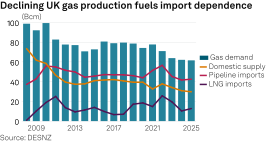
Gas production has fallen similarly and was just 29.68 Bcm in 2025, compared to demand of over 60 Bcm, according to DESNZ, leaving the UK dependent on imported pipeline gas from Norway.
The challenging regulatory and tax environment in the basin has fueled a wave of M&A, from consolidation deals to IOC exits in recent years. Meanwhile, OEUK estimates that scrapping the EPL could unlock GBP41 billion of new North Sea investment between now and 2050.
UK crude production might be declining, but its Brent and Forties grades still underpin the Dated Brent benchmark, a key cog in the global oil trade.
Dated Brent was last assessed by Platts at $80.32/b on June 19.
Low UK production volume was one factor behind Platts' decision in 2022 to include US WTI Midland crude in the Dated Brent basket.
