Crude Oil
June 22, 2026
South Korea moves to expand Canadian crude imports as diversification continues
HIGHLIGHTS
Korea Customs, Alberta officials visit SK Innovation’s Ulsan complex
H1 Canadian crude imports expected at 8.16 million barrels
Diversification a long-term strategy: Commissioner Lee
South Korea is accelerating imports of heavy sour Canadian crude into its refining feedstock slate, as Asia's third-largest crude buyer seeks to diversify supply sources and reduce its dependence on Middle Eastern oil, according to the customs department and refining sources June 22.
The push gained momentum on June 19, when Korea Customs Service Commissioner Lee Jong-wook and Alberta's Minister of Energy and Minerals Brian Jean jointly inspected SK Innovation's Ulsan Complex, a major refining hub capable of processing Canadian extra-heavy crude, KCS said in a statement June 22.
The visit to the country's top refiner in Ulsan followed an April customs cooperation agreement between South Korea and Alberta designed to simplify proof-of-origin documentation for Canadian crude oil imports. The arrangement allows South Korean refiners to apply a preferential 0% tariff available under the Korea-Canada Free Trade Agreement, down from the standard 3% duty, KCS said in the statement.
The simplification removes a practical barrier that had limited broader use of Canadian crude in South Korea's refining system, according to the customs department and feedstock managers at two major South Korean refiners based in Ulsan and Yeosu. Previously, individual suppliers were required to provide proof-of-origin documentation by company and by export shipment, complicating FTA verification and reducing the commercial appeal of Canadian barrels, the refinery feedstock managers said.
Korea Customs Service said the measure has already delivered results. On June 2, South Korea imported around 600,000 barrels of Canadian crude using verification documents issued by the Alberta government, allowing the cargo to receive the 0% FTA tariff, according to the customs department.
KCS Commissioner Lee said the expansion of Canadian crude imports should be viewed as part of a longer-term diversification strategy rather than a short-term response to market volatility.
"More than 70% of [South] Korea's crude oil imports have been concentrated in the Middle East, and diversification of crude import sources is urgently needed," Lee said. "The expansion of Canadian crude imports is not a temporary response but a starting point for diversifying the energy supply chain."
South Korea's refineries were historically configured to optimize processing of Middle Eastern medium sour crude grades, aligning with established import trends and domestic system compatibility. However, South Korean crude distillation units, broader feedstock strategies and procurement economics have evolved significantly over the past two decades, refinery feedstock managers based in Ulsan and Yeosu told Platts, part of S&P Global Energy, on June 22.
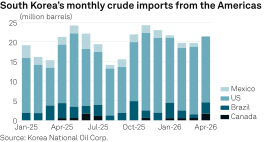
For example, South Korea has emerged as Asia's top buyer of US crude in recent years, underscoring a clear shift toward wider sourcing flexibility, the Ulsan-based refinery feedstock manager said. "South Korean refiners are now expected to continue diversifying not only their trade relationships but also their refining techniques and feedstock optimization strategies to maintain energy security, commercial competitiveness and operational resilience."
The Ulsan Complex is expected to play a central role in that strategy, KCS said. "The facility has proprietary technology to blend and refine Canadian extra-heavy crude, which typically has high viscosity and high sulfur content, with other crude grades."
Canadian crude import outlook
In the first four months, South Korea purchased 3.35 million barrels of Canadian crude, more than a sixfold increase from 548,000 barrels imported over the same period a year earlier, the latest data from state-run Korea National Oil Corp. issued May 27 showed.
Looking ahead, 8.16 million barrels of Canadian crude are expected to be imported in the first half of 2026, equivalent to 1.7 times the total volume shipped to South Korea during all of 2025, KCS said.
Reflecting South Korea's strong demand for Canadian heavy sour crude as an alternative to Middle Eastern medium and heavy sour grades, Platts, part of S&P Global Energy, assessed delivered Pacific Cold Lake at an average premium of $6/b against Dubai, CFR South Korea, to date in June.
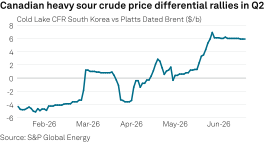
In comparison, the premium averaged $2.46/b in May, 8 cents/b in April, and minus $2.78/b in the first quarter.
Meanwhile, Jean said Alberta crude exporters expect the customs cooperation and tariff benefits to help expand energy trade with South Korea, according to KCS.
"Alberta crude oil exporters expect energy trade with [South] Korea to expand further as a result of the customs duty reduction measures," Jean was quoted as saying in the KCS statement.
