Crude Oil, Natural Gas
June 22, 2026
De la Espriella's victory in Colombia could accelerate energy projects, but major hurdles remain

By Sheky Espejo
Editor:
HIGHLIGHTS
De la Espriella win may restart oil exploration
Constitutional limits block fracking, licensing
Gas supply critical as reserve margins tighten
Colombia's energy sector could see a policy reversal under president-elect Abelardo De la Espriella, with analysts and industry participants expecting a renewed push for conventional oil and gas exploration, a redirection of Ecopetrol toward hydrocarbons and faster permitting for energy projects. However, observers warn that entrenched hurdles may hinder the incoming administration's pro-industry agenda.
De la Espriella defeated Iván Cepeda in the June 21 presidential runoff with a narrow margin of roughly 250,000 votes.
Experts and observers are optimistic that a new vision in the government can advance the energy sector, as several measures from De la Espriella's energy agenda can be implemented through executive action. Either by decree or executive control, he can restart conventional oil and gas exploration contracting, since the freeze was executive branch policy, not law, said Dorian Kantor, a political science professor at Freie Universität in Berlin and director of Kantor Consulting, with offices in Bogotá.
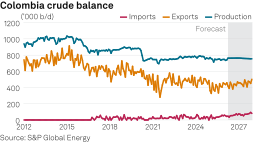
"He can replace Ecopetrol's leadership and redirect its strategy back to hydrocarbons, since the state owns about 88%," Kantor said, adding that the new government can also fast-track permits and prioritize the gas import terminals.
Industry priorities
Expectations for the new administration center on accelerating activity in contracts that have already been awarded, said Andrés Felipe Calderón Sánchez, vice president for Latin America at consultancy Welligence.
One of the government's main tasks will be coordinating consultation and environmental licensing processes while improving security in operating areas, Calderón said.
Mechanisms such as projects funded through royalties and works-for-taxes schemes could help improve relationships with communities and facilitate project execution, Calderón said, identifying the Sirius offshore gas project as a priority.
With estimated reserves of about 6 Tcf and plateau production of roughly 470 MMcf/d, the project could play a decisive role in restoring Colombia's gas self-sufficiency, he said.
Beyond Sirius, Calderón said the government should support regasification projects being developed on the Caribbean coast and in Buenaventura.
Unconventional resources is another area where progress could be made, Calderón said.
"The Kale and Platero research projects are evidence that Colombia has already advanced part of the way toward developing unconventional reservoirs," he said.
Congressional approval needed
While some actions can be taken by decree, others require congressional approval.
"What he needs Congress for is the tax and royalty incentives that make new exploration actually attractive, any structural overhaul of the power market, and any attempt to rewrite the prior consultation framework," Kantor said.
De la Espriella is expected to have to form a coalition with several parties, as the left, represented by the runner-up Ivan Cepeda, holds 39 of the 103 seats in the lower house.
However, some of the most important obstacles facing energy projects cannot be removed through executive action, observers said.
"What is blocked by the Constitution and the courts, and thus beyond his reach entirely, are fracking, environmental licensing and prior consultation," said Kantor.
Kantor noted that prior consultation is protected as a fundamental right under ILO Convention 169.
According to Kantor, the same consultation mechanism affects both renewable and hydrocarbon projects.
La Guajira
La Guajira is one of the clearest examples of the difficulties facing energy projects, observers agreed.
A major push to develop renewable energy projects began in 2019, when investors proposed large wind developments in the region, said Oscar Alberto Mariño Estupinán, an independent consultant in Colombia. Many remain stalled.
"The main bottlenecks are environmental licensing and prior consultation," said Mariño, a former legal executive at Celsia Energía, which develops renewable energy infrastructure in Colombia.
The region is home to large Wayuu indigenous communities, making consultation processes a key part of project development, Mariño said, but prior consultation lacks a clear statutory framework.
"We all know prior consultation exists, but we don't know how we are going to make it effective, or what the deadlines are," he said.
One project can spend more than two and a half years in consultation procedures and still only be halfway through the process, he said.
Kantor agreed that consultation plays a role but argued that it is only part of the problem. According to him, transmission constraints are also a major factor.
"The blackout risk is mostly a transmission-and-finance problem dressed up as a community problem. This same mechanism blocks both the La Guajira wind buildout and his own fracking plans," he said, describing the issue as "the real structural battle" of De la Espriella's energy agenda.
Gas at the center
Discussions about unblocking Colombia's power sector are fundamentally linked to natural gas, said observers.
"Gas-fired plants are what back up the grid when hydro falls short," said Kantor, adding that the country faces the prospect of an El Niño event later in 2026, making gas supply particularly important, although he noted that much of the infrastructure required to address the problem is already under development.
In his view, a new administration would be accelerating projects that are already moving forward rather than launching entirely new ones.
Colombia's electricity system has been operating with a shrinking reserve margin, Mariño said.
Historically, available generation capacity exceeded demand by 10%-20%, providing a cushion in the event of outages or extreme weather.
"Today, the balance is much tighter," Mariño said. "We are almost one-to-one," he said.
Colombia has lost the gas self-sufficiency it previously enjoyed, Mariño said.
Among the projects expected to help restore domestic supply is Sirius, the offshore gas development being advanced by Ecopetrol and Petrobras, which has also faced obstacles associated with consultation and permitting requirements.
Kantor noted that even under a new administration, major supply additions will take time.
Import terminals are expected to enter service through 2026, while Sirius is not expected to produce until 2029-2030, he said.
US support
Following the announcement of the election results, US Secretary of State Marco Rubio congratulated the president-elect on social media platform X, and reiterated that the US will support the country.
"The Trump Administration looks forward to working closely with your incoming administration to advance regional security cooperation, end illegal immigration to the United States, and strengthen our economic ties," Rubio wrote.
"Colombia's best days are ahead," Rubio said.
