Crude Oil, NGLs
June 22, 2026 · Updated June 23, 2026
Canada to see major increase in H2 oil, gas drilling, higher E&P activity: trade group

By Ashok Dutta
Editor:
HIGHLIGHTS
Record 424 wells drilled in May
Forecast to see 210 rigs in Q3
65% of wells are for heavy oil
The Canadian Association of Energy Contractors is forecasting a major uptick in the drilling of oil and gas wells in the Western Canadian Sedimentary Basin in the second half of 2026, on the back of higher crude oil prices and incremental exploration and production activity, President Mark Scholz said June 22.
"The market has very clearly signaled we will be busy, particularly if the WTI price averaged $70/b to $75/b in the coming few months," Scholz told Platts, part of S&P Global Energy, in an interview from Calgary.
"All the conversations we have had with our [association] members have been very constructive. At first, we were trying to determine if the spurt in drilling activities was part of a front-loading initiative to book available rigs. But now, we see a shift, with producers unveiling [additional] capital spending in exploration and production activities in the basin," he said.
The CAOEC represents 89 land drilling, offshore drilling, and service rig member companies that operate a fleet of 365 drilling rigs and 693 service rigs in British Columbia, Alberta, Saskatchewan, Manitoba, Ontario, and Atlantic Canada.
Scholz's comments come after WCSB drilling activities posted a record of 424 wells in May with 175 active rigs – the single highest in the past 12 years.
This is compared with 324 wells in May 2025, when 146 rigs were deployed, he said.
Of the total wells drilled last month (May, 2026), nearly 65% were for conventional heavy and light oil and condensate, and the remaining 35% were for natural gas, Scholz said.
Drilling activity in Western Canada had averaged over 5,000 wells, but the scenario changed with COVID-19 and 'collapsing' prices, he said.
"We have been preparing for this major uptick, and the expectation will be for the industry to be on an upward swing. Current geopolitical changes have brought Canada's energy resources to the forefront, and both oil and LNG producers are now stepping up efforts. There's a heightened importance of Canadian heavy oil and LNG for our G7 nation partners from an energy security perspective," Scholz said.
Prime driving forces
On the crude oil side, higher prices have spurred conventional heavy and light oil activities in the WCSB – particularly the Clearwater, Mannville, Montney, Willesden Green, Cardium and Peace River plays – to name a few, while for LNG projects the signing of two new offtake agreements in early June by the 12 million metric tons/year Ksi Lisims development in coastal British Columbia along with a second phase development of LNG Canada with capacity of also another 12 million mt/year will result in additional drilling work, Scholz said.
"Western Canadian conventional and oil sands producers had taken a wait-and-watch policy for geopolitical issues to settle. But now they have factored in a premium with the closure of the Hormuz Strait and moving ahead with their drilling activity in the second half of 2026," he said.
For its part, the federal government in Ottawa has also given clear signals of streamlining the regulatory process and making the WCSB an investment destination, Scholz said.
In late April, Shell announced the acquisition of light oil/condensate gas producer ARC Resources under an estimated $16 billion deal, providing access to an additional 370,000 b/d of oil equivalent resources.
This was followed by Tamarack Valley Energy selling its assets in Charlie Lake, and Minneapolis-based Northern Oil and Gas stating it had acquired a 25% interest in the light oil/condensate assets at Duvernay in the WCSB owned and operated by Parallax Energy Operating, the companies said separately.
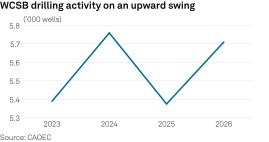
In late 2025, CAOEC forecast drilling 5,709 wells in 2026. But that will change given the current higher activity, Scholz said.
"We will be entering the third quarter [of 2026] with 210 rigs," he said.
The total number of wells drilled in the WCSB last year was 5,374, compared with 5,758 wells in 2024, 5,389 in 2023, CAOEC spokesperson An Tran said separately in an email.