Crude Oil
June 19, 2026 · Updated June 23, 2026
Sanctions relief lifts Iran's oil outlook, but its full recovery will take time
HIGHLIGHTS
Infrastructure eroded by war, years of sanctions
Damage makes recovery harder than during JCPOA
Iran likely to tap storage to boost near-term exports
As talks with the US aim to forge a lasting peace deal that lifts sanctions, Iran is eyeing a recovery for its battered oil sector, but a ramp-up in crude output and exports could be slower than that of its neighbors.
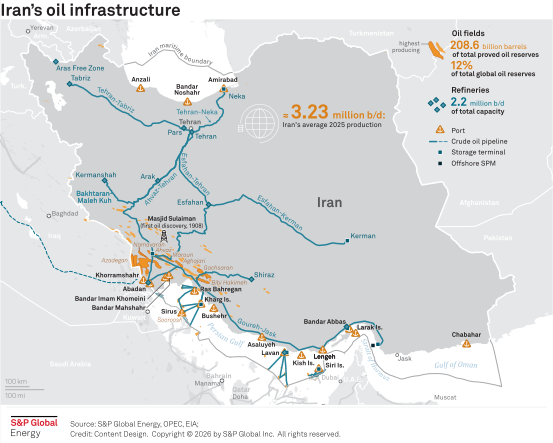
Unlike other Middle Eastern producers, Iran has seen its oil infrastructure suffer from years of underinvestment caused by Western sanctions, and the war with the US and Israel has brought further damage.
That will make Iran's ability to reclaim lost market share more difficult, analysts say.
"Iran may face a longer recovery path than some of its neighbors given the additional constraints imposed by sanctions and the more extensive attacks on its energy and transport infrastructure," Carole Nakhle, founder of consultancy Crystol Energy, said.
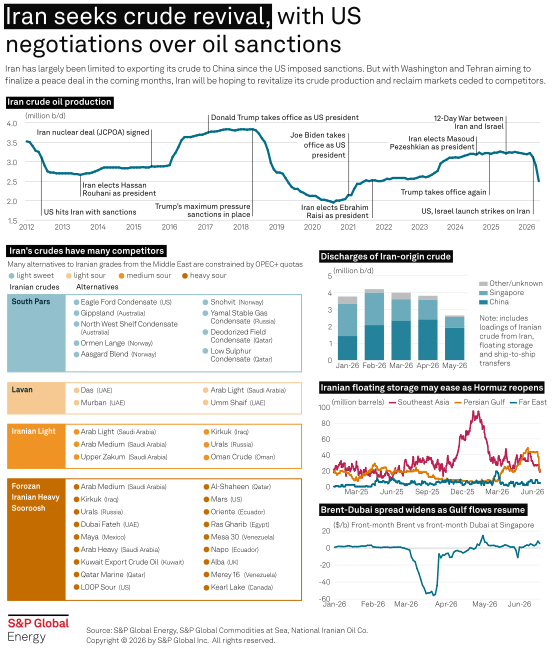
Once a powerhouse OPEC producer, Iran's crude output fell to 2.5 million b/d in May, according to the Platts OPEC+ survey by S&P Global Energy. This was down from 3.19 million b/d in January, before the war started on Feb. 28, and an all-time peak of 4 million b/d, which it last achieved in August 2008, Platts survey data shows.
The plunge in Iranian production came as the US blockaded the country's ports, while Tehran sought to control the Strait of Hormuz and block many other oil cargoes from its Middle East rivals from leaving the Persian Gulf.
The US and Iran on June 18 agreed to a preliminary peace deal that lifts the blockade, provides a 60-day sanctions waiver for Iranian crude sales, and reopens the Strait of Hormuz, with talks now underway to clinch a final deal within a 60-day deadline.
Full sanctions relief would allow foreign investment to return to Iran's oil sector, though appetite amongst potential investors may depend on the security environment and what fiscal terms Tehran will offer.
Heavy damage
The last time Iran benefited from significant sanctions relief was 2015, when it signed the Joint Comprehensive Plan of Action (JCPOA) with China, France, Germany, Russia, the UK, the US and the EU.
Iran was producing 2.88 million b/d in July 2015, according to the Platts survey. Output remained around this level until February 2016, when it jumped to 3.19 million b/d and continued to grow.
Mohsen Ghamsari, former director of international affairs for Iran's state oil company NIOC, said circumstances are different now.
"At the time, the issue was only the sanctions, marketing and sealing contracts. We [now] have technical issues [due to war damage] in addition," he said.
Iranian officials have given some detail on repair progress at oil infrastructure targeted during the war. Iranian Offshore Oil Co. Managing Director Ahmadreza Rasti said June 16 that reconstruction of the maritime oil production platforms at Lavan had reached 91%, according to a statement on the company's website.
"Only one week after the incident, 50% of the region's production was revived and oil production resumed," Rasti said.
Frankfurt-based energy analyst Abdollah Babakhani said in a post on X that damage to Iranian energy infrastructure runs into the billions of dollars, and that foreign resources should be used to carry out repairs.
He said Iranian companies have a window of opportunity until the US midterm elections to secure export permits and contracts for the equipment needed for these repairs.
The US-Iran peace agreement includes $300 billion for the country's reconstruction. However, it is not clear who would be funding that.
Export rebound
In the meantime, Iran will have to rely on its stored crude volumes to boost exports in the short-term.
Sanctions had largely limited Iran to selling its crude to China at massive discounts. The sanctions waiver announced by the US on June 22 could allow Iran to sell crude that had built up in floating storage in the Gulf due to the US blockade, as well as volumes on tankers in Southeast Asia that have used ship-to-ship transfers to send crude to buyers.
Discharges of Iranian crude, including from loadings from Iran, floating storage and ship-to-ship transfers, fell to 2.65 million b/d in May, down from 4.21 million b/d in February, according to tracking data from S&P Global Commodities at Sea.
Oil prices have fallen in recent weeks on the prospect that Middle Eastern barrels, including those from Iran, could return to the market. Platts, part of S&P Global Energy, assessed Dated Brent at $75.39/b on June 23, down from $100.30/b at the start of June.
Iranian official estimates of its pre-war production are higher than many independent estimates. Hamid Hosseini, a spokesperson for Iran's Oil, Gas and Petrochemical Products Exporters' Union, put pre-war output at 3.6 million b/d, of which 1.5 million-1.6 million b/d was exported as loaded from Iran. He said that production likely fell to 2.5 million b/d during the war.
Iran is unlikely to increase output to this level in the near future because emptying storage and reviving capped wells will take time, he said.
"It will take two weeks or so until we empty the storage tanks and ships start moving and NIOC starts new production," he said, referring to the National Iranian Oil Co.
He estimated that Iran could fall 100,000-150,000 b/d short of pre-war oil production.
"We should open wells for roughly 1 million b/d with all the repairs... they plan to gradually open the wells as of next week. It depends on when the storage tanks empty, how the wells get restored," Hosseini said, adding that other equipment needs to be checked and repaired.
The Iranian oil ministry did not reply to a request for comment on production plans.
The former NIOC official Ghamsari told Platts that exports were likely around 2 million b/d before the war started. He sees production potentially reaching 4 million b/d, with exports at around 2 million b/d, if the agreement holds.
Tapping into floating storage would be "quickly accessible," he said, though signing marketing and sales deals would require time.
He said it is hard to predict without exact storage figures, but exports could be back at pre-war levels in around three months.